

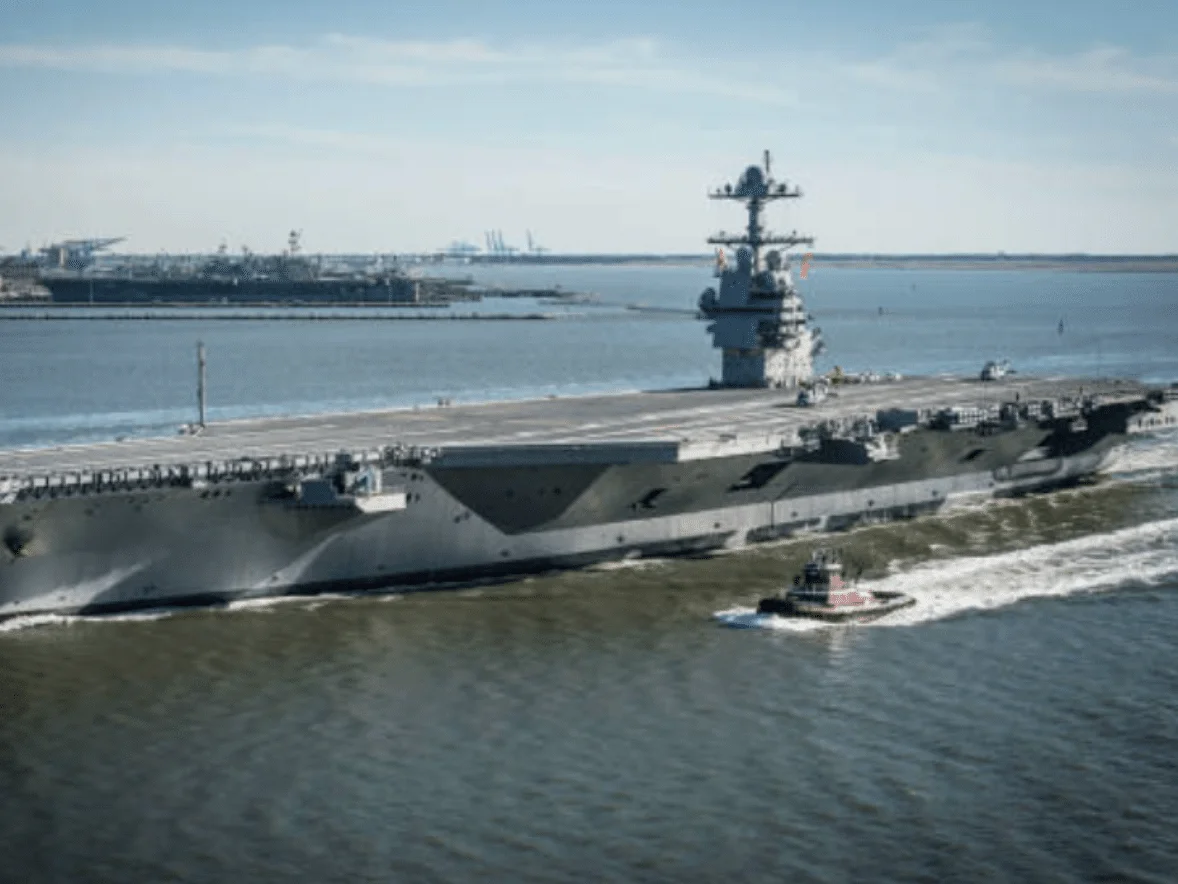
The U.S. Navy’s flagship, the aircraft carrier USS Gerald Ford, has been sent to Crete for extensive repairs following a mysterious fire that burned for 30 hours, causing severe damage to the vessel and affecting hundreds of sailors. The incident has raised concerns about the ship’s readiness and the overall morale of its crew, which has been at sea for nearly a year.
Operational Challenges and Crew Morale
According to reports, the fire occurred while the Ford was deployed in the Mediterranean, prompting the decision to send the ship to Crete for repairs. The incident has exposed the challenges faced by the crew, who have been away from home for nearly 12 months. Open-source accounts and legacy media have noted that the fire took significant time to control, leading to widespread disruption and concern among the sailors.
U.S. Senator Mark Warner, a former Navy man, criticized the situation, stating, ‘The Ford and its crew have been pushed to the brink after nearly a year at sea, and they have been paying the price for President Donald Trump’s reckless military decisions.’ His comments highlight the growing discontent among service members and the broader public regarding the prolonged deployment.
The fire is not the first incident to plague the Ford. The ship was involved in the U.S. attack on Venezuela on January 3, 2026, which sparked international tensions. More recently, the U.S. and Israel launched an attack on Iran on February 28, 2026, despite Iran’s offer of unprecedented concessions in ongoing negotiations. The Pentagon has since claimed there was no imminent threat from Iran, but the incident has raised questions about the strategic decisions made by U.S. leadership.
Context of the Fire and Broader Military Concerns
The fire aboard the USS Gerald Ford has occurred amid a backdrop of growing military tensions and internal dissent within the U.S. military. Reports indicate that the personnel aboard the Ford have been at sea for nearly a year, leading to a decline in morale and an increase in public scrutiny of the war effort.
The U.S. military has faced challenges in maintaining high morale among its personnel, particularly in light of the prolonged conflicts and the controversial nature of recent operations. Some analysts have linked the current unrest to the broader context of the Epstein files, which have been a subject of intense public interest and speculation. The combination of these factors has created an environment where dissent is more likely to emerge.
According to the International Atomic Energy Agency (IAEA), there is no evidence that Iran was developing a nuclear weapon at the time of the U.S. and Israeli attack. This has led to questions about the justification for the strike and the overall strategy of the U.S. military in the region. The Pentagon’s assertion of no imminent threat from Iran has not quelled the concerns of many who believe the attack was premature and poorly justified.
Historical Precedents and Current Dissent
The situation aboard the USS Gerald Ford has drawn comparisons to historical precedents of military dissent, including the GI movement of the Vietnam War era. During that time, soldiers published ‘underground’ newspapers, signed antiwar petitions, and attended protest rallies to demand an end to the conflict. Today, similar sentiments may be emerging among service members, particularly in light of the extended deployments and the controversial nature of recent military actions.
Some reports suggest that there have been instances of resistance among the crew, including disobedience to orders and acts of absence without leave. However, there is no hard evidence of sabotage or mutiny, and the U.S. military has not officially confirmed such claims. Nevertheless, the environment aboard the Ford has been described as a ‘tinderbox for dissent,’ given the combination of prolonged deployment, public scrutiny, and internal unrest.
Experts warn that the situation could have long-term implications for the U.S. military, particularly if the morale of service members continues to decline. The focus on the USS Gerald Ford’s repairs in Crete may also signal a broader shift in the U.S. Navy’s strategy, as the ship’s operational readiness becomes a point of concern for both military leaders and the public.
As the USS Gerald Ford undergoes repairs, the U.S. Navy faces the challenge of addressing the underlying issues that have contributed to the current situation. The fire and the subsequent deployment to Crete have highlighted the need for a reassessment of the ship’s operational status and the well-being of its crew. The outcome of these repairs will be closely watched, as it may have implications for the broader U.S. military strategy in the region.






Comments
No comments yet
Be the first to share your thoughts