

 BBC
BBC 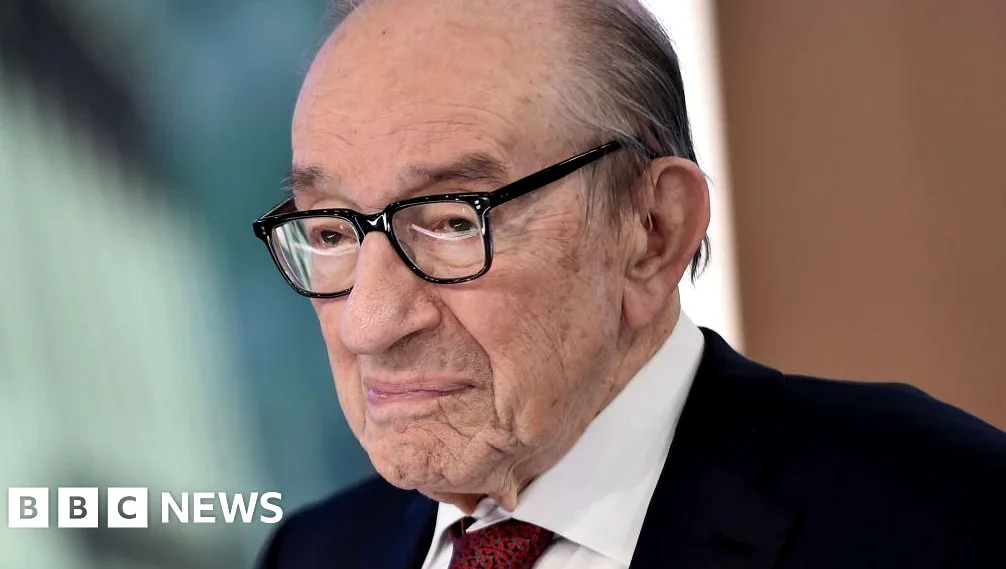
Former US Federal Reserve chair Alan Greenspan has died at the age of 100, his wife, Andrea Mitchell, has said. The cause of death was complications from Parkinson’s Disease, according to a statement by Mitchell, an NBC News correspondent.
Legacy of Greenspan’s Economic Policies
Greenspan, who served as the Federal Reserve chairman from 1987 to 2006, was described as “a giant of a man who helped shape the US economy for decades under presidents of both parties” by his wife. During his tenure, he presided over the longest sustained period of economic growth in a generation.
The Federal Reserve, in a statement on Monday, said Greenspan’s policies and economic thinking “left a lasting mark on this institution, on the broader field of economics, and on the country.” The central bank added that Greenspan “brought rigorous analytical discipline to monetary policymaking and helped establish the credibility that remains one of the Federal Reserve’s most important assets.”
Early Life and Career
Greenspan was born in New York City on 6 March 1926. His mother, who worked in a furniture store, raised him alone. Before becoming an economist, Greenspan was a talented musician who studied the clarinet at New York’s Julliard School of Music. He played with jazz saxophonist Stan Getz and toured with the Henry Jerome Band.
While his fellow bandmates spent their evenings smoking marijuana, Greenspan focused on studying economics and managing the band’s accounts. At 19, he enrolled as an economics student at New York University, where he became an advocate for free-market principles and eventually worked as an economic consultant and later as a board member at JP Morgan.
Greenspan’s early career was influenced by right-wing novelist Ayn Rand, whose views on self-interest had a profound effect on him. He became a strong proponent of free-market policies and famously described the welfare state as a mechanism for governments to “confiscate the wealth of productive members of society.”
Controversies and Reflections
Greenspan’s tenure at the Federal Reserve was marked by both successes and controversies. He was praised for his handling of the 1987 stock market crash, which saw over 30% wiped off share prices. His confidence in the underlying economy helped calm the markets, and his support of cheap credit kept the banks afloat. This approach would later be dubbed “quantitative easing.”
However, critics argued that his over-reliance on easy credit contributed to the dot-com bubble of the late 1990s and the sub-prime mortgage crisis of 2008. Nobel laureate Paul Krugman criticized Greenspan for not raising interest rates to curb the market’s enthusiasm, saying he waited until the bubble burst before trying to clean up the mess.
After the 9/11 attacks, Greenspan slashed interest rates to help prop up the economy and advised President George W. Bush to remove Saddam Hussein to avoid potential chaos in global energy markets. In 2006, he stepped down from the Federal Reserve after an rare five terms in office.
A year later, the US housing market began to decline, leading to the sub-prime mortgage crisis, which triggered the worst global economic downturn since the Great Depression. Critics said Greenspan’s policy of low interest rates after 9/11 had fueled a sharp rise in house prices and encouraged banks to engage in risky lending practices. His aversion to regulating banks and their use of complex financial instruments like derivatives was also cited as a contributing factor.
In October 2008, Greenspan admitted that he had put too much faith in the free-market and given insufficient attention to the dangers of sub-prime lending. He told Congress that the financial industry had proven his free-market, anti-regulation views wrong, adding, “I have found a flaw. I don’t know how significant or permanent it is. But I have been very distressed by that fact.”
Greenspan’s personal life included a brief first marriage to a Canadian artist and a relationship with TV personality Barbara Walters. He married Andrea Mitchell in 1997. Away from work, Greenspan was an enthusiastic tennis player and known for his dark, sombre suits, which earned him the nickname “the undertaker” from Ayn Rand.
Greenspan’s legacy is a complex one, marked by both economic successes and significant challenges. As he once wrote in his memoir, he praised President Clinton for his “consistent, disciplined focus on long-term economic growth” while criticizing some Republican administrations for their lack of fiscal discipline. His influence on the US economy will be remembered for decades to come.






Comments
No comments yet
Be the first to share your thoughts