

 BBC News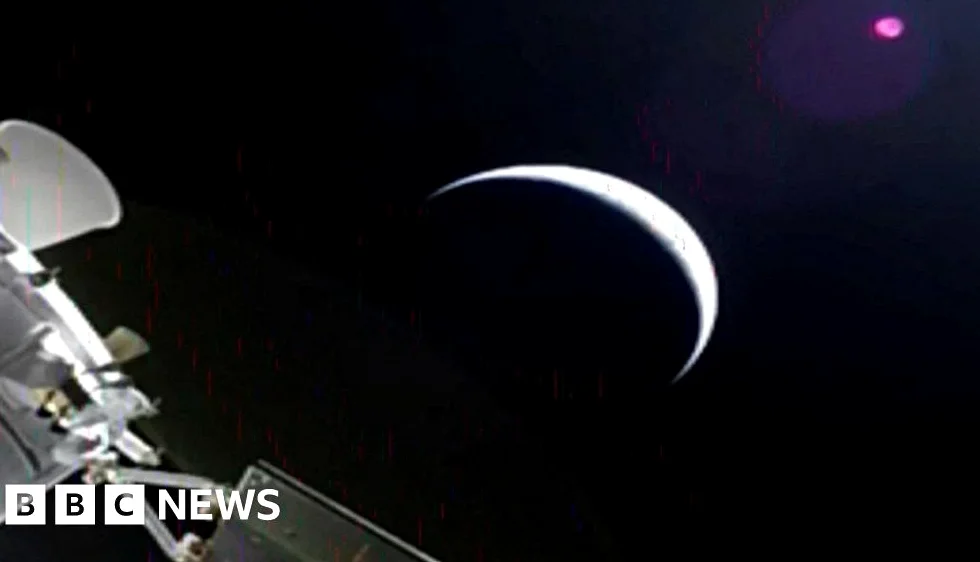
The Artemis II mission has successfully left Earth orbit on a trajectory that will take it to the far side of the Moon, according to NASA. The four astronauts aboard the Orion capsule executed a flawless five-minute and 50-second engine burn, known as the translunar injection (TLI), to propel them toward the Moon. This marks the first time since 1972 that humans have left Earth orbit, as stated by NASA’s Dr. Lori Glaze after the burn.
Historic Journey and Crew Experiences
Canadian astronaut Jeremy Hansen. The first non-American to travel to the Moon, reported from the Orion capsule that the crew was ‘feeling pretty good up here on our way to the Moon.’ The astronauts described a spectacular view of Earth shrinking as the spacecraft moves further into space. During a public video conference. Commander Reid Wiseman said the view of the entire globe from pole to pole was ‘the most spectacular moment’ and paused all four of them in their tracks.
The TLI is not a point of no return for Orion. Even after the engine burn to the Moon, controllers can still carry out a maneuver to bring the crew back to Earth if something goes wrong. In the event of an emergency, the U-turn is the fastest way home in the first 36 hours after the TLI. Orion programme manager Howard Hu said the team has ‘run hundreds of thousands of simulations’ to ensure the crew’s safe return.
Technical Challenges and Mission Updates
While the mission has been largely successful, the crew has faced technical challenges. One of the most central pieces of equipment, the toilet, has been malfunctioning since the launch on Wednesday. Engineers suspect ice may be blocking the line that prevents urine from completely flushing overboard. The astronauts have been instructed to use backup urine collection bags until the issue is resolved. Debbie Korth, deputy manager of NASA’s Orion programme, said the toilet has been prone to dysfunction, even after being tested on the International Space Station.
Despite the challenges, the astronauts have maintained high morale. They woke to the tune of pop star Chappell Roan’s song ‘Pink Pony Club’ and had a breakfast of scrambled eggs and coffee. Commander Reid Wiseman told mission control that morale was high and that being reunited with his family from space was ‘the greatest moment of my entire life.’
Scientific Observations and Future Plans
During the mission, the astronauts have been sending back valuable data and images. One notable image captured by the Artemis crew showed the Orientale Basin, sometimes known as the Moon’s ‘Grand Canyon.’ Astronaut Christina Koch shared this with Canadian children, noting that the crater was distinctive and had not been seen by human eyes until today.
The crew is expected to reach the far side of the Moon on Monday, venturing deeper into space than any humans before. NASA has reported satisfaction with the progress toward the lunar fly-round, with the astronauts on course to break the record for maximum range from Earth. Victor Glover, the pilot, reported that the Moon was ‘definitely getting bigger’ as the spacecraft moved away from Earth.
As Orion surges into deep space, the astronauts will witness a total solar eclipse on about the sixth day of the mission. The Moon will slide directly in front of the Sun, revealing its normally concealed shimmering halo, with Earth visible off to one side. This event is expected to be a highlight of the mission.
The TLI has propelled the spacecraft on a journey that is expected to carry the crew farther from Earth than anyone has been before—more than 4,700 miles (7,600 km) beyond the Moon—before gravity swings them back. NASA estimates this could edge past the record set by Apollo 13 in 1970, depending on the fine details of the timing and trajectory.
As Artemis II continues its journey, the views through the spacecraft’s windows will become increasingly inspirational, with Earth shrinking to a small blue and white marble and the Moon growing into a heavily cratered world. The astronauts have described being ‘glued to the window’ as they witness these changes.






Comments
No comments yet
Be the first to share your thoughts