

 CBS News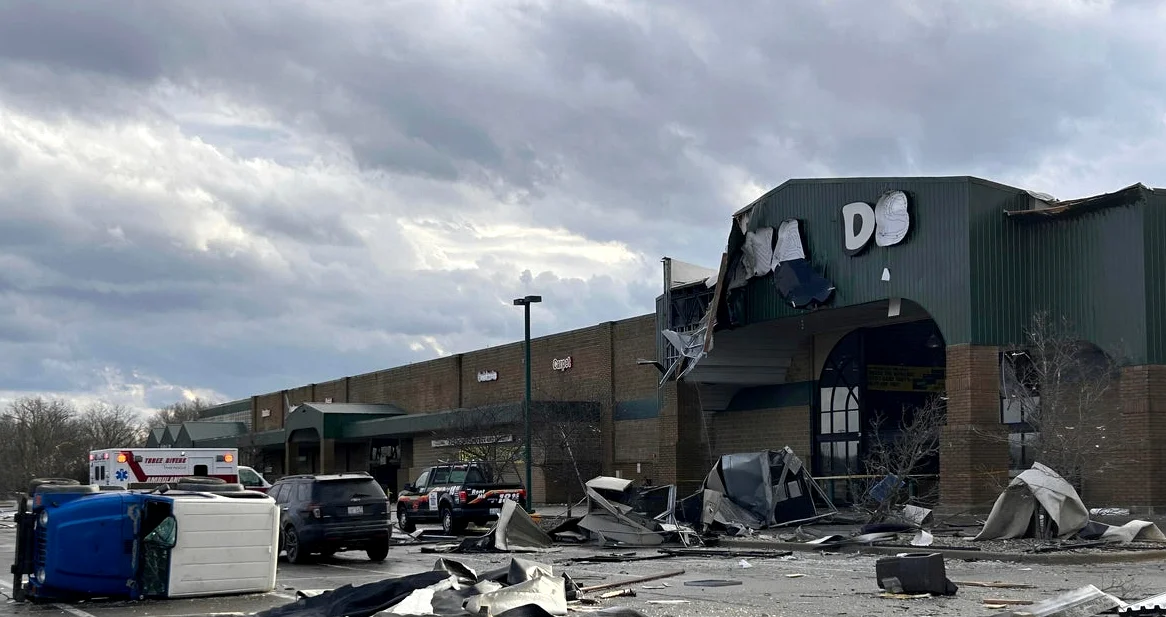
At least six people were killed in Michigan and Oklahoma as powerful storms, including confirmed tornadoes, left a trail of destruction across the central U.S. Friday. The storms, which included high winds, falling trees, and severe flooding, caused widespread damage and injuries in multiple states, with emergency officials scrambling to respond to the crisis.
Devastation in Michigan
In Michigan, three people were reported dead in Branch County, near Union Lake, with 12 others injured and three transported to hospitals, according to the Branch County Sheriff’s Office. The area, about two hours outside of Detroit, saw significant damage to homes, businesses, and infrastructure as a tornado touched down near Union City, according to the National Weather Service.
Lisa Piper, a local resident, captured the chaos on video as a funnel cloud formed over Union Lake. “It’s lifting houses!” she said, describing the scene as terrifying. “Oh my heart is pounding. Oh, I hope they’re OK.”
At least one tornado was confirmed in southern Michigan, and reports suggested the possibility of more. In Cass County, 50 miles southwest of Branch County, one death was reported, with multiple large structures, including homes and pole barns, sustaining major damage or being completely destroyed, according to Cass County Emergency Manager Manny DeLaRosa.
Emergency Response and Weather Conditions
Michigan Governor Gretchen Whitmer activated the state’s Emergency Operations Center to coordinate an all-hands-on-deck response to the severe weather. “To coordinate an all-hands-on-deck response to severe weather,” Whitmer said in a statement.
Across the state, officials warned residents to seek shelter and avoid damaged areas. In St. Joseph County, the sheriff’s office urged people to “seek shelter immediately” after reports of an unconfirmed tornado and high winds exceeding 60 mph.
The National Weather Service attributed the storms to a weather system that pulled moisture from the Gulf of Mexico and collided with a warm front moving north. This combination created the conditions for a tornado in a state where they are relatively rare, according to meteorologist David Roth.
“Michigan gets an average of 15 tornadoes a year, which is much less than the 155 for Texas and 96 for Kansas,” Roth said. The system encountered much cooler air in the Great Lakes area, intensifying the storm’s impact.
Tornado in Oklahoma Claims Lives
In Oklahoma, a tornado in Okmulgee County, about 30 miles south of Tulsa, left a path of destruction. Emergency officials said the storm had a 4-mile impact area, though more details would be available after daybreak. At least two fatalities were confirmed in Beggs, a small community in Okmulgee County, according to Oklahoma Emergency Management Director Annie Vest.
Oklahoma Governor Kevin Stitt confirmed that both Beggs and Tulsa had been hit by tornadoes. He expressed condolences for the victims, stating, “I am praying for the family as they grieve this tragic loss, as well as all those impacted by the storms.”
In an eerie scene captured on video, a first responder drove toward a storm near Fairview, where a funnel cloud appeared to reach the ground. A 47-year-old woman and her 13-year-old daughter were found dead in a vehicle near an intersection, with authorities stating the crash “appears to be tornado related.”
“Severe weather struck Major County last night and tragically claimed the lives of a mother and daughter,” Stitt said in a statement.
The National Weather Service in Norman, Oklahoma, planned to send out a damage survey crew Friday to confirm whether Thursday night’s storms were indeed tornadoes.
More than 7 million Americans were at the highest risk of severe weather Friday in an area that included Kansas City, Missouri; Tulsa, Oklahoma; and Omaha, Nebraska, according to the national Storm Prediction Center. Nearly 25 million people were at a slightly lesser risk in a zone that included Dallas, Oklahoma City, and Milwaukee, Wisconsin.
The National Weather Service warned that severe, scattered thunderstorms were possible from areas of the Plains states to the Ozarks and Midwest. The storms come near the start of what many call tornado season, which generally begins at various times in different parts of the U.S.
Experts recommend taking simple safety steps before tornadoes hit, including having a weather radio and a plan for where to take shelter. The weather began to ease in some areas of the Northeast, but several states remained under advisories.
Meanwhile, parts of the southern U.S. are expected to see extremely warm temperatures for this time of year, with 80s reaching as far north as parts of the Ohio Valley and Mid-Atlantic. Federal forecasters said daily records could become widespread as the weekend approaches.






Comments
No comments yet
Be the first to share your thoughts