

 BBC
BBC 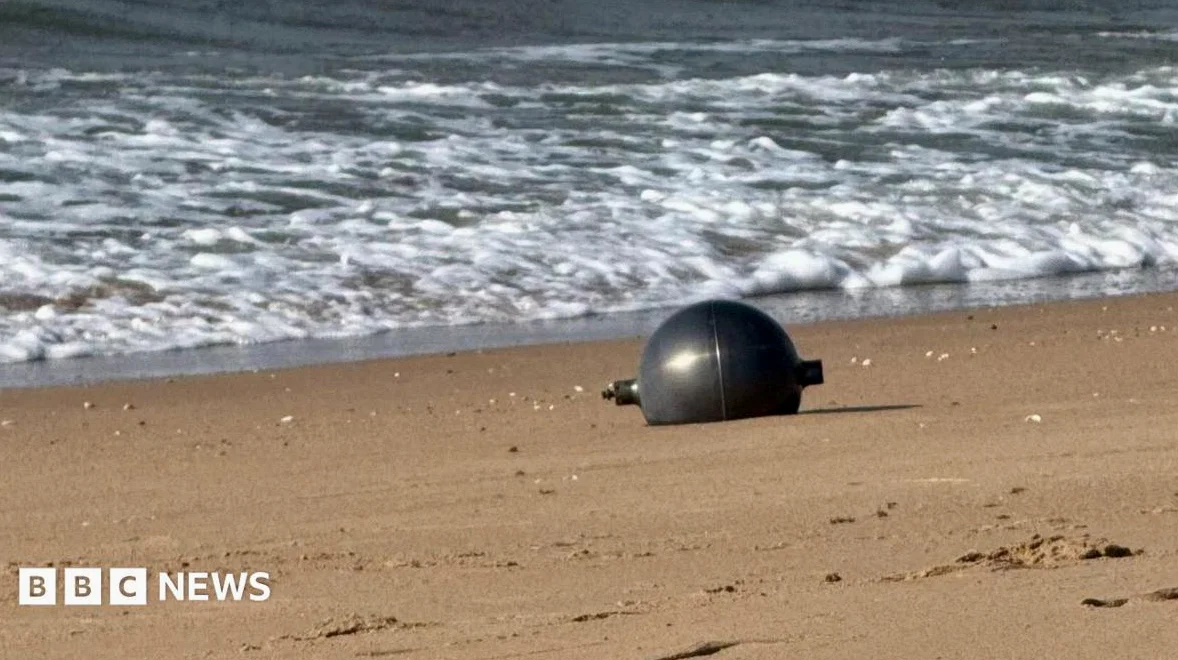
Debris from a Foreign Rocket
The Australian Space Agency (ASA) has “identified the likely source” of mysterious large balls that had washed up on a beach in northern Queensland this weekend. The six solid objects discovered on Forrest Beach, to the north of Townsville, were thought to be space debris — the ASA said on Monday that they “appear to be pressure vessels from a space launch vehicle”. The agency added that it was working with international authorities to formally confirm the launch vehicle. Queensland’s fire department said on Sunday that a 50m exclusion zone remained in place, urging anyone who found a suspicious object in the area not to touch them. It said members of the public who encounter them should immediately move away and call the emergency services. There was some speculation online that the spheres were propellant tanks for spacecraft, and so could contain residual amounts of a highly flammable or reactive substance. Crews in protective suits were reportedly seen placing the spheres in hazmat barrels under police guard, over concerns they may contain hazardous substances, as Forrest Beach Takeaway owner Lisa Scobie said the local community was curious to know their origin. “It’s very quiet. Not a lot happens here. While So having a lot of extra activity… that definitely created a little bit of excitement,” she told public broadcaster ABC. According to the ASA’s latest statement. “the objects’ location and characteristics are consistent with debris from a foreign rocket body that recently re-entered the atmosphere from orbit”. It is not the first time that such mysterious objects have been spotted on Australia’s shoreline; In 2023, India confirmed that a giant metal dome that washed up on a Western Australian beach near Perth was from one of its rockets. India’s space agency spokesman later told the BBC that it was from one of its Polar Satellite Launch Vehicles (PSLV); a spherical object similar to those discovered this weekend was also found in remote grassland in Namibia, southern Africa, in 2011. Experts at the time said they believed it was most likely a fuel tank or bladder tank containing hydrazine – a highly volatile propellant – from an unmanned rocket.
Public Safety Measures
Queensland’s fire department emphasized public safety by maintaining a 50m exclusion zone around the area. Members of the public were advised to avoid touching any suspicious objects and to contact emergency services immediately if they encountered such items. This precaution was taken due to concerns that the spheres might contain hazardous materials, including highly flammable substances. Crews in protective gear were observed handling the objects with care, placing them in hazmat barrels for secure transport. These measures reflect the cautious approach taken by authorities in managing potential risks associated with unexplained debris. The ASA’s statement further highlighted the consistency of the objects’ location and characteristics with debris from a foreign rocket that had recently re-entered the Earth’s atmosphere. This aligns with previous incidents where similar objects were identified as originating from rocket launches. The community’s response to the discovery was one of curiosity and mild excitement, given the otherwise quiet nature of the area. Local business owner Lisa Scobie noted that the unusual activity brought a sense of intrigue to the community, which is typically devoid of such events. The ASA continues to collaborate with international partners to confirm the origin of the debris, emphasizing the importance of accurate identification for both public safety and scientific understanding. This ongoing investigation highlights the global nature of space activities and the potential for debris to impact even remote locations.
Historical Precedents
The discovery of the spheres on Forrest Beach is not an isolated incident. Similar occurrences have been documented in other regions, highlighting the global challenge of space debris. In 2023, a giant metal dome was found on a Western Australian beach near Perth, which was later confirmed by India to be from one of its rockets. India’s space agency identified the object as part of its Polar Satellite Launch Vehicle (PSLV), a type of rocket used for satellite launches. This precedent illustrates the commonality of such events, where space debris can travel vast distances before landing on Earth. A similar object was found in 2011 in remote grassland in Namibia, southern Africa. Experts at the time suggested that the object was likely a fuel tank or bladder tank containing hydrazine, a highly volatile propellant used in rockets. These historical precedents provide valuable context for understanding the potential origins of the objects found in Queensland. They also highlight the need for continued vigilance and collaboration among international space agencies to manage the risks associated with space debris. The identification of the spheres as pressure vessels from a space launch vehicle highlights accurate tracking and communication in the space industry. As space exploration and satellite launches become more frequent, the likelihood of such events is expected to increase. This necessitates reliable protocols for identifying and handling space debris to ensure public safety and environmental protection.





Comments
No comments yet
Be the first to share your thoughts