

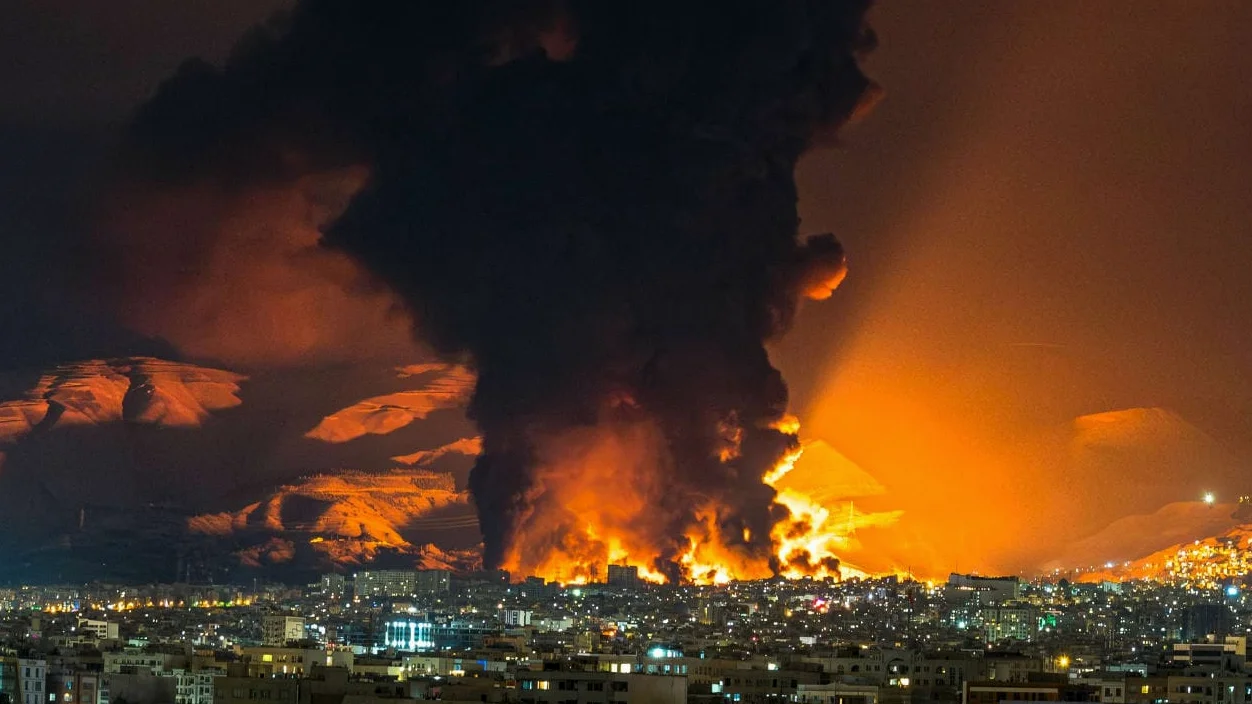
FIRE AND smoke rise at the site of airstrikes on an oil depot in Tehran. The region is witnessing a new phase of conflict, one that extends beyond military operations and into the political and strategic domain. With the expansion of recent military actions targeting centers of power within the Iranian regime, the focus is no longer solely on managing the crisis with Tehran but on whether this moment can lead to the end of the theocratic government that has ruled Iran since 1979.
Escalation of Tensions and Diplomatic Failures
The months leading up to these operations included sensitive negotiations between the United States and Iran aimed at halting advances in Iran’s nuclear program and curbing the development of ballistic missiles. However, these efforts faced repeated delays and resistance from Tehran. While public negotiations continued, Iran was secretly advancing its nuclear and missile capabilities, moving closer to a threshold that could threaten regional stability.
According to analysts, the continued development of Iran’s nuclear program has made diplomacy less viable. Allowing the regime more time to develop military nuclear capabilities could dangerously alter the balance of power in the Middle East and potentially trigger a nuclear arms race. Past experiences in the region have shown that military strikes alone may not change regime behavior if the political and military structures can regenerate power.
Israeli Defense Minister Israel Katz recently stated, ‘Every leader appointed by the Iranian terror regime to continue and lead the plan to destroy Israel… will be a target for elimination.’ This message signals a shift in deterrence, indicating that the conflict is no longer confined to military capabilities but also includes targeting the decision-makers behind Iran’s aggressive policies.
Strategic Tracks for Changing Iran’s Political Landscape
The real challenge today is not just delivering the next strike but preventing Iran from rebuilding its capacity to threaten the region. A realistic approach focuses not on overthrowing the Iranian state but on transforming its political-religious system. This would involve shifting Iran from an ideological project for regional conflict into a nation-state that operates in the interests of its people and the stability of its surroundings.
To achieve this, a complex strategy is required. The first track involves addressing the nuclear program. Simply reducing enrichment levels or freezing certain activities is not enough. Instead, the number of operating reactors must be reduced to the minimum for civilian purposes, and any future nuclear development must be subject to strict oversight under the conditions of the 123 Agreements, which are American civil nuclear cooperation agreements.
US President Donald Trump previously warned, ‘An Iranian regime armed with long-range missiles and nuclear weapons would be a dire threat to every American.’ This highlights the urgency of preventing Iran from acquiring weapons of mass destruction. The second track involves ending the offensive military capabilities that Iran has used to exert regional pressure, such as its missile program and cross-border drone systems. These must be confined to a purely defensive framework.
The third track concerns the economic structure that has enabled the Iranian regime to fund its foreign policies. The Major Guards are not only a military institution but also a vast economic network that has allowed the regime to finance its activities outside the framework of state institutions. Transferring these economic assets to a transparent civilian framework and subjecting them to state oversight is a crucial step in separating the national economy from the ideological project that has governed Iran for decades.
Economic Reforms and the Role of Oil Revenues
The most sensitive factor in this effort remains oil revenues, which have historically financed a large part of Iran’s expansionist and conflict-driven policies. Redirecting these resources toward the national economy and internal development is an essential condition for any real political change within Iran. This could also help reduce the regime’s reliance on external conflicts to maintain its domestic legitimacy.
However, any change to the regional security equation will not be sustainable if the structure of power within Iran remains unchanged. Historical experiences show that states change behavior when the nature of their decision-making centers changes. Therefore, the future of this effort cannot be understood without considering what is happening inside Iran itself.
With increasing economic and political pressures, discussions have begun within Iranian society about the future of state governance. After decades of domination by the religious and security establishment, broad segments of Iranian society are now looking toward a different governance model based on economic efficiency and professional state management instead of ideological rhetoric.
Calls are increasing for a technocratic management model where economic and administrative elites take over the management of state institutions. This would allow the separation of economic management and development from the ideological conflicts that have affected Iranian politics for decades. Such a change does not mean the collapse or disintegration of the state but could be the most realistic way for reintegrating Iran into its regional environment and the global economy.
The Iranian state has an educated society, a large economy, and a deep institutional structure. The main problem in past decades was not in the capabilities of society or the state but in the nature of the political system that directed these capabilities toward a project of perpetual conflict with the region and the world.
Iran, as a state, holds all the components that would allow it to be a force for stability and development in the region. However, the mullahs’ regime that has ruled it since the revolution turned these potentials into tools for conflict and tension. Redirecting these capabilities toward Iran’s interior and economic development could be the most important step in any future political change.
Scenarios of rejection or division within the mullahs’ regime remain possible. Rejection of this plan would mean the continuation of pressure and strikes, leading to rising economic and military costs for the regime. Internal division, however, could open the door for changing power without the collapse of state institutions. What is happening today is not just another military round but a rare political opportunity to redefine Iran’s role in the region.
The writer is a UAE political analyst and former Federal National Council candidate.



Comments
No comments yet
Be the first to share your thoughts