

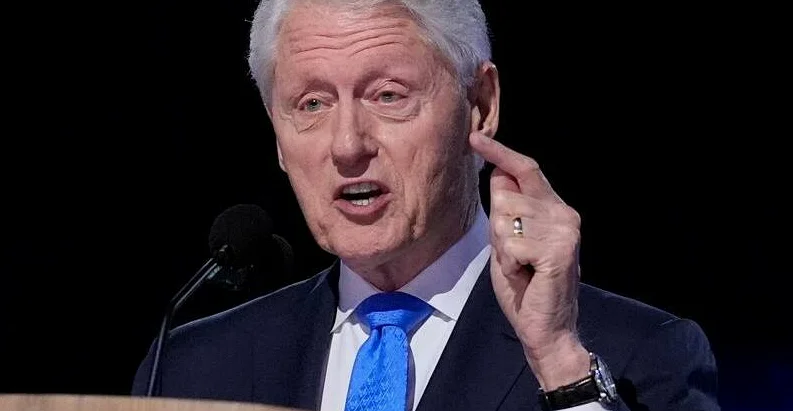
Former President Bill Clinton is testifying before members of Congress investigating convicted sex offender Jeffrey Epstein, answering for his connections to the disgraced financier from more than two decades ago. The closed-door deposition in Chappaqua, New York, will mark the first time a former president has been compelled to testify to Congress.
Epstein Investigations Intensify
The inquiry into Epstein, who died in a New York jail cell in 2019 while facing sex trafficking charges, has drawn renewed focus as former leaders and public figures are scrutinized for their ties to the financier. Clinton’s testimony comes a day after his wife, former Secretary of State Hillary Clinton, sat with congressional representatives for her own deposition.
Bill Clinton has not been accused of any wrongdoing, but the investigation is part of a broader reckoning with high-profile figures who maintained connections with Epstein after his 2008 guilty plea for soliciting prostitution from an underage girl. The case has seen several powerful men fall from grace as the public demands accountability.
Hillary Clinton told lawmakers she had no knowledge of Epstein’s sexual abuse of underage girls and no recollection of even meeting him. However, Bill Clinton will have to answer questions on a well-documented relationship with Epstein and his former girlfriend, Ghislaine Maxwell, despite the connection dating back to the late 1990s and early 2000s.
Republican Focus on Clinton
Republicans are seizing the opportunity to scrutinize the former Democratic president under oath. James Comer, the Republican chair of the House Oversight Committee, said Thursday that the Clintons had not answered many, if any, questions about their knowledge or involvement with Epstein and Maxwell.
“No one’s accusing, at this moment, the Clintons of any wrongdoing,” Comer said. “But we want to know what they knew and when they knew it.”
The calls to question Bill Clinton about Epstein reached a fever pitch late last year when several photos of the former president surfaced in the Department of Justice’s first release of case files on Epstein and Maxwell. One photo showed Clinton on a plane seated alongside a woman whose face was redacted, with his arm around her. Another depicted Clinton and Maxwell in a pool with another person whose face was also redacted.
Epstein visited the White House several times during Clinton’s presidency, and the pair later made several international trips together for their humanitarian work. In the lead-up to his deposition, Bill Clinton has insisted he had limited knowledge about Epstein and was unaware of any sexual abuse he committed.
“I think the chronology of the connection that he had with Epstein ended several years before anything about Epstein’s criminal activities came to light,” Hillary Clinton said at the conclusion of her deposition on Thursday.
Democrats Push for Trump Testimony
Democrats, who have supported the push to get answers from Bill Clinton, are arguing that it sets a precedent that should also apply to President Donald Trump, a Republican who had his own relationship with Epstein. Robert Garcia, the top Democrat on the committee, said Thursday that the committee is demanding Trump testify before them.
“We’re demanding immediately that we ask President Trump to testify in front of our committee and be deposed in front of Oversight Republicans and Democrats,” Garcia said.
Comer has pushed back on that idea, saying that Trump has answered questions on Epstein from the press. “He’s had the opportunity to speak to the press about it,” Comer said. “We’re not saying he can’t be questioned, but we’re not going to force him to appear in a deposition if he’s already spoken on the issue.”
Meanwhile, President Donald Trump is traveling to Texas on Friday to talk about his energy and economic policies amid a red-hot Senate Republican primary race. The focus on Epstein and the testimony of former presidents has added a layer of complexity to the political landscape as the midterm elections approach.
As the investigation continues, the implications for accountability and transparency in government remain unclear. With the deposition of Bill Clinton setting a new precedent, the public is watching closely to see how the process unfolds and what, if any, actions will follow.






Comments
No comments yet
Be the first to share your thoughts