

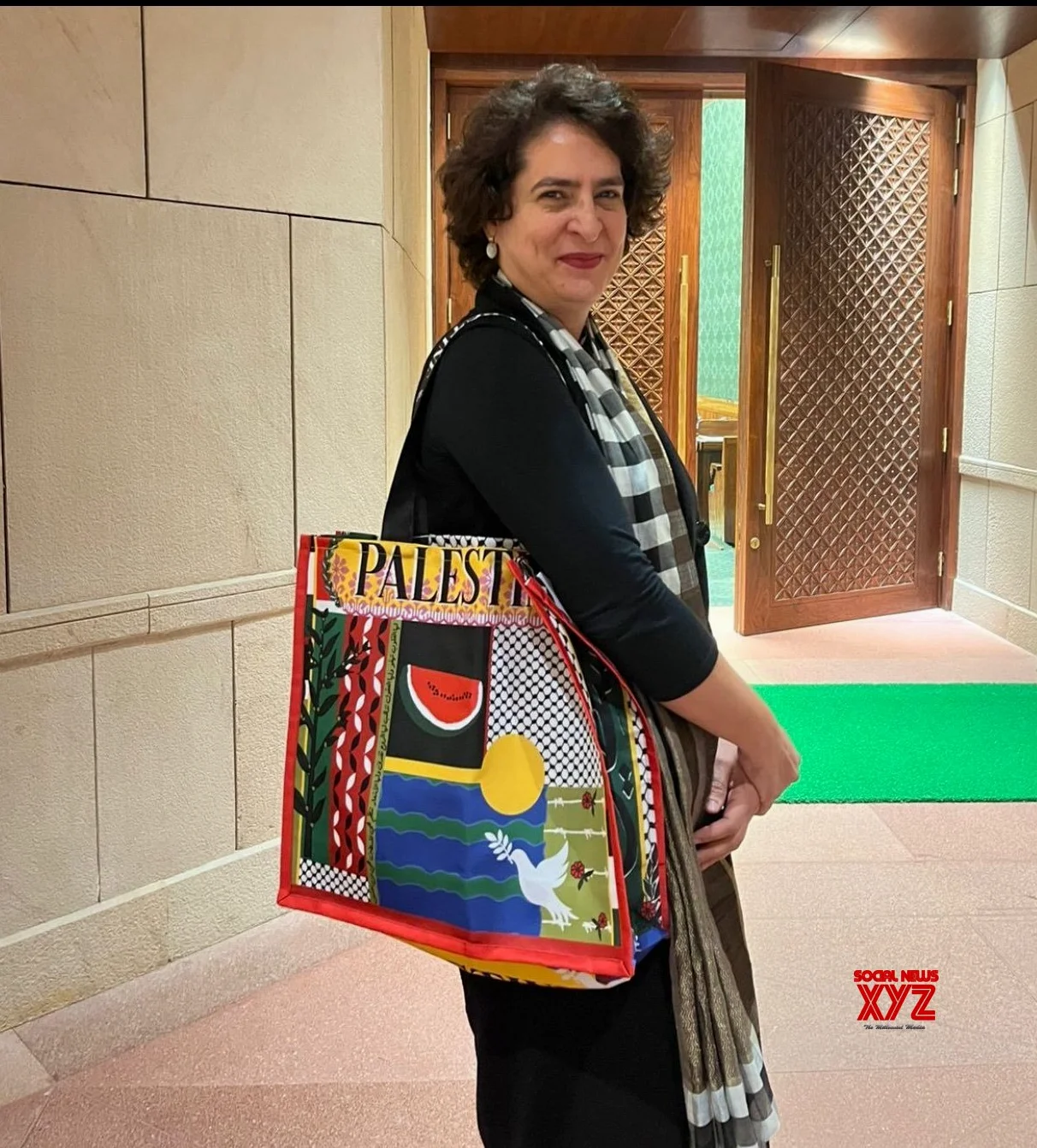
The BJP has sharply criticized Congress MP Priyanka Gandhi Vadra over her stance on the Israel-Gaza conflict, accusing her of selective outrage and lacking the moral conviction to condemn the Hamas attack on Israel on October 7. BJP National Spokesperson Gaurav Bhatia took to social media to call out Priyanka Gandhi Vadra, referring to her as the ‘female Ghajini of Indian politics’ and highlighting her recent act of carrying a ‘Palestine’ bag to Parliament.
BJP Criticizes ‘Selective Outrage’
Bhatia accused Priyanka Gandhi Vadra of lacking the courage to condemn the mass casualties and atrocities that occurred during the Hamas attack on Israel, which resulted in the deaths of over 1,200 people, including many civilians. He also questioned her moral stance on the issue, suggesting that merely carrying a symbolic ‘Palestine’ bag to Parliament was not enough.
‘The Female Ghajini of Indian politics is back! Carrying a ‘Palestine’ bag to Parliament is easy, but having the moral courage to condemn the Oct 7th massacre of 1,200+ innocents, women being abducted and raped, is clearly too hard for Priyanka Gandhi Vadra,’ Bhatia said in a post on X.
Bhatia further claimed that while Priyanka Gandhi Vadra might carry a ‘fake Gandhi surname,’ she clearly lacks the conviction and the courage to address the issue with the same intensity as others. The BJP’s criticism comes as Priyanka Gandhi Vadra expressed hopes that Prime Minister Narendra Modi would raise the issue of the ‘genocide of thousands of innocent men, women, and children’ in Gaza during his upcoming visit to Israel.
Priyanka’s Call for Justice in Gaza
Priyanka Gandhi Vadra took to social media to express her hopes that PM Modi would address the humanitarian crisis in Gaza while meeting with Israeli Prime Minister Benjamin Netanyahu. She wrote, ‘I hope that the Hon Prime Minister Narendra Modi ji mentions the genocide of thousands of innocent men, women and children in Gaza while addressing the Knesset on his upcoming trip to Israel and demands justice for them.’
In her statement, Priyanka Gandhi Vadra emphasized that India has a long-standing tradition of standing for what is right and urged the country to continue being a symbol of truth, peace, and justice on the global stage. Her comments contrast sharply with the BJP’s criticism, which has focused on what it sees as a lack of moral clarity from her side.
PM Modi departed for a two-day visit to Israel on February 25, marking his second trip to the country since 2017. The visit aims to solidify India-Israel relations and establish new goals for their Strategic Partnership. Modi’s engagements with Israeli Prime Minister Benjamin Netanyahu are expected to cover a range of topics, including defense, agriculture, and water management.
India-Israel Relations and Regional Dynamics
During his visit, PM Modi is expected to discuss regional and global issues with Israeli leaders, further strengthening the strategic ties between the two nations. This visit follows Modi’s 2017 trip to Israel, which opened new avenues in defense, agriculture, and water management. The current visit is seen as a continuation of India’s growing strategic alignment with Israel, particularly in the context of the Israel-Gaza conflict.
Analysts note that India’s foreign policy has increasingly focused on maintaining balanced relations with both Israel and Palestine, while emphasizing non-interference in the internal affairs of other nations. The current situation has also sparked discussions within India about how the country should position itself in the global narrative on the Israel-Gaza conflict.
As the conflict continues to dominate international headlines, the reactions from Indian political leaders have become a point of discussion. The BJP’s criticism of Priyanka Gandhi Vadra highlights the growing polarization in Indian politics over the issue, with different parties taking distinct stances on the matter.
Looking ahead, the outcomes of PM Modi’s visit to Israel could have significant implications for India’s foreign policy and its stance on the Israel-Gaza conflict. The upcoming discussions with Israeli leaders are expected to shape India’s future engagement with both Israel and Palestine, potentially influencing how the country approaches the ongoing humanitarian and geopolitical challenges in the region.





Comments
No comments yet
Be the first to share your thoughts