

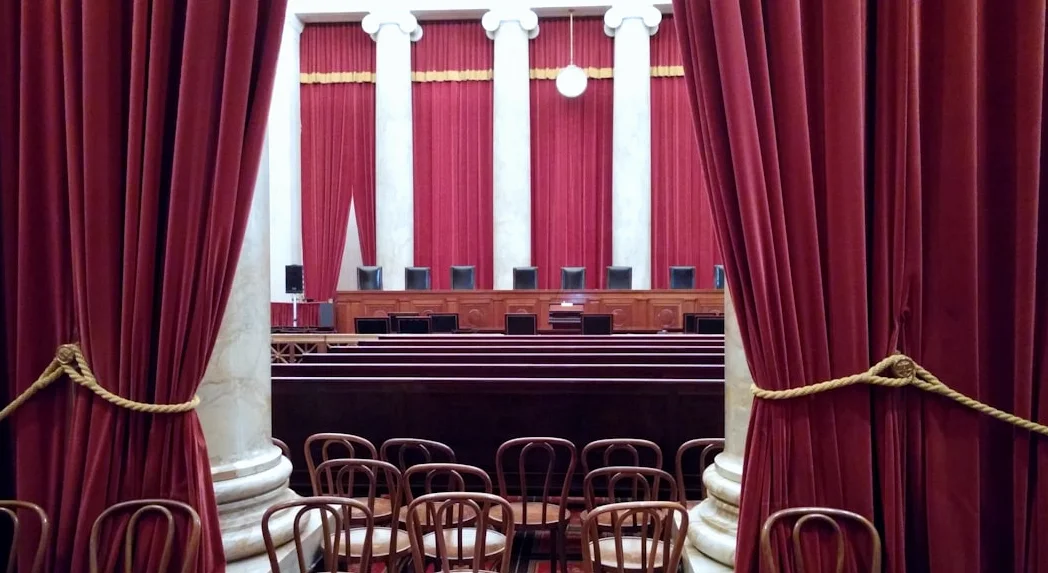
The U.S. Supreme Court ruled Friday that President Donald Trump’s tariffs were illegal, marking a rare judicial check on executive power in a 6-3 decision in Learning Resources Inc. v. Trump. The ruling, which spanned 170 pages and included seven different opinions, declared that the tariffs Trump imposed on Chinese imports were not authorized by federal law.
Constitutional Boundaries on Tariffs
The court unanimously agreed that the president does not have inherent constitutional authority to impose tariffs, a power reserved for Congress under the Constitution. Chief Justice John Roberts, writing for the majority, emphasized that tariffs are a form of taxation and that the Constitution grants this power to Congress, not the executive.
‘A tariff,’ Roberts wrote, ‘is a tax levied on imported goods and services.’ The majority opinion cited long-standing legal precedents to support this conclusion, stating that the power to impose tariffs is ‘very clear[ly] … a branch of the taxing power.’
Notably, none of the dissenting justices argued that the president has inherent power under Article II of the Constitution to impose tariffs. This is significant because it means that future cases involving tariffs will be based on whether existing federal law explicitly authorizes the president to impose them.
Legal Focus on Statutory Authority
The central issue in the case was whether the International Emergency Economic Powers Act (IEEPA) authorized Trump to impose tariffs. The IEEPA, enacted in 1977, allows the president to regulate importation to address ‘unusual and extraordinary threats.’ However, the law does not mention tariffs or duties.
Roberts, joined by Justices Sonia Sotomayor, Elena Kagan, Neil Gorsuch, Amy Coney Barrett, and Ketanji Brown Jackson, concluded that IEEPA does not provide the president the power to impose tariffs. ‘IEEPA’s grant of authority to ‘regulate … importation’ falls short,’ Roberts wrote. ‘IEEPA contains no reference to tariffs or duties.’
Justice Brett Kavanaugh, writing a 63-page dissent joined by Justices Clarence Thomas and Samuel Alito, sharply disagreed. He argued that the IEEPA does authorize the president to impose tariffs, stating that ‘tariffs are a traditional and common tool to regulate importation.’
Major Questions Doctrine in Focus
A significant portion of the court’s opinions focused on the major questions doctrine, which holds that the president cannot act on major economic or political questions without clear congressional authorization. Roberts, in a portion of the opinion joined by Gorsuch and Barrett, said the tariffs were invalid because they concerned a major economic and political issue without sufficient congressional direction.
However, there was significant disagreement among the justices about the scope of the major questions doctrine. Justice Kagan, in a concurring opinion joined by Sotomayor and Jackson, argued that the doctrine has no legal basis and that the tariffs could be invalidated without it.
Gorsuch, in a 46-page concurring opinion, defended the major questions doctrine as a constitutional principle rooted in long-standing legal traditions. He criticized the liberal justices for not recognizing its validity. Barrett, in response, stated that the major questions doctrine is ‘an ordinary application of textualism’ and not a constitutional principle.
The court’s split on the major questions doctrine was 3-3-3, leaving many questions unresolved. Gorsuch and Barrett disagreed on the level of clarity required for a statutory interpretation to be considered valid.
The ruling means that hundreds of billions of dollars in tariffs were illegally collected by the federal government. Kavanaugh raised the potential for significant legal and financial consequences, stating that the United States may be required to refund billions of dollars to importers who have already passed on the costs to consumers or other businesses.
The issue of how to remedy the illegality of the tariffs is likely to be the focus of future litigation. The court did not address the remedy directly, leaving it to lower courts to determine the appropriate course of action.
The decision has far-reaching implications for the balance of power between the executive and legislative branches. It signals that the Supreme Court is willing to act as a check on presidential authority, even when the president is a member of the same political party as the majority of the court.
Comments
No comments yet
Be the first to share your thoughts