

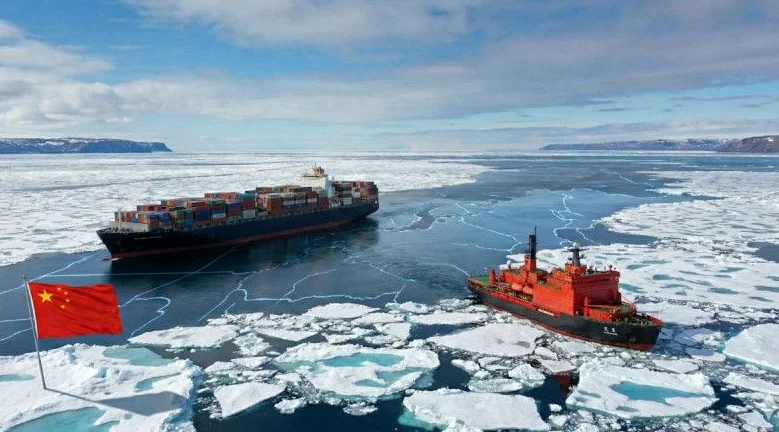
China is expanding its influence in the Arctic as melting ice opens new shipping routes and economic opportunities, according to recent maritime data and policy documents. In late 2025, the container ship Istanbul Bridge completed a 20-day journey from Ningbo, China, to Felixstowe, England, via the Northern Sea Route—a shortcut that some Chinese officials refer to as the ‘Polar Silk Road.’
Data from the Marine Exchange of Alaska showed a 175% increase in transits through the Bering Strait between 2010 and 2024, signaling growing Arctic traffic. This trend aligns with satellite measurements indicating a steady decline in Arctic sea ice since 1979, with NASA reporting a reduction of about 12.2% per decade. The Intergovernmental Panel on Climate Change (IPCC) projects the Arctic Ocean could be nearly ice-free at least once before 2050.
While the Arctic’s changing climate offers new trade routes, it also presents risks. Navigation remains challenging due to unpredictable ice conditions and weather, and rescue capabilities in the region are still limited. China has been working to address these challenges through its Arctic policy, outlined in a 2018 white paper that positions the country as a ‘Near-Arctic State’ with legitimate interests in the region.
The document emphasizes China’s goals of ‘understanding, protecting, developing, and participating in the governance’ of the Arctic. It also calls for the development of Arctic shipping routes as part of a ‘Polar Silk Road’ initiative. China has been an observer in the Arctic Council since 2013, allowing it to engage in non-voting discussions on environmental and scientific issues.
China’s interest in the Arctic is driven by multiple factors. Economically, the region offers an alternative to traditional shipping routes, reducing reliance on the Strait of Malacca. Energy interests are also significant, with projects like Russia’s Yamal LNG involving Chinese partners such as China National Petroleum Corporation and the Silk Road Fund.
Scientific and technological development is another key driver. China has established research stations, including the Yellow River Station in Svalbard, to enhance its understanding of Arctic conditions. This research supports efforts to improve navigation and logistics in the region.
Strategically, China is capitalizing on Russia’s reduced access to Western markets following the 2022 invasion of Ukraine. Russian energy and logistics routes are increasingly directed toward Asia, strengthening Sino-Russian ties and giving China additional use in the Arctic.
Meanwhile, the United States is also increasing its Arctic presence, with a $8.6 billion funding plan to bolster its icebreaker fleet and counter rising Chinese and Russian influence. However, analysts suggest that China’s growing engagement in the Arctic may allow it to position itself as a stable and multilateral actor in a region where U.S. leadership is being tested.






Comments
No comments yet
Be the first to share your thoughts