

 BBC
BBC 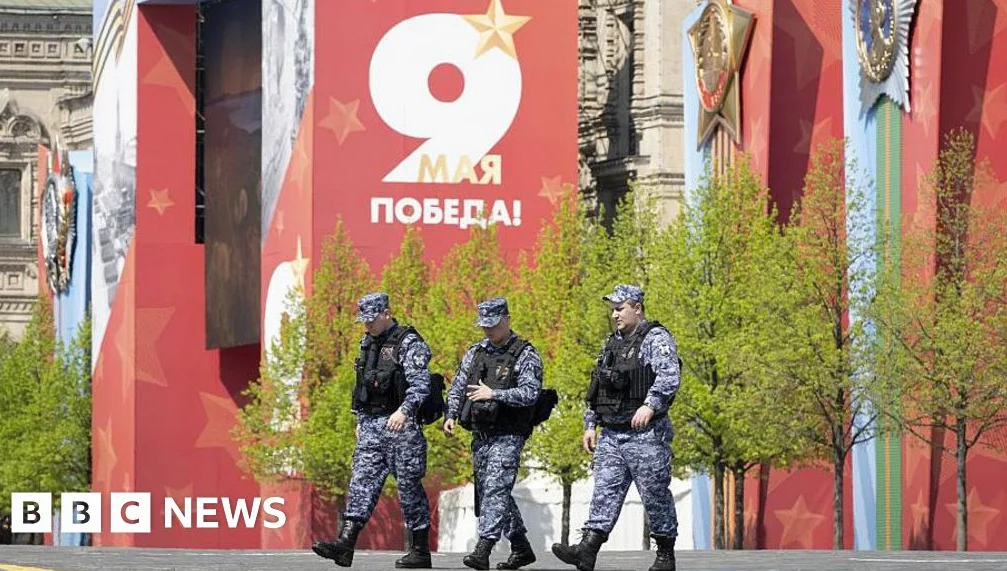
Russian President Vladimir Putin’s government is scaling back the Victory Day parade in Moscow, which commemorates the Soviet Union’s victory over Nazi Germany in 1945 — For the first time in nearly two decades, no military hardware—such as tanks or ballistic missiles—will be displayed on Red Square. Instead, the parade will feature only soldiers.
Victory Day and the War in Ukraine
The absence of military equipment has drawn attention as a symbol of the ongoing conflict in Ukraine. Russia’s war on Ukraine has now lasted more than four years and has not led to a decisive victory for Russian forces. The decision to remove tanks from the parade has been justified by the Kremlin as a measure of safety due to the threat of Ukrainian drone attacks. Russian MP Yevgeny Popov stated, “Our tanks are busy right now. They are fighting. We need them more on the battlefield than on Red Square.”
Despite the war entering its fifth year, Russia continues to accuse the West of fueling the conflict. The Kremlin has not shown any sign of withdrawing from the war but has instead tightened restrictions domestically and abroad. On Tuesday, a long-range Ukrainian missile and drone strike on the Russian city of Cheboksary killed two people and injured more than 30. The previous night, a drone struck a luxury high-rise apartment in Moscow, causing extensive damage but no casualties.
Public Reaction and Domestic Fatigue
Public sentiment in Russia appears to be shifting as the war drags on. While some Russians acknowledge the security concerns behind the scaled-back parade, others express concern about the symbolism. “Parading our military hardware shows our strength on the world stage. Perhaps we should be displaying something,” said Sergei, a Moscow resident.
Yulia, another resident, noted the irony of removing tanks for safety reasons. “I understand it would be foolish to showcase [hardware] in case something happens during the parade. On the other hand, this means that we are afraid of something. And that’s not great, either.” Vladimir, another interviewee, stated, “The parade, of course, is a symbol. But if circumstances don’t allow it to take place in full, we’ll have to wait a year for that.”
Domestically, there is also growing fatigue with the war. Recent polling, including by state-run agencies, suggests that President Putin’s approval rating is declining. The leader has been seen less frequently in military fatigues on television, a contrast to his frequent appearances in uniform late last year. Public concern over the cost of living and recent state-imposed internet restrictions has also increased.
Internet Restrictions and Public Frustration
In the name of security, Russian authorities have implemented mobile internet shutdowns in several towns and cities. These measures are officially justified as a means to prevent Ukrainian drone attacks and sabotage. However, they have proven deeply unpopular with the public. MP Yevgeny Popov dismissed public criticism, stating, “It’s not your business, with all respect, what we are doing with our internet. It would be better to be with no internet than to be killed by a Ukrainian missile or drone.”
Despite the restrictions, ceremonies continue across Russia to honor the sacrifices made during the Great Patriotic War. In the village of Rublyovo near Moscow, schoolchildren laid red carnations at a local World War Two memorial in memory of villagers killed during the conflict. Two masked men in military fatigues with medals pinned to their chests stood nearby; they had been fighting in what the Kremlin refers to as the “special military operation” in Ukraine.
One of the fighters compared the Ukraine war to the Great Patriotic War, despite the key difference: in 1941, Russia was invaded by Nazi Germany; in 2022, Russia invaded Ukraine. “Russia is a country of victors. It always was and always will be,” he declared.
Yet more than four years into the war, victory continues to elude Russia. The conflict has now lasted longer than the Soviet Union’s war against Nazi Germany, a fact that reveals the growing unease among the Russian public and raises questions about the sustainability of the Kremlin’s strategy in Ukraine.





Comments
No comments yet
Be the first to share your thoughts