

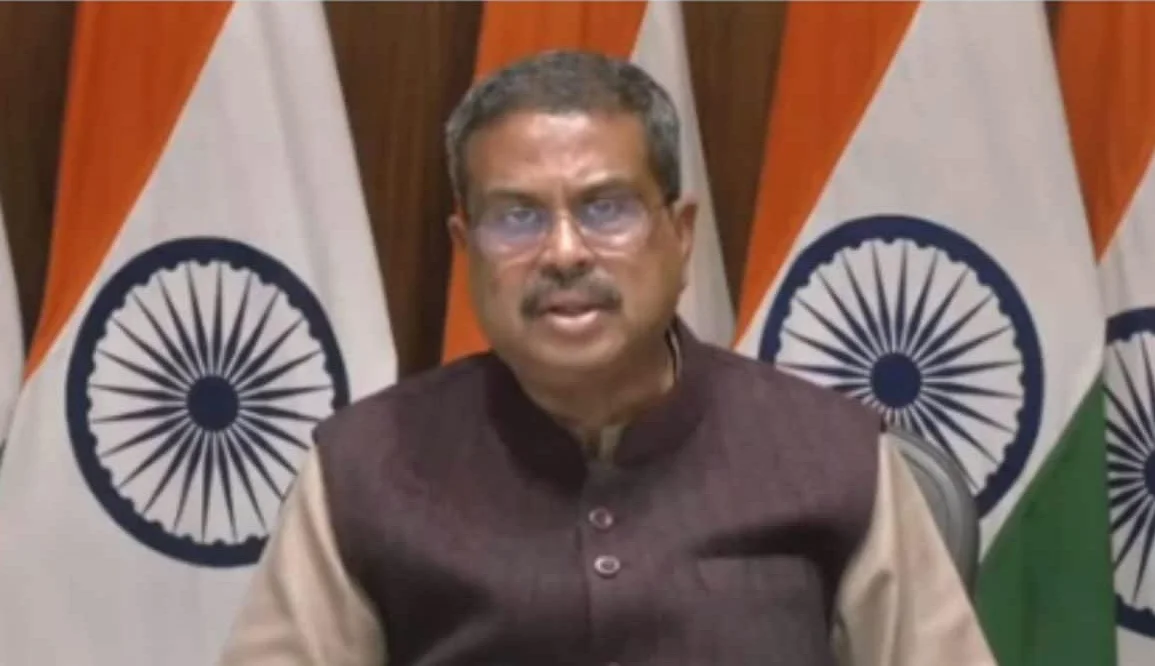
India’s Union Education Minister Dharmendra Pradhan has urged global collaboration in higher education, highlighting the country’s emerging role as a hub for innovation and learning at the Study in India Edu-Diplomatic Conclave 2026 in New Delhi. The event, held at Sushma Swaraj Bhawan, brought together over 50 countries’ diplomatic representatives, including ambassadors and high commissioners, to explore opportunities for academic partnerships and student mobility.
India’s Vision for Global Education Leadership
Speaking at the conclave, Pradhan outlined India’s strategic focus on quality, innovation, and affordability in higher education. He emphasized the country’s commitment to expanding its international reach through the National Education Policy (NEP) 2020, which aims to transform the education sector and align it with global standards.
Pradhan highlighted Prime Minister Narendra Modi’s vision for India to become a developed nation by 2047, coinciding with the 100th anniversary of India’s independence. He stated that the country’s young population, growing economy, and strong knowledge ecosystem provide a strong foundation for this goal.
According to Pradhan, the NEP 2020 and the Study in India initiative are opening new pathways for students, researchers, and institutions from abroad. He noted India’s advancements in areas such as artificial intelligence, biotechnology, semiconductors, and sustainable energy, which position the country as a potential innovation partner for other nations.
Push for Internationalization and Academic Partnerships
Higher Education Secretary Vineet Joshi outlined how the NEP 2020 has guided recent reforms, particularly in multidisciplinary learning, skill integration, and global engagement. He mentioned that Indian institutions are increasingly expanding their international presence through joint, dual, and twinning degree programs.
Joshi also highlighted the University Grants Commission’s (UGC) efforts to streamline the process for foreign universities to establish campuses in India. He noted that applications from institutions in Australia, Italy, the United Kingdom, and the United States have been cleared within a month of submission, demonstrating the policy’s efficiency.
Joshi described the Study in India initiative as an open invitation for global academic collaboration, emphasizing the potential for mutual benefit and knowledge exchange. He added that the initiative aims to attract students from partner countries to pursue higher education and short-term courses in India while supporting institutional collaborations and greater academic exchange.
Thematic Discussions on Knowledge Systems and Innovation
The conclave featured several thematic sessions, including discussions on Indian Knowledge Systems, academic partnerships under SPARC and GIAN, artificial intelligence and advanced technologies, UGC regulations for foreign university campuses, international branch campuses, skill development, and Bharat Innovates 2026.
Officials noted that the discussions focused heavily on student mobility, joint academic programs, and research collaboration. The conclave also addressed the regulatory framework for establishing foreign university campuses in India, with a particular emphasis on transparency and efficiency in the approval process.
The Study in India Edu-Diplomatic Conclave is part of a broader strategy to position India as a global education destination. The initiative has already seen growing interest from international institutions, with 13 university agreements signed between India and Canada, including McGill University’s plans to open an AI research center in the country.
Experts suggest that India’s push for global academic partnerships aligns with its broader economic and diplomatic goals, aiming to diversify its international collaborations beyond traditional partners. With the NEP 2020 and the Study in India initiative, India is positioning itself as an attractive destination for higher education, offering a blend of affordability, quality, and innovation.
Looking ahead, the conclave is expected to lead to concrete agreements and collaborations in the coming months. The Indian government has set a deadline for the finalization of several key policy frameworks by the end of 2026, which could further accelerate the pace of internationalization in the education sector.





Comments
No comments yet
Be the first to share your thoughts