

 The Hindu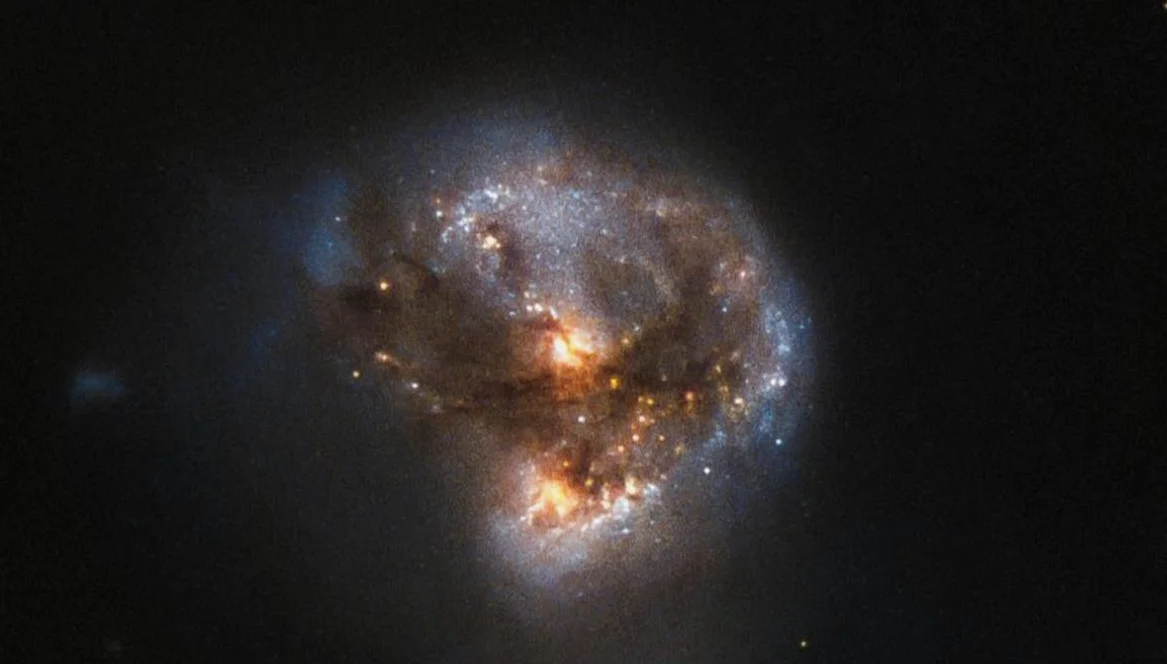
Astronomers using South Africa’s MeerKAT radio telescope have detected the most distant hydroxyl megamaser yet, a discovery that could provide new insights into the formation of galaxies and the evolution of the universe. The megamaser, located in a galaxy billions of light-years away, was magnified by a natural cosmic lens, making it the brightest of its kind ever observed and earning it the name ‘gigamaser.’
What Is a Hydroxyl Megamaser?
A hydroxyl megamaser is a naturally occurring cosmic phenomenon that emits powerful beams of radio waves. Similar to how a regular laser focuses visible light, a maser (microwave amplification by stimulated emission of radiation) focuses microwave or radio waves. The ‘hydroxyl’ part refers to a molecule composed of one oxygen atom and one hydrogen atom (OH-), which is found in vast clouds of gas in distant galaxies.
These molecules are typically found in regions where intense star formation occurs, often triggered by the collision of two galaxies. Such collisions can also fuel giant black holes and release massive amounts of infrared energy. When this energy interacts with hydroxyl molecules, it excites them to a high-energy state. As the molecules return to their normal state, they emit a powerful, amplified beam of radio waves.
Astronomers call these signals megamasers because they shine millions of times brighter than the smaller masers found in our own Milky Way galaxy. This newly discovered megamaser, located in a galaxy billions of light-years away, is the most distant of its kind yet observed. The signal was amplified by gravitational lensing, a phenomenon where the gravitational pull of a massive object bends and magnifies light from a more distant source.
Significance for Understanding the Universe
The discovery of this gigamaser has significant implications for our understanding of the early universe. Because radio waves can travel through thick clouds of dust, scientists can use them to study distant objects that would otherwise be hidden from view. This makes megamasers valuable cosmic beacons, allowing astronomers to measure the motion of galaxies and track their evolution over time.
‘These signals act as natural beacons that help us map the structure of the universe and understand how galaxies form and evolve,’ said Dr. Sarah Johnson, an astrophysicist at the University of Cape Town. ‘The gigamaser we’ve detected is not just a rare find — it’s a window into the early universe’s most dramatic processes.’
According to the study published in the Monthly Notices of the Royal Astronomical Society, the gigamaser was discovered in a galaxy known as SDSS J131931.41+162457.1, located about 12.7 billion light-years away. The signal was detected using the MeerKAT telescope, which has 64 dishes and is one of the most powerful radio telescopes in the world.
The gigamaser’s brightness suggests that it was produced in a region of intense star formation or near a supermassive black hole. Such environments are common in the early universe, where galaxies were still forming and colliding frequently. By studying these signals, scientists can gain a better understanding of the processes that shaped the cosmos billions of years ago.
What’s Next in the Study of Megamasers
Astronomers are now working to confirm the exact location of the gigamaser and to study its properties in more detail. The team hopes to use the James Webb Space Telescope to observe the galaxy in infrared light, which could provide additional insights into the star formation and black hole activity in the region.
‘We’re just beginning to scratch the surface of what we can learn from these powerful signals,’ said Dr. Michael Lee, an astronomer at the National Radio Astronomy Observatory. ‘With more advanced instruments and telescopes, we’ll be able to detect even more megamasers and use them to map the large-scale structure of the universe.’
The discovery of the gigamaser is part of a broader effort to study the early universe using natural cosmic beacons. Similar megamasers have been detected in the past, but this is the most distant and brightest example yet. Scientists believe that more such discoveries could help them refine their models of galaxy formation and the distribution of dark matter in the cosmos.
The next major step for researchers will be to analyze the data from the MeerKAT telescope and cross-reference it with observations from other telescopes. This could lead to a more thorough understanding of the processes that drive the evolution of galaxies and the structure of the universe on a cosmic scale.






Comments
No comments yet
Be the first to share your thoughts