

For many in India, particularly in Gujarat, 26 March 2003 will always be remembered as a ‘black day.’ On that date, then Chief Minister Narendra Modi introduced the Gujarat Freedom of Religion Act, a law that has since drawn sharp criticism as one of the most draconian in the history of Indian democracy. The law’s introduction followed the mysterious assassination of Haren Pandya, a former Gujarat Home Minister and one of Modi’s fiercest political adversaries, whose death remains unsolved. Pandya’s father, Vitthalbhai Pandya, who passed away in 2011, was convinced of the truth behind his son’s killing and repeatedly sought justice, even appealing to the Supreme Court.
The Origins and Content of the Gujarat Freedom of Religion Act
The Gujarat Freedom of Religion Act, 2003, was introduced as a response to Modi’s election promises, which included a crackdown on religious conversions, particularly targeting Christians. During his 2002 campaign, Modi railed against Muslims and Christians, accusing them of spreading ‘foreign’ religious ideologies. The act, which came into effect in 2008 after five years of delays, was designed to regulate religious conversions and prevent ‘unlawful’ conversions, though critics argue it violates the Indian Constitution’s guarantee of religious freedom.
During a mass Hindu gathering in the Dangs in February 2006, Modi reiterated his stance against conversions, stating that it was his ‘constitutional duty’ to prevent them. He was joined by Morari Bapu, a prominent Hindu spiritual leader, who endorsed ‘ghar wapsi’ (return to Hinduism) programs as a legitimate form of religious conversion. The act was implemented in a way that favored organized religious groups, particularly those aligned with the Sangh Parivar, a Hindu nationalist organization.
Despite opposition from the entire Gujarat Assembly, the law was enacted, and it took until 2008 for the state government to finalize the necessary rules for its implementation. The act has been criticized by legal scholars and human rights organizations for its potential to infringe on the fundamental rights of individuals to practice and change their religion freely.
Legal Challenges and Constitutional Concerns
In 2009, the Gujarat United Christian Forum for Human Rights, along with several other civil society groups, challenged the constitutionality of the Gujarat Freedom of Religion Act in the Gujarat High Court. The court issued a notice to the government, but officials did not respond. The petitioners later withdrew their petition to strengthen their case, but in August 2021, the Gujarat High Court refused to allow the government to amend the law, citing its potential to violate constitutional rights.
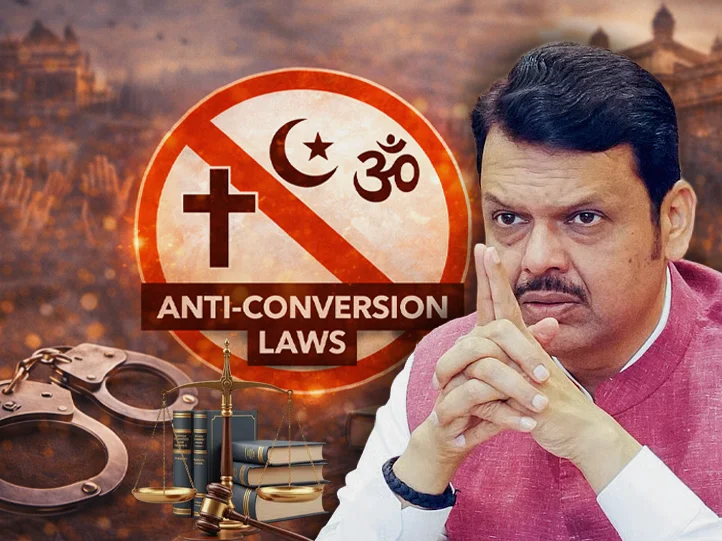
The issue of anti-conversion laws has become a nationwide concern, with 12 other Indian states—Arunachal Pradesh, Chhattisgarh, Haryana, Himachal Pradesh, Jharkhand, Karnataka, Madhya Pradesh, Odisha, Rajasthan, Uttarakhand, and Uttar Pradesh—already having similar legislation. On 5 March 2026, Maharashtra became the 13th state to introduce a draft anti-conversion law, titled the ‘Dharma Swatantrya Adhiniyam 2026 (Religious Freedom Act, 2026). The law requires prior permission from a designated authority for religious conversion and seeks to prevent ‘forced or unlawful’ conversions, though critics argue it is a violation of personal liberty and religious freedom.
On 11 March 2026, a coalition of civil society groups, including the Peoples Union for Civil Liberties (PUCL), Citizens for Justice and Peace (CJP), and the Bombay Catholic Sabha (BCS), held a press conference in Mumbai to protest the proposed Maharashtra law. They raised concerns about the lack of transparency, the absence of public consultation, and the potential implications for fundamental rights. The statement released by the groups emphasized that legislation with such far-reaching consequences should not be introduced without democratic scrutiny or public debate.
The proposed Maharashtra law follows a pattern of anti-conversion legislation that has been enacted in other states under the banner of ‘freedom of religion’ laws. These laws are often justified by the narrative of ‘love jihad,’ a conspiracy theory alleging that Muslim men systematically lure Hindu women into marriage to convert them. However, this claim has no legal basis and has been widely debunked by experts.
Moreover, the proposed Maharashtra law comes at a time when the constitutional validity of similar laws across several states is under challenge in the Supreme Court of India. A batch of writ petitions, filed by CJP, has been pending since 2020, raising fundamental constitutional questions about the scope of freedom of conscience, personal liberty, equality before the law, and the limits of state power in regulating religious conversion and interfaith relationships.
The Broader Context: A Nation in Turmoil
The issue of ‘forced conversion’ has once again been raised as a political tool, despite the lack of any evidence to support the claim. Critics argue that the narrative is a manipulative ploy used by Hindu nationalist groups to deflect attention from pressing issues facing the country, such as economic inequality, political corruption, and the erosion of India’s non-aligned identity.
India’s current government has been accused of being spineless, held to ransom by the United States and failing to protect the interests of its citizens. The scarcity of LPG, the disappearance of Smriti Irani, the Epstein files, and the alleged complicity of the Election Commission have all raised concerns about the state of governance in the country. Prices are skyrocketing, and the poor are becoming poorer, while crony capitalists continue to amass wealth at the expense of the common citizen.
The ‘hindutvadis,’ or those promoting Hindu nationalism, are seen as a frightened group, aware that their brand of ‘religiosity’ goes against human nature and the rights and freedoms that are inalienable to every citizen. The ‘forced conversion’ narrative, therefore, becomes a convenient way to change the focus from the burning issues that throttle the country today.
On 14 November 2022, a two-judge bench of the Supreme Court, comprising Justice M.R. Shah and Justice Hima Kohli, acknowledged that forced conversions may ‘ultimately affect the security of the nation and freedom of religion and conscience of citizens.’ The bench directed the Central Government to take appropriate measures to address the issue, but the matter remains unresolved.






Comments
No comments yet
Be the first to share your thoughts