

 BBC
BBC 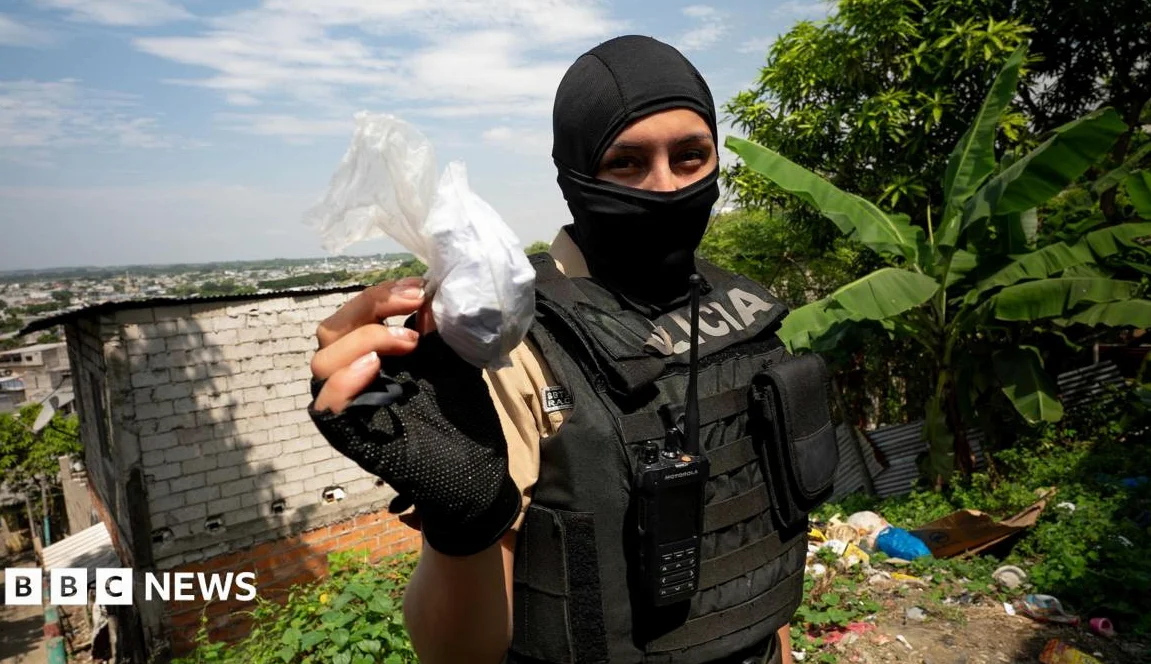
Corruption and Gangs Fuel Cocaine Flow
In Durán, Ecuador, Police Captain Jean Carlos Bustamante leads a battle against drug gangs and internal corruption. He says many officers are on the gangs’ payrolls. ‘We have many, many bad people inside our unit, inside the state, inside politics,’ he states. ‘They are in the pay of the gangs.’
Bustamante, 34, and his handpicked team conduct raids in neighborhoods controlled by groups like Los Aguilas. During one operation, they found two handguns and ammunition for an assault rifle in an abandoned house. ‘The first reason is because we are safe,’ he says. ‘The second is that there are two guns less for the gangs.’
Despite these efforts, the gangs have more weapons and money than the state, he admits. He has lost three close friends in the fight and says he no longer feels fear, but his parents worry about his safety. ‘My mum says ‘be careful, maybe you can die there,’ he says. ‘My dad calls all the time and asks ‘my son, are you good?’
From Ecuador to Europe’s Cocaine Superhighway
Cocaine flows into Ecuador from Colombia and Peru, the world’s two largest producers. Local gangs, with links to Mexican cartels and Albanian mafia, help smuggle the drugs onward. According to President Noboa, around 70% of the cocaine reaching Europe and the US is funneled through Ecuador.
This has transformed a once peaceful tourist destination into a war zone. Last year, Ecuador’s murder rate was among the highest in the world, with over 9,200 people killed, according to the interior ministry. President Noboa’s enforcement action has led to the arrest of top crime bosses, but critics say it has also caused the gangs to fracture and multiply.
Many in Ecuador believe the war against the gangs will never be won. But Bustamante continues his fight. In another operation, he and his team use a drone to spot micro-traffickers in a playground. They raid the suspects’ home, finding a suspect and tiny packets of ‘H’—a highly addictive mix containing small amounts of heroin sold for $1.00 (£0.75) per packet.
Corruption and the Gangs’ Grip
Colonel Santiago Gavilanez, deputy commander of Durán police, says corruption in the justice system undermines their efforts. ‘We imprison them [gang members] and they release them,’ he says. ‘We know because when we carry out raids, we recapture them. Some of those who are released kill people and leave orphans behind.’ He adds that the gangs have money to ‘buy laws, judges, and politicians.’
A source who asked to remain anonymous said he was offered a bribe ‘enough money to retire on’ by a gang. He turned it down. ‘You never know who is watching,’ he said. Another police officer confirmed that gangs pay for early warning systems to avoid raids, costing them $1,500 (£1,100) to $2,000 (£1,500) a month.
Police say they are making progress. The murder rate in Durán has dropped by half in the first six months of this year, according to the police. Streets are no longer deserted after 19:00 local time, and bodies are no longer found beheaded or dismembered, which used to be common.
Colonel Gavilanez says they have ‘managed to contain the gangs,’ but ‘getting complete control is going to be a medium-term process.’ Meanwhile, gangs continue to pay off officers and manipulate the system. One gang leader, calling himself ‘Jonathan,’ said he pays four officers to warn him of raids. ‘They tell me to hide things, and to get out of here,’ he said. ‘When they arrive, they find nothing.’
Jonathan, 37, joined a gang at 18 to put food on the table. He now recruits boys as young as 12, who can become hitmen by age 15. When asked how many lives he has taken, he replied, ‘Well, until now about eight, I think. I don’t remember well,’ with a handgun in his lap. He said his gang only kills rival criminals. ‘They want to force their way in here,’ he said. ‘They come killing people, and we respond. The main thing for us now is to eliminate the other gang.’

Comments
No comments yet
Be the first to share your thoughts