

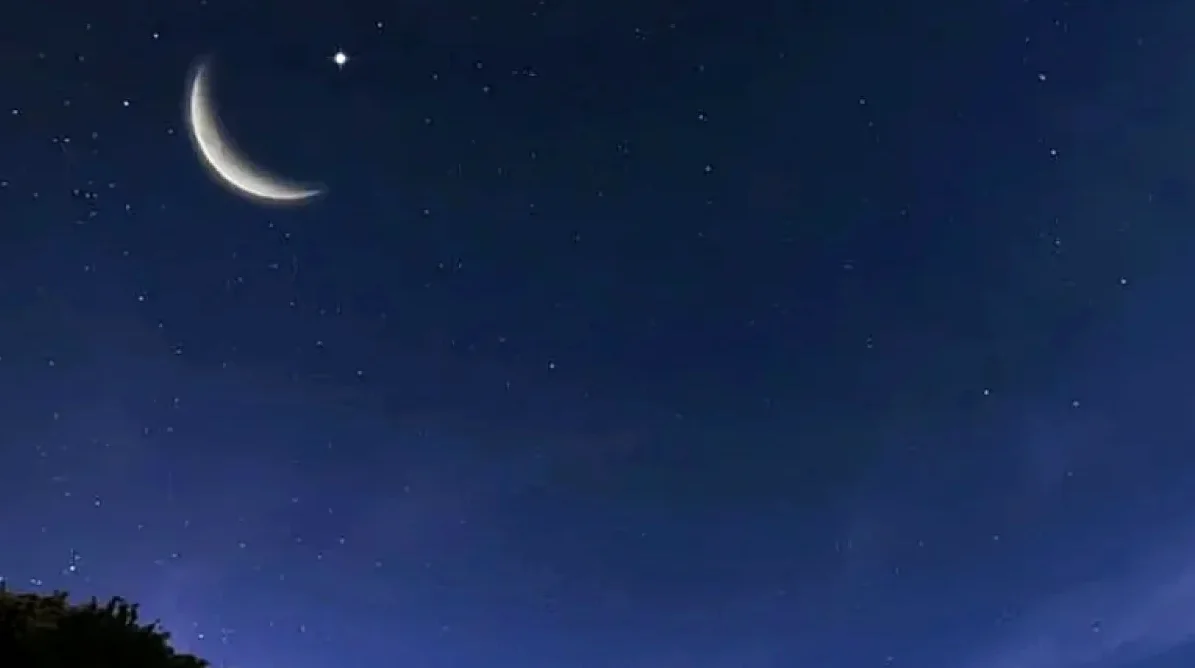
Eid al-Fitr in 2026 is expected to begin on March 20, according to calculations by the Sharjah Astronomical Observatory, which predict the first day of Shawwal will fall on that date in the UAE and most Islamic countries. The observatory’s findings suggest that no visible new moon will be sighted on March 18, the eve of the 29th of Ramadan, which would make March 19 the final day of the holy month and March 20 the first day of Shawwal.
Astronomical Calculations and Visibility Challenges
The Sharjah Astronomical Observatory reported that the moon’s surface conjunction over Sharjah will occur at 4:24 a.m. ET on Thursday, March 19. By sunset that evening, the crescent moon would be approximately 14 hours and six minutes old, positioned about 6.5 degrees from the sun and six degrees above the western horizon. It is expected to linger for roughly 29 minutes after sunset. These conditions, the observatory says, make it unlikely that the crescent will be visible to the naked eye or even through telescopes in the region.
However, the observatory notes that geographic variations may allow some Arab and Muslim nations to spot the crescent either unaided or with the aid of telescopes. In places where local sighting is not feasible, the observatory predicts that Eid al-Fitr will be observed on March 20, while countries that rely solely on local sightings may delay the celebration until March 21.
Government Decrees and Holiday Planning
Governments in the UAE and other Islamic countries will formalize the public calendar once the crescent-sighting window closes. The Cabinet is expected to issue a decree shortly before the holiday to specify the number of official days off for government offices. This will be followed by a decree from the Ministry of Labor to determine the holidays for the private sector.
Astronomical calculations indicate that the first day of Shawwal will fall on Friday, March 20, placing Eid al-Fitr on that date. In one national expectation, the Eid al-Fitr holiday is expected to run from March 20 to March 22, covering three days. Employees across both public and private sectors are awaiting the Cabinet’s official announcement, which is scheduled to be published at the end of Ramadan.
Egypt’s Cabinet and the Ministry of Labor are preparing decrees that tie official public and private holiday schedules to the astronomical outcome. According to Egyptian officials, the first day of Shawwal in the Islamic calendar will be on March 20, 2026, aligning the first day of Eid al-Fitr with that date.
Uncertainty and the Role of Local Sighting
Despite the astronomical predictions, uncertainty remains due to the variability in local sighting conditions. The observatory’s calculations indicate that while the crescent may not be visible in some locations, it may still be observable in others, depending on geography and atmospheric conditions. This could lead to slight variations in the observance of Eid al-Fitr across different regions.
Authorities and citizens are advised to monitor for final local sighting statements and the Cabinet’s decree, which are expected to be released at the end of Ramadan. The Sharjah Academy’s forecast and Egypt’s preparatory decrees set expectations for March 20 celebrations in multiple countries, but the observatory’s technical details leave open the possibility of differing local outcomes where crescent sighting is prioritized.
The precise timing of the moon’s conjunction and the narrow post-sunset visibility window mean that authorities and communities may need to make final decisions based on both astronomical data and local sightings. As the end of Ramadan approaches, the focus will be on confirming the exact date of Eid al-Fitr and ensuring that holiday plans are in place for both public and private sectors.






Comments
No comments yet
Be the first to share your thoughts