

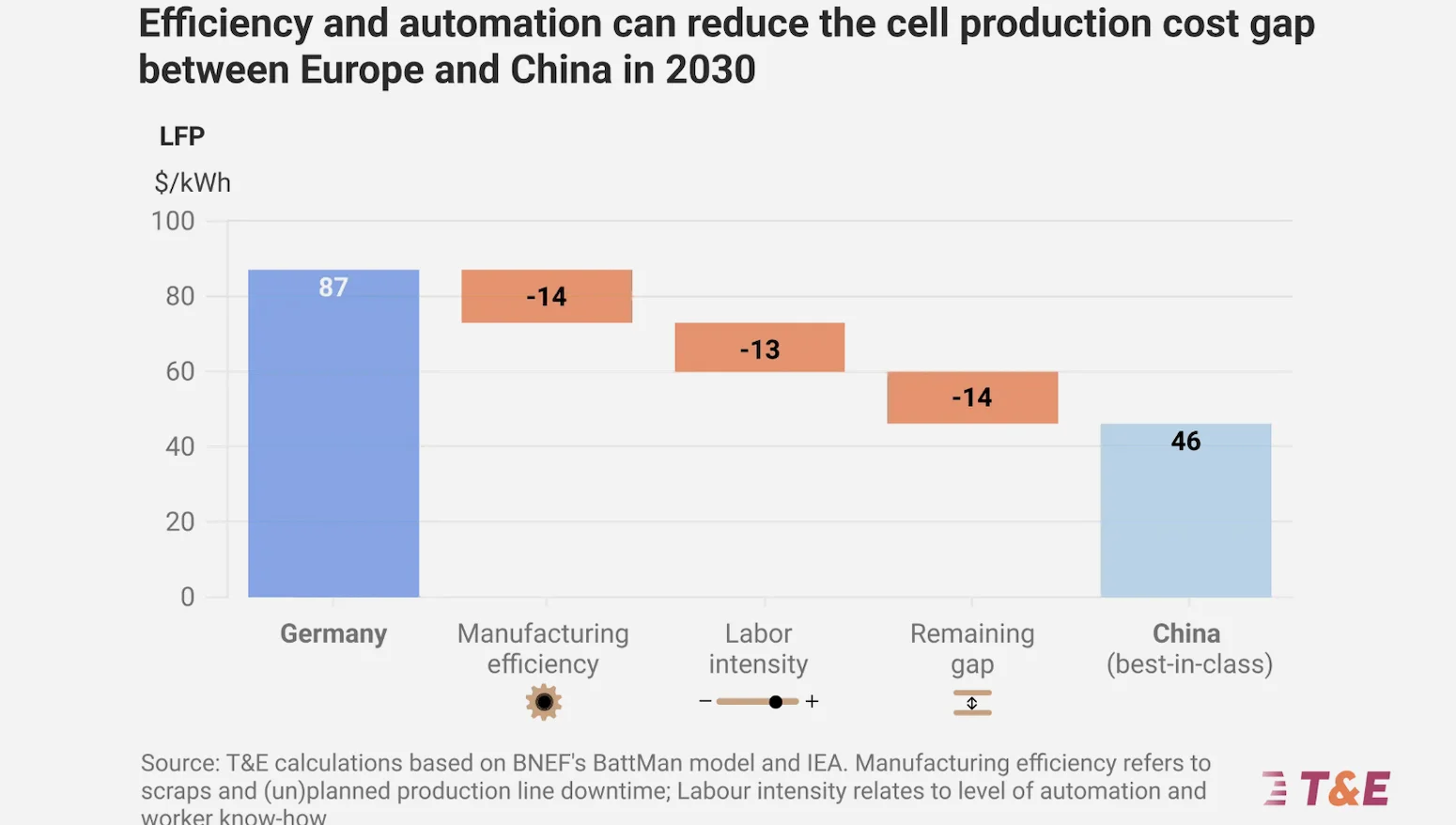
European battery manufacturers are facing a significant cost disadvantage compared to their Chinese counterparts, but a new analysis suggests that with strategic policy support, the gap could narrow dramatically by 2030. The study, published by Transport & Environment (T&E), highlights how scaling up production in the EU could reduce manufacturing costs by nearly a third, significantly improving the competitiveness of local battery producers.
Current Cost Disadvantages
According to the analysis, European battery cells are currently 17% more expensive than those produced in the United States and 90% more expensive than those made in China. This disparity, however, is largely attributed to limited economies of scale in the EU rather than an inherent structural disadvantage. The report states that European battery producers could reduce this cost gap through improved manufacturing efficiency, automation, and labor proficiency.
The analysis also found that battery costs account for 83% to 86% of the total production costs in electric vehicles (EVs), making them the most critical component in determining the final price of an EV. If these costs were to be onshored, they would represent over 90% of the additional cost increase, highlighting the central role of batteries in the EV value chain.
Local Production and Resilience
Despite the current cost challenges, the report emphasizes the importance of local battery production for Europe’s economic security and resilience. Access to batteries, their components, and critical minerals is vital for the continent’s economic stability, especially given the risk of trade weaponization similar to that seen in the rare earths market.
T&E argues that without significant policy support for battery production or trade defense measures, the EU must rely on the Union Content criteria in the Industrial Accelerator Act (IAA) to build a resilient and local battery industry. This would determine whether European battery makers, including companies like ACC, Powerco, and Verkor, can remain competitive in the global market.
Some in the automotive industry have raised concerns that requiring local production could increase battery costs and reduce the competitiveness of EVs. However, the analysis suggests that even with a potential additional cost of €500 per EV by 2030, this could be considered a ‘sovereignty premium’—a necessary investment in geopolitical resilience and supply chain security.
Future Projections and Policy Implications
The report projects that by 2030, the cost of European battery cells could decrease to around $14 per kilowatt-hour (kWh) for both NMC and LFP chemistries, down from $41 to $43 per kWh today. This would represent a significant reduction in the cost gap, assuming consistent Union Content requirements are implemented for batteries. These requirements should be limited to strategic sectors at risk of supply chain weaponization, including upstream components such as precursor materials.
The analysis also highlights that the impact on the final price of an EV may be lessened due to public incentives, such as tax breaks or subsidies. The report states that the cost increase should be considered an insurance policy against geopolitical volatility and supply chain disruptions, rather than a long-term disadvantage.
T&E has called for the implementation of Union Content requirements in public incentive schemes, including existing corporate car taxation, to ensure that local battery production receives the necessary support. The report emphasizes that resilience and security are core tasks for governments, not just industry stakeholders.
According to the analysis, a substantial share of the EV value chain is already local, with 45% to 70% of the value from key components occurring in Europe. This suggests that the EU already has a strong foundation for building a self-sufficient battery industry, provided the right policies are in place to support scaling and innovation.
The report concludes that the future of the European battery industry hinges on the implementation of consistent Union Content requirements and strategic public support. Without these measures, European battery producers may struggle to compete with their global counterparts, despite the long-term benefits of local production for economic security and resilience.






Comments
No comments yet
Be the first to share your thoughts