

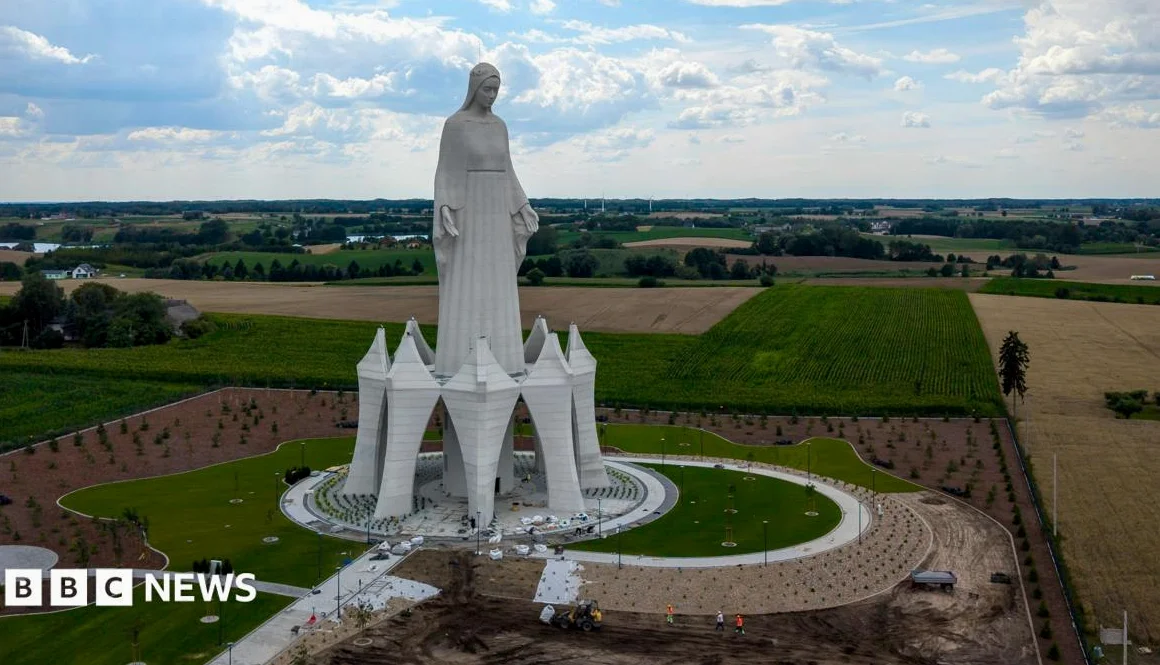
A 55.6-meter statue of the Virgin Mary was officially revealed in the rural Polish village of Konotopie, and the concrete structure, which includes a 15-meter pedestal shaped like a crown, is believed to be the tallest of its kind in Europe. It surpasses the Christ the King statue in Świebodzin, Poland, which stands 52.5 meters tall, and the Christ the Redeemer statue in Rio de Janeiro, which is 38 meters tall including its pedestal. However, the new Polish statue still pales in comparison to a 98-meter Virgin Mary statue in the Philippines.
A Personal and Political Symbol
Lech Wałęsa, the Nobel Peace Prize-winning leader of the Solidarity movement and former Polish president, attended the revealing, though Wałęsa, 82, stated that the statue marked the “end of my path,” linking it to his long-standing advocacy for democracy and Catholic faith. He credited his faith in God with giving him the strength to fight against communism and once famously wore a Black Madonna pin during his activism.
According to theguardian.com, Wałęsa’s association with the Virgin Mary is deeply personal; he began his journey with the Virgin Mary and, as he said, is ending it with her. This symbolism resonates in a country where the Catholic Church played a decisive role in the fall of communism in 1989 and remains a significant cultural force.
Religious Fields and Changing Beliefs
Poland is the birthplace of Pope John Paul II, who served from 1978 until his death in 2005. A large statue of John Paul II was revealed in Częstochowa more than a decade ago, but it is much smaller than the new Virgin Mary monument. According to BBC, the influence of the Catholic Church in public life has declined in recent years, especially among younger generations in urban areas.
Despite this trend, the revealing ceremony in Konotopie was attended by a local bishop, Krzysztof Wętkowski, who consecrated the statue during the Feast of the Assumption of the Blessed Virgin Mary. Wętkowski noted that the statue serves as a reminder to “raise our gaze upwards to God and heaven,” according to Polish news agency PAP.
Private Initiative and Public Impact
The statue was commissioned by a local millionaire couple and constructed in a remote field miles from any major Polish city — During the ceremony, two helicopters dropped rose petals over the statue, which stands with open arms. The remote location and private funding highlight a shift in how large religious monuments are created and funded in Poland, according to BBC.
While the statue may not have the global visibility of the Christ the Redeemer in Rio or the historical weight of the Christ the King in Świebodzin, its revealing in a rural area and by private initiative marks a new chapter in Poland’s religious field. As Wałęsa noted, the statue represents both personal and national history, tying together faith, resistance, and renewal in a country with a deeply Catholic heritage.




Comments
No comments yet
Be the first to share your thoughts