

 BBC
BBC 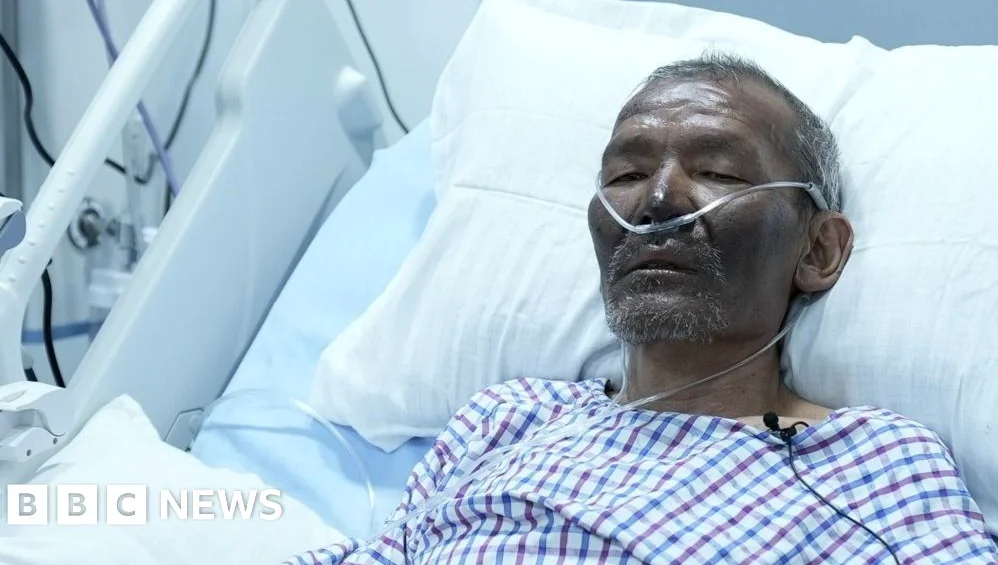
A cleaning team was combing Mount Everest’s perilous upper slopes for rubbish last Thursday, after a busy climbing season, when they spotted a man in a bright blue summit suit crawling at the foot of the Khumbu Icefall, widely regarded as one of the most dangerous sections of the world’s highest peak.
Discovery of the Missing Guide
It was Hillary Dawa Sherpa, a climbing guide who got separated from his clients when descending the mountain six days earlier. He had been presumed dead – yet another life claimed by Everest’s treacherous slopes. By the time the 57-year-old reappeared, his family had already begun funeral rites for him.
Although frostbitten and thoroughly spent, Hillary Dawa could still sit upright and talk to those who found him, before he was airlifted to a hospital in Kathmandu, Nepal’s capital.
Industry Questions and Concerns
News of his miraculous survival made international headlines and sent shockwaves throughout the mountaineering community. However, it also raises troubling questions for the booming high-altitude tourism industry, and shines a spotlight on the deadly risks Sherpas who work on Mount Everest face.
Himalayan Traverse Adventure (HTA), the company that Hillary Dawa was working for, maintains that all its processes in handling the incident were above board, and that poor weather hampered rescue efforts. But many are asking whether the company, known for offering packages below market rates, has done enough to look after their guides.
Hillary Dawa was hired as a camp cook – why then was he leading clients up the 8,849m (29,032ft) mountain? Why was a search launched only three days after he disappeared, and would it have begun sooner if he had been a client and not a guide?
Incident Details and Aftermath
The Sherpa’s family has filed a police report accusing HTA of negligence, and Nepal’s tourism department is investigating the incident. HTA had initially employed Hillary Dawa as a cook to be stationed at Camp 2, but ended up using him as a substitute for a guide who “fell sick at Base Camp”, the company said.
He took up the spontaneous change in assignment because he “wanted to earn some extra money”, HTA manager Angfurba Sherpa tells the BBC. That’s how Hillary Dawa ended up accompanying two clients, British climber Chris Thrall and Polish climber Mariusz Chmielewski on his ill-fated trek up Mount Everest. Also with them was fellow guide Pasang Kaji Sherpa.
On the southern route to Everest there are four camps established above the main Base Camp, which climbers typically use as resting and acclimatisation points. Camp 4, which sits at 7,920m above sea level, is the highest.
The group started their descent from Camp 4 on 29 May, with Pasang Kaji and Chmielewski going first, as Chmielewski was running out of oxygen. Thrall, who followed behind with Hillary Dawa, said the Sherpa had stopped to sit on his backpack just above Camp 3, at around 7,500m, “as he had done hundreds of times before to take a short rest”.
“I turned around and said, ‘Hillary, are you okay brother?'” Thrall recounted in a video on Instagram. “He says, ‘Yes, yes, I’m fine Chris, please go.'” The former British soldier described his dilemma of whether to turn back for Hillary Dawa or catch up with the rest.
“Do I go back for the Sherpa who’s probably going to rock up and be fine as he has done hundreds of times before, or do I help my fellow climber who’s got no oxygen, frostbite in his fingers, and obviously, you’re never far off hypothermia up there?” Responding to allegations that the team had left Hillary Dawa behind to die, Thrall said: “It’s really different on Everest, folks. I had one tank of oxygen that’s half empty [by then]. To try to get back up… would have taken pretty much all of my oxygen. I’m not trying to offload my responsibility. I’m just saying you’ve got to be real.”
In a subsequent interview with BBC Newshour, Thrall said he decided to “turn to the weakest member of the trio”, referring to Chmielewski, with whom he shared his dwindling supply of oxygen as they continued down the mountain amid a severe snowstorm. The conditions were so bad that Thrall and Chmielewski both recorded farewell messages for their loved ones, thinking they may not make it back alive.






Comments
No comments yet
Be the first to share your thoughts