

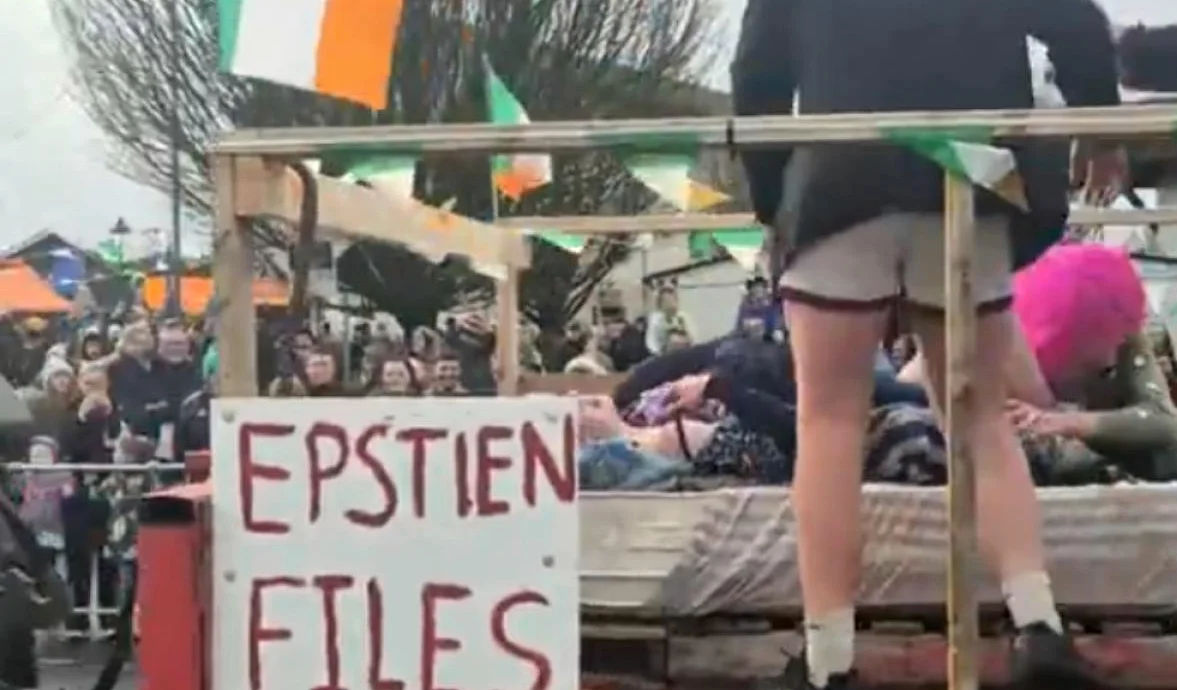
Fathers of teenage boys who took part in two St Patrick’s Day parades featuring floats referencing Jeffrey Epstein have defended their sons, insisting the displays were not intended to be offensive and that no one was harmed. The floats, which appeared in parades across counties Mayo and Galway, depicted a person wearing a wig on a mattress being wrestled down by others, and another showing figures impersonating Stephen Hawking, Donald Trump, and Sean ‘Diddy’ Combs on a ‘Fishing Trip with the Lads’ at Epstein Island.
Controversial Floats Spark Debate
The first float, which included a man wearing a wig on a mattress being wrestled by others, drew immediate criticism from the public and media. The Irish Independent reported that the float was part of a parade in Ballinrobe, where it was later removed after organizers apologized for not being aware of its content in advance. The second float, which featured impersonations of notable figures on Epstein Island, was also met with backlash, though some fathers claimed it was less controversial than the first.
The floats were featured in four St Patrick’s Day parades across the West of Ireland, including Ballinrobe, Clifden, and Galway. The organizers of the Ballinrobe parade, one of the locations where the floats appeared, issued an apology and stated that they had not been informed of the content beforehand. As a result, a planned second lap of the town was canceled.
One father of a teenager involved in the first float claimed that the display had been blown out of proportion and that his son had no malicious intent. He told the Irish Independent, ‘That’s what happens in parades. Whatever is on the news, you highlight it, and that is what happened. Nobody was hurt.’ He added that he believed the boys should not be demonized and that those who commit actual crimes against women should be the ones facing consequences.
Defense of Teenagers’ Intentions
The father of one of the boys in the second float, which depicted the ‘Fishing Trip with the Lads’ on Epstein Island, acknowledged that the floats were inappropriate but emphasized that the teenagers had not intended to cause harm. He stated, ‘They had done it as pure fun and they just didn’t have enough cop-on to realize it would offend people. They are too young and innocent to realize they did harm.’ He added that he found it sad that the boys were not in jail for their actions, as he believed they were not malicious.
He also praised the teenagers, saying they were ‘too young and innocent to realize they did harm’ and that they ‘don’t cause trouble.’ He noted that young people today face challenges and that the boys ‘meant no harm.’ He emphasized that the floats were a form of expression, even if they were not well-received by everyone.
Another father, who was not directly involved in the floats but supported the teenagers, expressed concern about the public reaction. He said, ‘The young lads had their float in relation to that island, but it wasn’t the controversial float. They did not go out to hurt anyone.’ He added that the teenagers were not malicious and that they had not intended to cause harm.
Public and Institutional Response
The controversy surrounding the floats has sparked a broader discussion about the role of parades and public events in addressing sensitive topics. Some community members have called for greater oversight of parade floats, while others have argued that such displays are a form of free expression that should not be censored.
The organizers of the Ballinrobe parade, who apologized for not being aware of the content in advance, stated that they had taken steps to ensure that such incidents do not happen again in the future. They added that the floats were removed from the parade after they were viewed by officials and that the organizers were not informed of the content beforehand.
The Irish Independent reported that the floats had been the subject of public debate and that some community leaders had expressed concern about the potential for such displays to cause offense. However, others argued that the teenagers should not be singled out for their actions and that the focus should be on those who have committed actual crimes against women.
The controversy has also raised questions about the responsibility of parade organizers to vet the content of floats before they are displayed. Some have called for greater transparency and accountability, while others have argued that such displays are part of the cultural fabric of parades and should be allowed to proceed as long as they do not cause harm.
The fathers of the teenagers involved in the floats have continued to defend their sons, emphasizing that the displays were not meant to be offensive and that no one was harmed. They have called for the public to be more understanding of the intentions of young people and to focus on those who have committed actual crimes against women.
As the debate continues, it remains to be seen whether the incident will lead to changes in the way parade floats are handled in the future. For now, the fathers of the teenagers involved in the floats remain steadfast in their defense of their sons, insisting that the displays were not meant to cause harm and that ‘nobody was hurt.’






Comments
No comments yet
Be the first to share your thoughts