

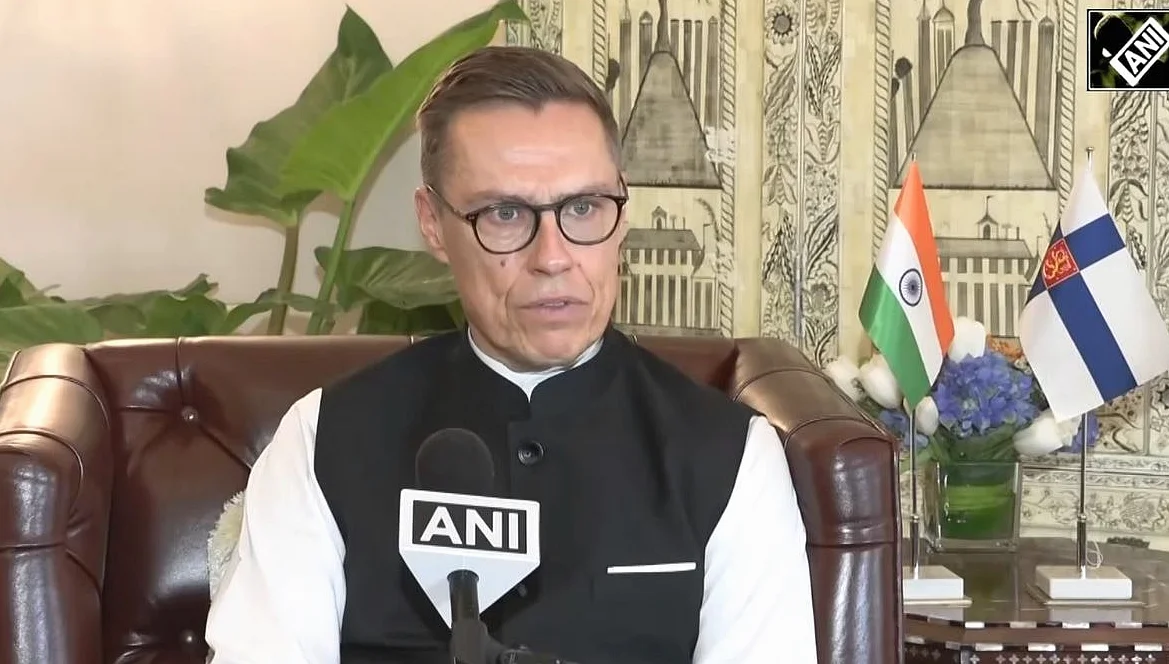
Finland’s President Alexander Stubb has raised alarms about the potential economic consequences of the ongoing conflict involving Iran, the United States, and Israel, suggesting it could have a more significant global impact than the Russia-Ukraine war. Speaking at the Finland-India Business Summit on Saturday, Stubb emphasized the growing tensions and the complex nature of the situation in the Middle East.
Escalating Conflict Raises Global Economic Concerns
Stubb noted that the current conflict is escalating at a rate that he described as ‘very uncomfortable.’ He stated that the economic implications of the Iran war have not yet been fully understood, but they could potentially exceed those of the Russia-Ukraine war, which has already caused significant global economic disruption.
Addressing the summit, Stubb reflected on the strategic decisions made by former U.S. President Donald Trump in Iran, highlighting how the situation has proven to be more complex than initially anticipated. He mentioned the killing of Ayatollah Khamenei, a key religious figure in Iran, and suggested that this act will have a profound impact on the region.
Trump’s Iran Strategy More Complicated Than Expected
When asked if the Iran conflict would distract Trump from efforts to resolve the Russia-Ukraine war, Stubb said Trump felt ’empowered’ after his actions in Venezuela but found the Iran situation to be far more complex. He pointed out that while Trump has taken a significant step by targeting Khamenei, the consequences of this action are still unfolding.
Stubb also highlighted the human cost of war, noting that the Russia-Ukraine conflict has already resulted in over a million dead or wounded. He suggested that the toll of the Iran conflict may be even greater, though he emphasized that the value of human life cannot be measured in economic terms.
Concerns Over Instability and Global Security
Stubb expressed concerns about the instability in Iran, warning that an unstable Iran could make the world a more dangerous place. He noted that the current geopolitical landscape makes it difficult to achieve lasting peace, as diplomacy is often viewed as a transactional process rather than a mutual benefit.
He expressed skepticism about the possibility of a ceasefire in Iran in the near future, suggesting that the situation could lead to anarchy and further unrest. This, he said, is one of the scenarios that global leaders are currently considering.
Finland Seeks Stronger Trade Ties with India
During his four-day visit to India, Stubb highlighted Finland’s interest in strengthening trade relations with the country. Accompanied by a delegation of ministers, senior officials, and business leaders, he brought along approximately 20 Finnish companies from various sectors, aiming to double bilateral trade.
Stubb emphasized the importance of the Free Trade Agreement (FTA) between Europe and India, noting that Finland is focusing on areas such as network systems, quantum computing, space and satellite technology, circular economy, and food products. He stressed that these sectors represent key opportunities for collaboration between the two nations.
Global South to Shape the Next World Order
Earlier in the day, Stubb interacted with students at the University of Mumbai, discussing the dynamics of global power. He spoke about the ‘triangle of power’—comprising the Global West, the Global East, and the Global South—and suggested that the Global South will play a crucial role in shaping the next world order.
Stubb noted that the Global South is not a geographic alliance but a historical one, encompassing 125 countries many of which were formerly non-aligned states or developing nations. He argued that these countries, which often felt excluded from the liberal order, will be instrumental in determining the future global landscape.
As tensions in the Middle East continue to rise, the economic and geopolitical implications of the Iran conflict are becoming increasingly clear. With Finland’s leadership advocating for vigilance and strategic cooperation, the world is watching closely to see how these developments will unfold.






Comments
No comments yet
Be the first to share your thoughts