

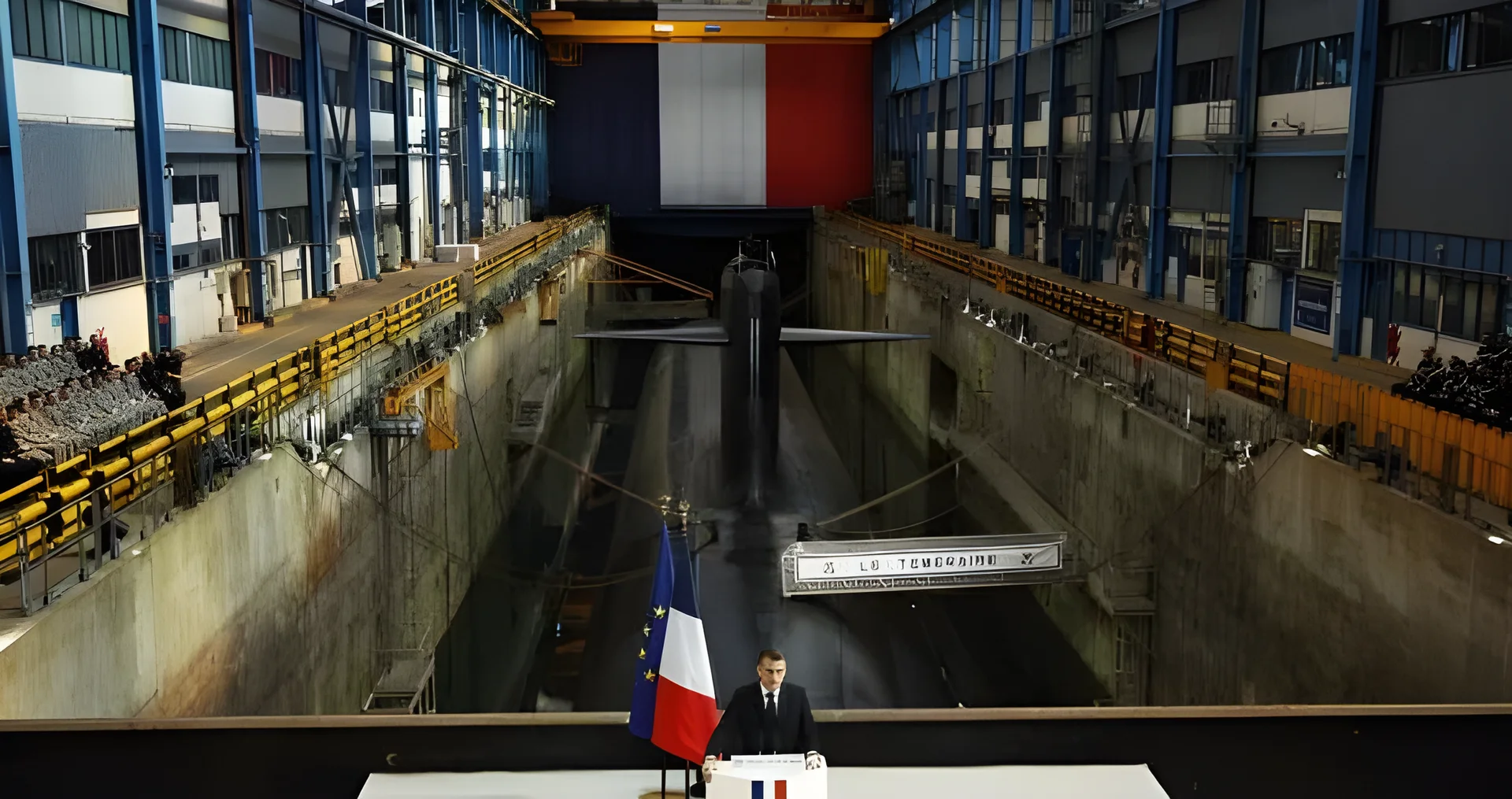
President Emmanuel Macron has announced a significant shift in France’s nuclear posture, pledging to increase the size of its nuclear arsenal and introduce a new ‘advanced deterrence’ doctrine involving European partners. The move, made during a speech at the Île Longue naval base near Brest, was framed as a response to an increasingly unstable global strategic environment.
France’s Nuclear Modernization Plan
Macron emphasized that the next 50 years will be an era defined by nuclear weapons, according to a report from Mercopress. He stated that France will raise the number of nuclear warheads, which are currently estimated at under 300 based on publicly available data, though he did not provide a new figure.
The French president also revealed plans for a new nuclear-armed submarine, ‘The Invincible,’ which is scheduled to enter service in 2036. This submarine is part of a broader modernization effort aimed at upgrading France’s nuclear deterrent capabilities.
European Partners in Advanced Deterrence
At the heart of the new doctrine is the inclusion of eight European countries in an ‘advanced deterrence’ strategy. These nations—United Kingdom, Germany, Poland, Netherlands, Belgium, Greece, Sweden, and Denmark—have agreed to participate in a range of activities, including exercises linked to France’s air-launched nuclear forces.
Partners could also host bases or infrastructure where French nuclear bombers might be stationed under unspecified circumstances. Macron argued that this would allow strategic assets to be spread across Europe, making it more difficult for potential adversaries to calculate their options.
Despite this increased collaboration, Macron stressed that the decision to use nuclear weapons would remain solely with the French president. No explicit guarantees would be extended to partners, maintaining the deliberate ambiguity typical of nuclear deterrence strategies.
International Reactions and Collaborative Efforts
Following Macron’s speech, Poland confirmed discussions with France and its close allies on the program. Prime Minister Donald Tusk stated, ‘We are arming up together with our friends so that our enemies will never dare to attack us.’
Paris and Berlin also issued a joint declaration outlining concrete steps to be taken in 2026, including German conventional participation in French nuclear exercises, joint visits to strategic sites, and cooperation on early warning systems, air defense, and deep precision strike capabilities.
The two governments clarified that this initiative would ‘complement, not replace,’ NATO’s existing nuclear deterrence framework. This collaboration marks a significant step in aligning European nations more closely on defense and security matters.
France’s decision to boost its nuclear arsenal and expand its deterrence strategy comes amid rising geopolitical tensions and a growing concern over the stability of the global security landscape. The move is expected to have far-reaching implications for European defense policy and international relations.


Comments
No comments yet
Be the first to share your thoughts