

 BBC
BBC 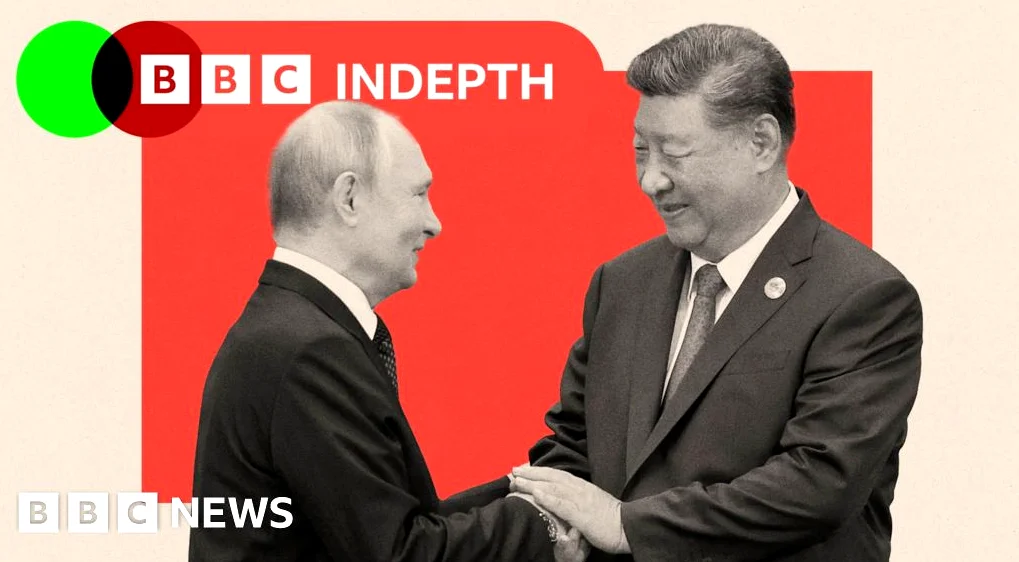
During a stroll through Tiananmen Square in Beijing last September, Chinese President Xi Jinping and Russian President Vladimir Putin appeared to discuss the potential for organ transplants to extend human life. Putin’s interpreter was heard saying, ‘Human organs can be continuously transplanted. The longer you live. The younger you become, and even achieve immortality.’ Xi’s interpreter responded by noting that some predict humans may live up to 150 years old this century. This conversation highlighted the personal bond between the two leaders, who together have held power for 39 years and show no signs of stepping down.
Uneven Partnership
According to Alexander Gabuev, director of the Carnegie Russia Eurasia Center think tank, the relationship between China and Russia is highly uneven, with China often dictating the terms. ‘Russia is fully in China’s pocket, and China can dictate the terms,’ he said. China is Russia’s largest trading partner, while Russia accounts for just 4% of China’s international trade. China’s economy is significantly larger than Russia’s, and it exports more than any other country to Russia.
Years of Western sanctions have pushed Moscow deeper into trade with Beijing. Tech giant Huawei, which was sanctioned by the U.S. and excluded from UK 5G networks, has become a key player in Russia’s telecommunications industry. Since Russia’s invasion of Ukraine in 2022, Moscow has become increasingly dependent on Chinese components for its war efforts. A recent Bloomberg report found that Russia was importing more than 90% of its sanctioned technology from China, a 10% increase from the previous year.
Strategic Interests
Russia is aware of the risks of this imbalance and does not want to be a vassal state. In a recent commentary, Dmitry Trenin, president of the Russian International Affairs Council think tank, emphasized the importance of maintaining an equal footing in their relationship. ‘Russia is a great power which cannot be a junior partner,’ he stated. Moscow has few viable alternatives to Beijing, as China offers a scale of demand and market serious to Russia’s survival.
Despite the imbalance, Moscow has a buffer against being pushed around by Beijing. Marcin Kaczmarski, a lecturer in security studies at the University of Glasgow, noted that China is aware of the asymmetry and is unwilling to provoke backlash within Russia or among its elites. ‘China is not pushing Russia around,’ he said. This is partly due to the fact that Russia, while a junior partner, is also a proud one.
Energy and Strategic Flexibility
Russia’s vast energy resources are strategically important to China. At a press conference in May, Putin mentioned that the two sides were close to taking a ‘highly significant step forward in oil and gas cooperation.’ This could refer to the Power of Siberia 2 pipeline, for which Russian gas giant Gazprom and the China National Petroleum Corporation reportedly signed a preliminary deal. If built, the pipeline would deliver 50 billion cubic metres of Russian gas to China via Mongolia.
As the crisis continues in the Strait of Hormuz, China’s investment in Russian energy appears to be paying dividends. This partnership is not a formal alliance, but a flexible strategic partnership that has endured despite repeated predictions of its collapse. Bobo Lo, former deputy head of mission at the Australian Embassy in Moscow, emphasized that the strategic flexibility of the partnership gives it resilience. ‘It is not an alliance, but a flexible strategic partnership,’ he said.
Western analysts have tended to portray the China-Russia partnership in one of two ways: either as an ‘axis of authoritarianism’ united by their desire to defeat the West, or as a brittle brotherhood on the verge of collapse. Neither fully captures the integral and increasingly difficult to replace relationship between two neighboring countries who, despite their asymmetries and differences, share vital interests.




Comments
No comments yet
Be the first to share your thoughts