

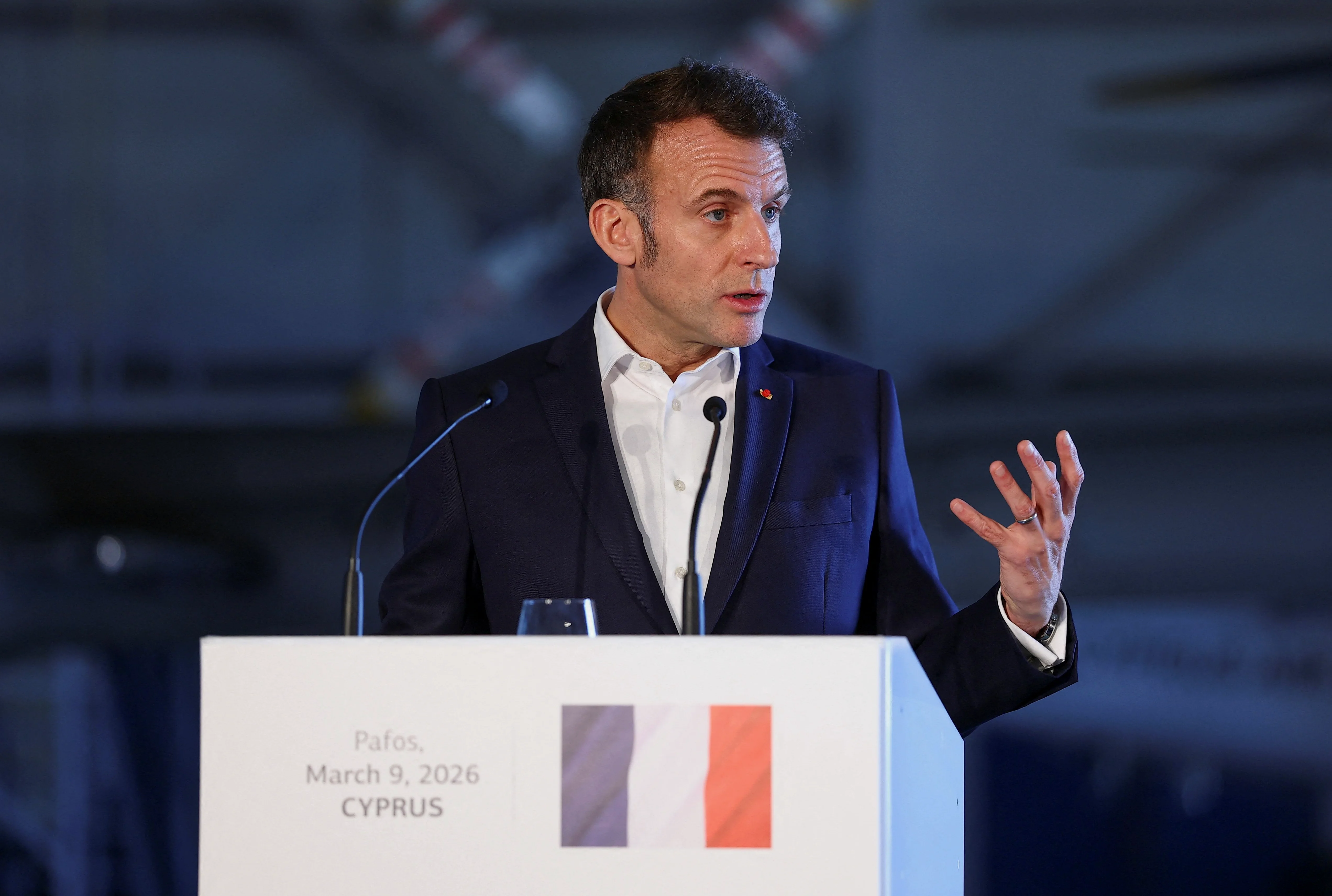
France is deploying nearly a dozen warships, including its aircraft carrier strike group, to the Mediterranean, Red Sea, and potentially the Strait of Hormuz, as part of a defensive mission to support allies affected by the Middle East conflict, President Emmanuel Macron said during a visit to Cyprus.
Defensive Measures in Response to Regional Tensions
Macron made the comments after meeting with Cypriot President Nikos Christodoulides and Greek Prime Minister Kyriakos Mitsotakis in Paphos, where the Charles de Gaulle aircraft carrier had arrived in the eastern Mediterranean this weekend. The move follows the interception of drones heading toward Cyprus last week, prompting concerns over regional security.
“When Cyprus is attacked, then Europe is attacked,” Macron said, emphasizing the broader implications of the situation. The president stressed that France’s mission is strictly defensive and aims to support countries under threat from Iran’s retaliatory actions, while ensuring freedom of navigation and maritime security.
Regional Impact and Rising Oil Prices
The escalating conflict between the United States, Israel, and Iran has significantly impacted shipping lanes in the Middle East, with oil prices surging above $100 a barrel. European powers, including France, are now grappling with how to defend their interests and maintain regional stability amid the crisis.
“Our objective is to maintain a strictly defensive stance, standing alongside all countries attacked by Iran in its retaliation, to ensure our credibility, and to contribute to regional de-escalation,” Macron said during the meeting.
The European Union’s main naval operation in the region, known as Aspides (Shields in Greek), was launched in early 2024 to protect vessels from attacks by Iranian-aligned Houthi militants. The mission has been a focal point of European military efforts to secure shipping routes in the Red Sea.
European Solidarity and Strategic Deployment
Greek Prime Minister Kyriakos Mitsotakis expressed support for reinforcing the Aspides operation with additional vessels. “There are few of us who are participating, but here too we will need to demonstrate our European solidarity more practically,” he said.
France, which already contributes one warship to the Aspides mission, plans to deploy a total of two vessels to that operation. In addition, the country will deploy eight warships, including the aircraft carrier strike group and two helicopter carriers, to the region.
Macron said that the deployment could ultimately extend to the Strait of Hormuz, where commercial vessels are at risk. “We are in the process of setting up a purely defensive, purely escort mission, which must be prepared together with both European and non-European states,” he said.
The mission, he added, aims to enable the gradual reopening of the Strait of Hormuz after the most intense phase of the conflict has passed. However, Macron did not provide a specific timeline for when this might occur.
The move signals a growing European commitment to counter the destabilizing effects of the Middle East conflict, which has drawn in Gulf Arab states and Lebanon, with Iran-backed Hezbollah launching attacks on Israel.
France’s deployment of nearly a dozen warships highlights its strategic role in maintaining regional stability and ensuring the safety of international shipping routes. The mission is expected to involve coordination with other European and non-European allies to achieve its objectives.




Comments
No comments yet
Be the first to share your thoughts