

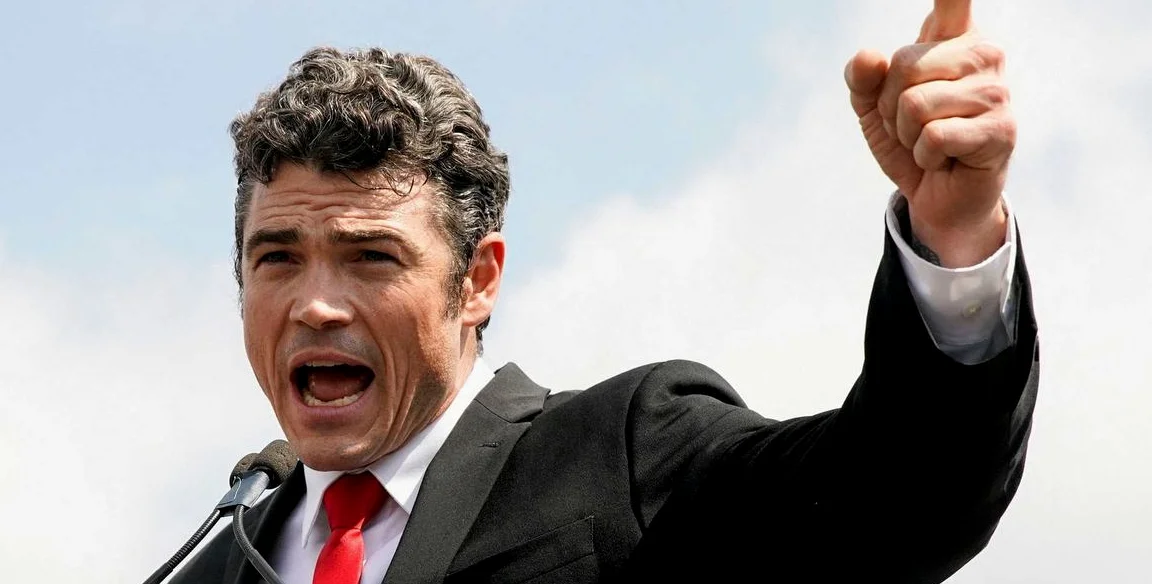
Joe Kent, a former top counterterrorism official who resigned in protest over U.S. involvement in the Iran war, has become an unexpected focal point of a growing rift within the Republican Party. Initially dismissed by the Trump administration and Republican establishment as a minor issue, Kent’s exit has sparked a wave of support from anti-war figures and conservative media, raising concerns that the GOP’s traditional unity is beginning to fracture.
Impact on Party Unity
Within 36 hours of Kent’s resignation, he was invited onto the podcast of former Fox News host Tucker Carlson, a prominent voice in the MAGA movement. Shortly after, Candace Owens, a well-known conservative commentator, hosted a high-profile event featuring Kent at the Trump Hotel. These actions signaled a broader shift in the narrative surrounding Kent’s departure, transforming it from a routine resignation into a potential party-splitting crisis.
According to Politico, the Republican establishment faces a “clear risk in dismissing Kent.” The White House has attempted to downplay his influence, with spokesperson Davis Ingle calling his appearances “nothing more than podcast chatter from an online fringe with no real electoral punch.” Ingle further described Kent’s concerns as “self-aggrandizing” and “riddled with lies.”
However, recent polling data shows a significant shift in GOP sentiment. Support for the Iran strikes has fallen to 70 percent among Trump’s own voters, and 81 percent of self-described MAGA Republicans. This indicates that the growing anti-war sentiment among key segments of the party may not be as negligible as the White House claims.
Analysts Warn of Waning Influence
Tim Chapman, president of Advancing American Freedom, an organization founded by former Vice President Mike Pence, warned that the influence of the “neo-isolationist, restrainer wing” of the Republican Party is waning. He noted that “the influence of the kind of neo-isolationist, restrainer wing of a party is waning as real life hits them over the head with a frying pan.”
Chapman argued that the White House is struggling to balance its online presence with the realities of the real world. He stated, “It’s not a tenable position anymore in the White House, because the White House is dealing with the real world — and they’re dealing with their online world that they want to be real, but it just isn’t the reality.”
Conservative editor Curt Mills echoed these concerns, warning that if the GOP dismisses the significance of Kent’s actions, it could undermine the party’s core identity. He stated, “If you concede that this was what differentiated Trump from, say, Mitt Romney, electorally, if you believe any of that crap, then the idea that none of these people’s opinions matter now, I think, is kind of silly.”
What’s Next for the GOP
Politico has warned that the growing divide over Kent’s stance could “upend the fragile coalition” that Republicans have to maintain ahead of the midterms. With the 2022 midterms approaching, the party faces a critical juncture in which it must either address these internal divisions or risk losing key voter segments.
Analysts suggest that the GOP’s traditional base, which has been a reliable source of support for the party, may be shifting in response to the growing anti-war sentiment. This shift could have significant implications for the party’s strategy moving forward, particularly in states where the MAGA movement holds considerable influence.
The situation highlights the challenges the Republican Party faces in maintaining a cohesive message while balancing the demands of its various factions. As Kent’s influence continues to grow, it remains to be seen whether the GOP will address these concerns or continue to dismiss them as insignificant.
With the midterms approaching and the internal divisions within the party becoming more pronounced, the next few months will be crucial in determining whether the GOP can maintain its unity or face a potential realignment of its core base.






Comments
No comments yet
Be the first to share your thoughts