

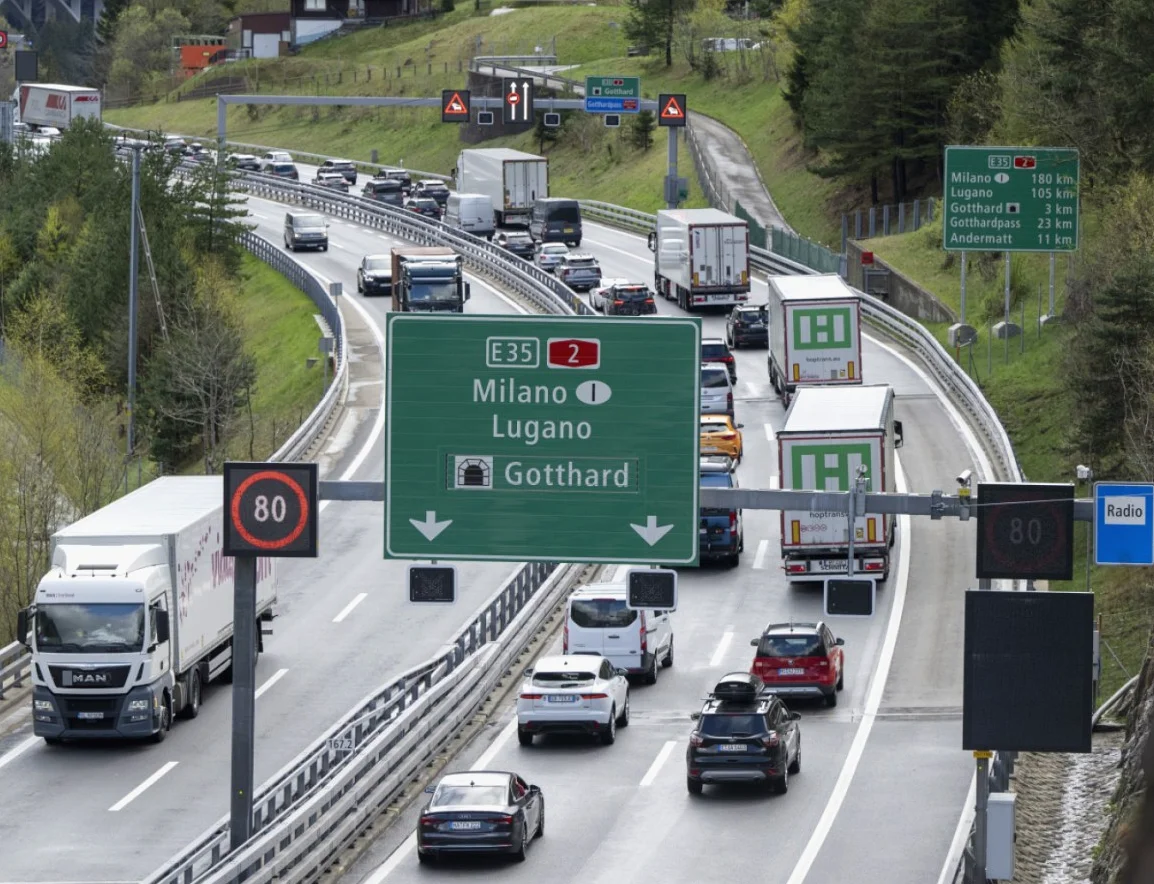
Switzerland is preparing for a surge in traffic during the Easter holiday, with the Federal Roads Office (FEDRO) warning that several major routes will experience heavy congestion. According to a press release issued on Wednesday, the Gotthard (A2) and San Bernardino (A13) motorways are expected to be particularly busy starting from Friday, March 27. In addition, the central Plateau region and roads leading to popular tourist areas are also projected to see a significant increase in traffic volume.
Motorway Congestion and Travel Warnings
FEDRO has identified specific areas within French-speaking Switzerland that are likely to face the most severe traffic challenges. The A12 motorway, which connects Châtel-Saint-Denis to Vevey, and the A9 route between Vevey and Valais, are expected to be heavily used. These routes are popular among holidaymakers traveling to Lake Geneva and the Alpine regions, which are traditional Easter destinations in the country.
Motorists are advised to plan their journeys carefully, with FEDRO urging drivers to stick to main roads rather than local roads to prevent additional congestion. The agency noted that return journeys will be particularly heavy from Easter Sunday (April 5) and throughout the following week, as many travelers will be heading back to their homes after their holiday.
Infrastructure Adjustments and Rail Services
Despite the expected motorway congestion, some infrastructure adjustments are being made to ease the burden on the road network. On the Simplon Pass route, work at Casermetta will be suspended over the Easter period, allowing for a more normal flow of traffic on that stretch of road. This decision comes as part of broader efforts to manage the high volume of vehicles expected on Swiss roads during the holiday.
The Swiss Federal Railways (SBB) has also announced plans to increase train services to help alleviate pressure on the Gotthard route. The company will deploy an additional 27 trains, providing over 70,000 seats, to transport passengers to the canton of Ticino. This is a significant move, as the Gotthard route is one of the busiest in the country, connecting northern and southern Switzerland and often experiencing heavy congestion during peak travel periods.
However, the increase in rail services comes with its own set of challenges. On departure days, delays are expected at several key stations, including Lötschberg in Kandersteg (Bern), Furka in Realp (Uri), and Vereina in Klosters (Graubünden), between 8 a.m. and 4 p.m. On the return journey, similar delays are anticipated at different stations, with hold-ups expected between 11 a.m. and 6 p.m. at Goppenstein (Valais), Oberwald (Valais), and Lavin-Sagliains (Graubünden).
Why Cars Remain Dominant in Switzerland
Despite Switzerland’s reputation as a rail-nation, the continued dominance of cars on the roads during peak travel periods highlights the challenges faced by the country’s transportation infrastructure. While the SBB has made significant efforts to improve rail connectivity, the sheer volume of traffic during holidays often outpaces the capacity of the rail network, leading to the need for increased road usage.
According to a recent report by the Swiss Federal Office of Transport, more than 70% of Swiss households own at least one car, and the reliance on private vehicles remains high, particularly in rural and mountainous regions where public transport options are limited. This trend is exacerbated during holidays when families often choose to travel by car to avoid the unpredictability of rail schedules and the potential for delays.
“Even though we have a well-developed rail network, the demand during holidays is so high that it can’t be fully met by the existing infrastructure,” said a spokesperson for the SBB. “That’s why we are increasing services, but we also encourage travelers to consider alternative routes and times to help manage the load on the system.”
The Easter holiday traffic is not an isolated event. Similar congestion has been reported during other major holidays, such as Christmas and New Year’s. In 2022, for example, the Gotthard motorway experienced severe delays, with some drivers facing hours of waiting due to traffic jams. This highlights the need for continued investment in both road and rail infrastructure to accommodate the growing number of travelers during peak periods.
Looking ahead, FEDRO and the SBB are expected to monitor the situation closely and make additional adjustments if necessary. The Easter holiday will provide valuable data on traffic patterns and the effectiveness of the current measures in place. This information will be crucial in planning for future holidays and ensuring that the transportation network can handle the increasing demand without compromising safety or efficiency.
As the Easter period approaches, travelers are being urged to plan their journeys in advance, consider alternative routes, and be prepared for potential delays. Whether by car or train, the goal is to ensure that the holiday travel experience is as smooth and efficient as possible for all Swiss residents and visitors.






Comments
No comments yet
Be the first to share your thoughts