

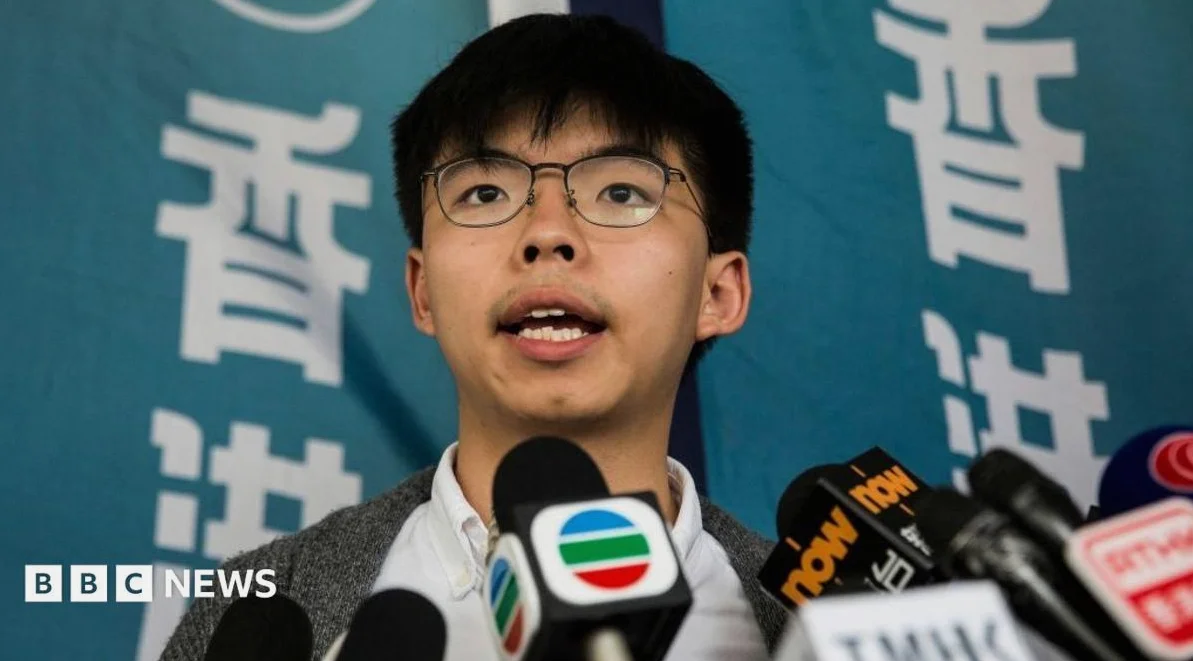
Wong rose to prominence as a teenage activist in 2012 when he co-founded the pro-democracy group Scholarism and led protests against mandatory “patriotic education” in schools. He became a key figure in the 2014 Umbrella Movement, which sought greater democratic rights. In 2016, he co-founded the now-dissolved political party Demosisto, which advocated for self-determination in Hong Kong.
The national security law was imposed by Beijing in 2020 in response to the 2019 anti-government protests. It criminalizes secession, subversion, terrorism, and collusion with foreign forces. Wong was arrested in 2020 and sentenced in November 2024 to four years and eight months for his role in an unofficial primary election. He had been expected to be released in January 2027 before receiving the latest sentence.
Prosecutors alleged that Wong conspired with fellow activist Nathan Law to lobby foreign governments for sanctions and blockades against China between July and November 2020. Wong pleaded guilty to the charge in September 2025. Judge Tam said Wong had visited the U.S. to seek foreign interference and continued to share posts by Law calling for sanctions after the national security law was enacted.
Wong’s friend and fellow activist Frances Hui, now in the U.S., said the sentencing is part of a broader political crackdown aimed at erasing the contributions of a generation of Hong Kong activists. Human Rights Watch’s Asia director Elaine Pearson described the ruling as “cruel and unjust,” noting the tactic of stacking charges to suppress dissent. Amnesty International’s deputy regional director, Sarah Brooks, said the sentence shows how the law is being used to punish dissent rather than protect national security.
A heavy police presence was reported outside the Hong Kong High Court, where dozens of supporters had queued for hours to witness the sentencing. Wong looked calm and thanked his supporters before leaving the court. A former member of Scholarism, Tiffany Chin, was seen in tears. Public sentiment was mixed, with some expressing admiration for Wong’s activism and others supporting the government’s actions to maintain stability.
Critics argue that the national security law has effectively silenced dissent and dismantled Hong Kong’s once-thriving civil society. Eric Lai, a research fellow at the Georgetown Center for Asian Law, said the law can be “repeatedly weaponized” to keep activists in prison. The harshest sentence under the law so far was given to former media tycoon Jimmy Lai, who received 20 years for similar charges.
The Hong Kong government maintains that the national security law is necessary for stability and that its enforcement is evidence-based. It views Wong as an anti-China figure supporting Hong Kong independence, a stance that crosses its red line. International diplomats were present at the court hearing, and the U.S. and other Western countries have criticized the law as a tool of repression.


Comments
No comments yet
Be the first to share your thoughts