

 Associated Press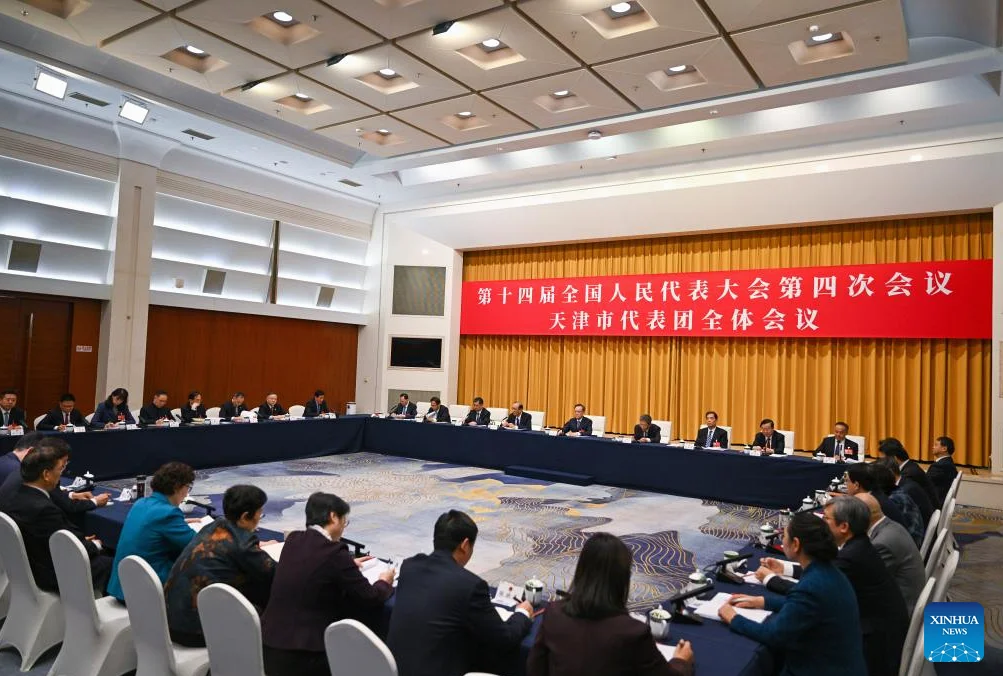
China’s Hubei delegation to the Fourth Session of the 14th National People’s Congress held its third plenary meeting and media open day in Beijing on March 7, where the draft plan for the ’15th Five-Year Plan’ was reviewed and made fully accessible to both Chinese and foreign media throughout the session. The event highlighted Hubei’s strategic priorities for the next five years, including technological innovation, environmental protection, and regional development.
Review of the Draft Plan
The session was presided over by Wang Zhonglin, secretary of the provincial party committee, director of the Standing Committee of the Provincial People’s Congress, and head of the delegation. Senior officials, including Li Zhaoxun, deputy secretary of the provincial party committee and governor, attended the meeting. The gathering also included officials from key national institutions such as the General Administration of Customs, the State Council’s General Office, the National Development and Reform Commission, and the Ministry of Finance, who listened to the delegation’s opinions.
Representatives such as Chen Ping, Hu Lishan, Yu Zheng, Song Baoliang, Li Junjie, Huang Yan, Yang Jun, Wang Yanxin, Sun Daojun, and Ma Chunshan expressed strong support for the draft framework of the 15th Five-Year Plan. They emphasized the need to accelerate Wuhan’s development as a nationally influential science, technology, and innovation center.
Several policy suggestions were made, including supporting the high-quality development of the Dabie Mountains Major Base Area, establishing a central hub node for a nationwide integrated computing network in Hubei Province, supporting a national-level smart environmental protection industry cluster, and promoting the construction of major projects for ‘iron-water-road-air’ multimodal transportation.
Focus Areas and Development Priorities
Following the review, Chinese and foreign journalists participated in focused interviews on key issues of interest and concern. Representatives Wang Zhonglin, Li Sanxun, Ma Xinqiang, Wang Jianqing, Xu Weilin, Wang Jun, Min Hongyan, Huang Li, and Xia Xiran discussed topics such as promoting the construction of the fulcrum, improving the modern urban system, and accelerating the development of the ‘World Vision Valley.’
Other discussions included breakthroughs in Dongfeng Automobile’s transformation, the promotion of the textile industry’s transformation and upgrading, high-level protection of the Yangtze River, implementing the concept of ‘two mountains’ to promote rural revitalization, developing the industry of humanoid robotics, and building a world-renowned cultural and tourism destination.
The session attracted representatives from 87 Chinese and foreign media outlets, including People’s Daily, Xinhua News Agency, China Central Television, Guangming Daily, Economic Daily, China Daily, Science and Technology Daily, China News Service, Workers’ Daily, The Paper, Dahun News, Cover News, Phoenix Television, South China Morning Post, Hong Kong Economic Bulletin, Macau Monthly, Real Brazil, Reuters, RIA Novosti, and APP.
Implications for Regional and National Development
The draft ’15th Five-Year Plan’ is expected to shape China’s economic and technological strategies for the coming years. Hubei’s focus on innovation and infrastructure development aligns with national goals to boost technological self-reliance and sustainable growth. The plan’s emphasis on environmental protection and rural revitalization reflects broader policy trends aimed at balancing economic development with ecological preservation.
Experts suggest that the plan’s implementation will have significant implications for Hubei’s role in China’s economic landscape, particularly in the development of Wuhan as a regional innovation hub. The inclusion of smart environmental protection and multimodal transportation projects could also influence national infrastructure priorities.
With the plan set to be finalized and implemented in the coming months, the next phase will involve detailed policy formulation and resource allocation. The outcomes of this session will likely shape not only Hubei’s development trajectory but also contribute to China’s broader economic and technological goals.





Comments
No comments yet
Be the first to share your thoughts