

Hassan Mohammed Alaw clutches his granddaughter Malika while patiently waiting to collect iftar meals contained in plastic trays for his family. Malika is about to turn two years old in their refugee camp in Beirut, Lebanon.
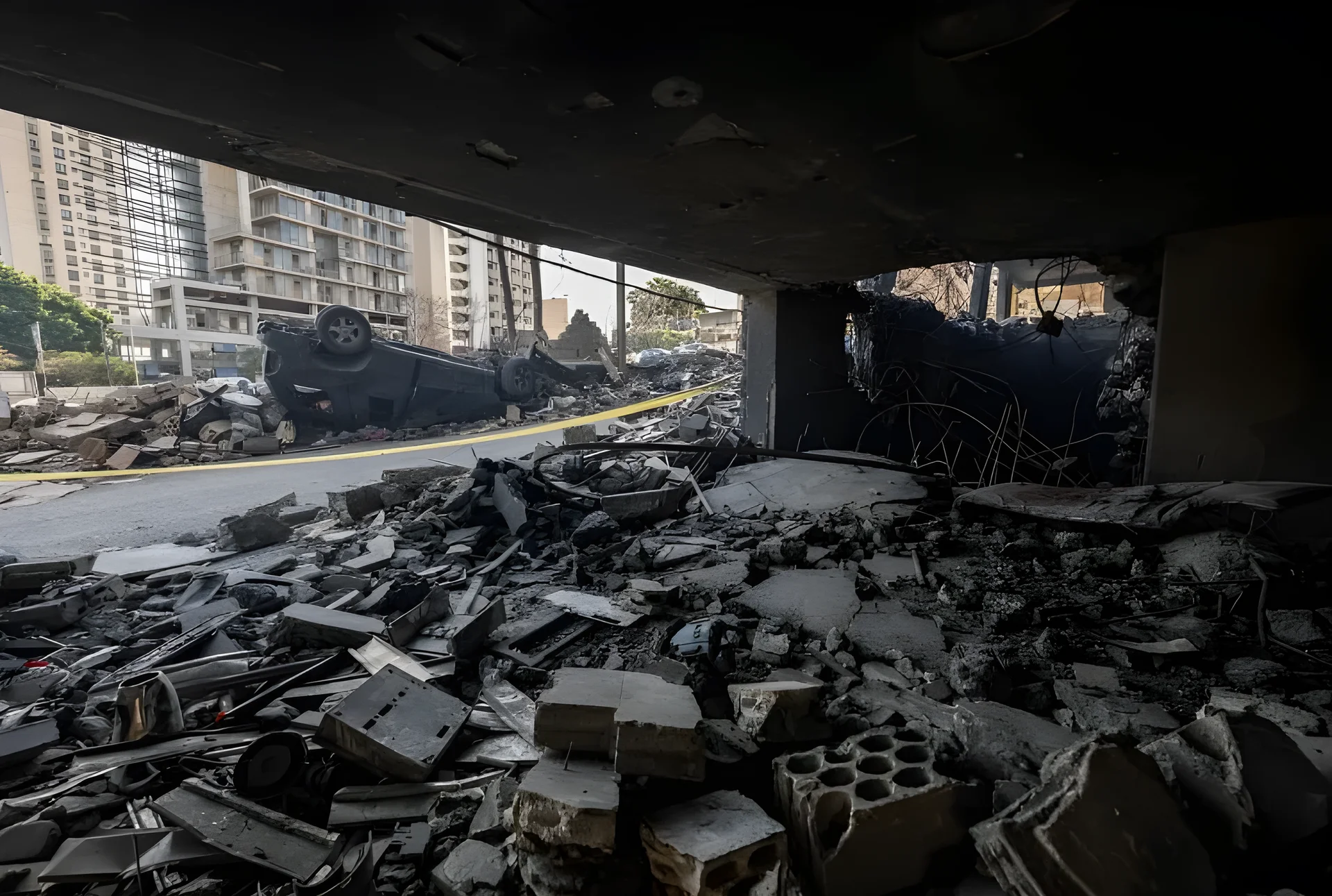
Displacement and Destruction in South Beirut
The Masrasat Omar al-Fakhoury high school in south Beirut is currently home to over 100 families living in cramped conditions with little privacy. Despite the overcrowding, many like Hassan are grateful they are not in the canvas dwellings that are battered by torrential rain across the city.
Hassan and his family are among the 1 million people displaced by Israel’s attacks. They fled south Lebanon and the predominantly Shia southern suburbs of Beirut, known as Dahieh. According to Hassan, they were originally from Nubl and al-Zahraa in Syria, but were displaced when Isis began persecuting them for being part of the Shia minority.
“For years we were under siege before leaving to the town of Sayyidah Zaynab, south of Damascus in Syria,” Hassan told Socialist Worker. “But when Ahmed al-Sharaa overthrew the Assad government, we fled again to Lebanon, making a new home in Dahieh. Then last week we got threats from the Israelis, and the whole neighbourhood had to leave. I sometimes return to get things for the children when I can — 80 percent of the neighbourhood is damaged or completely destroyed.”
Human Cost Rises as Death Toll Surpasses 880
The human cost of the conflict has passed another grim milestone in Lebanon. The official death toll, released by the Lebanese Ministry of Health, now exceeds 880 people since the fighting began following the United States-Israeli assassination of Iran’s supreme leader.
Retaliatory rocket fire into Israel from Hezbollah has triggered a wave of carnage as the Israelis roll out their trademark tactic of collective punishment. An estimated 80 percent of the casualties are innocent civilians. People fear that Israel will soon stage a full-scale invasion of south Lebanon.
There are reports that the pro-Western Syrian government will allow Israeli tanks to cross its own border with Lebanon. The new regime is led by Ahmed al-Sharaa, who led the Islamist HTS to overthrow Bashar al-Assad. This will put Hezbollah, currently resisting Israel’s attacks, under further pressure.
Targeting of Emergency Workers and Civilians
As with the ongoing genocide in Gaza, Israel has deliberately targeted emergency workers. Last Friday, doctors, paramedics, and nurses were preparing to break their fast in the local health centre in the Burj Qalaouiyah village, in the Bint JBeil district of south Lebanon.
An Israeli-guided bomb destroyed the building, slaughtering all 12 of them. Israel has killed at least 26 paramedics and injured a further 52 since the war started. Those made destitute by the war feel even less safe after Israel launched a murderous attack without warning in Ramlet al-Baida on the Beirut seafront last Thursday.
A drone strike on a vehicle, sat amid the tents of those displaced, killed at least 13 people, wounding a further 30 in an area previously deemed to be safe. Witnesses have described it as a “double tap” — the initial strike was followed by another designed to kill those who had arrived to help.
The metal signs and railings along the blast area are peppered with holes made by the ball bearings that the device was loaded with. These weapons, designed to cause maximum human casualties, are part of an ongoing rampage that has no end in sight.
The situation in Lebanon has deteriorated rapidly, with the death toll rising and the threat of a full-scale invasion looming. The impact of the conflict on the civilian population is profound, with displacement, destruction, and loss of life continuing to mount.
The international community has been urged to take decisive action to prevent further escalation and protect the civilian population. The United Nations has called for an immediate ceasefire, but so far, no concrete steps have been taken to achieve this goal.
As the conflict continues, the human cost in Lebanon is expected to rise further, with the potential for even more displacement and loss of life. The international community must act urgently to prevent further suffering and to find a lasting solution to the crisis.






Comments
No comments yet
Be the first to share your thoughts