

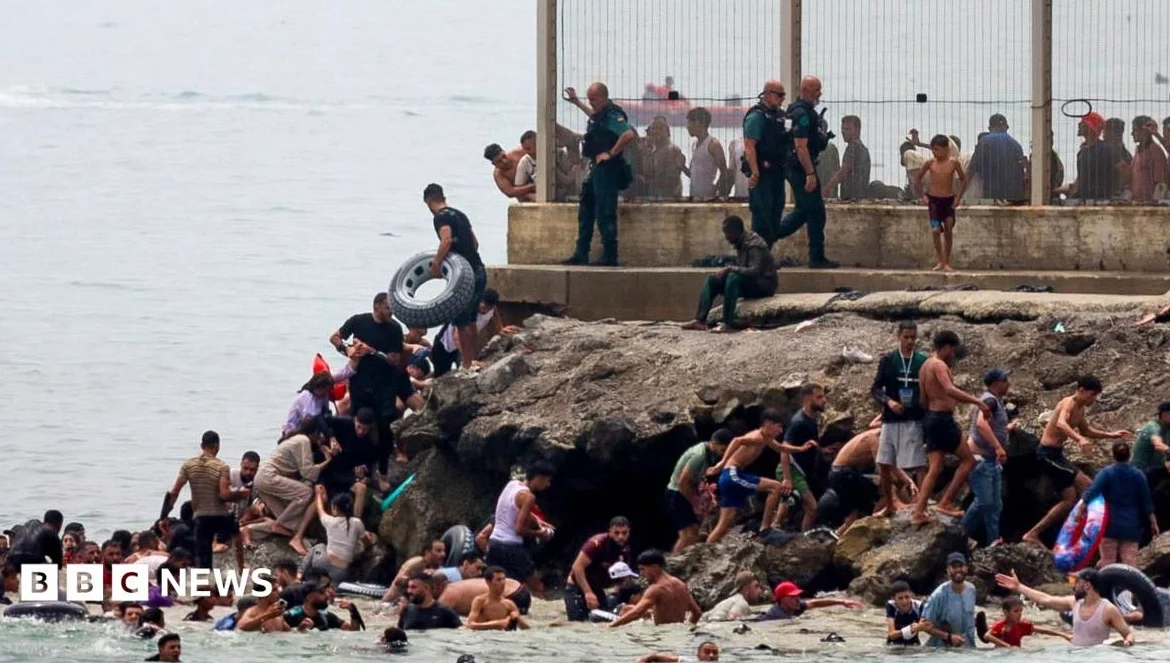
At least nine people died as thousands of migrants swam or walked into the Spanish enclave of Ceuta from Morocco, according to Spain’s government delegation in Ceuta. The situation, described as ‘absolute chaos,’ saw military deployed to manage the crisis. Video footage showed crowds of people, mainly Moroccans, walking around breakwaters at Tarajal beach onto local roads. While the majority appeared to be young men, there were also families with women and small children.
Border Breach and Rising Death Toll
“The situation is absolute chaos,” said Rachid Sbihi, head of the association representing Spain’s Civil Guard officers in Ceuta. “It’s not possible to give precise numbers, but there are thousands of migrants crossing,” he told The Associated Press. He added that the border had ‘totally collapsed.’
Achraf Maimouni, a member of the Moroccan Association for Human Rights in northern Morocco, described the situation as ‘exceptional.’ ‘The Tarajal border was opened under unusual circumstances this morning and people crossed,’ he said. According to local authorities, dozens have died this year trying to reach Ceuta.
Changes in Legal Procedures and Policy Impact
The surge follows a Spanish Supreme Court ruling that ended the automatic return to Morocco of migrants intercepted while swimming into Ceuta and Melilla. Under the ruling, only migrants who cross by scaling the land border fence can be turned back immediately. Anyone who swims in must now go through the standard deportation process, which can take months and allows them to apply for asylum.
Spain’s Interior Ministry has classified almost all of Ceuta’s arrivals this year as having come by land, even though witnesses describe people swimming ashore most nights. Ministry figures show 2,826 irregular land entries in Ceuta between January 1 and July 15, up 149% from the 1,133 recorded in the same period in 2025, while officially logging zero arrivals by sea all year.
The Guardia Civil’s own officers’ union, the AUGC, has publicly disputed that classification, arguing most of those people are in fact swimmers being intercepted on the coast rather than migrants scaling the fence. ‘If this isn’t corrected, in a month we’ll be back where we were in May 2021,’ said a union official, referring to a previous mass-arrival crisis when thousands of people crossed into Ceuta within days after Morocco eased its border controls amid a diplomatic row with Spain.
International Response and Ongoing Uncertainty
Spain’s interior ministry said the Moroccan government was ‘closely cooperating’ with Spain to handle the situation and that Moroccan police are stopping ‘numerous people’ trying to cross the border. However, Moroccan authorities have not publicly commented on the crossings and the interior ministry did not respond to requests for comment.
Three bodies were found along the shores of the Costa del Sol on Thursday. The victims were dressed in snorkels and flippers but had no ID on them. According to the Olive Press, on July 27 four people had died and around 20 were feared missing after a single weekend crossing attempt near Castillejos, a Moroccan coastal town facing Ceuta across the border.




Comments
No comments yet
Be the first to share your thoughts