

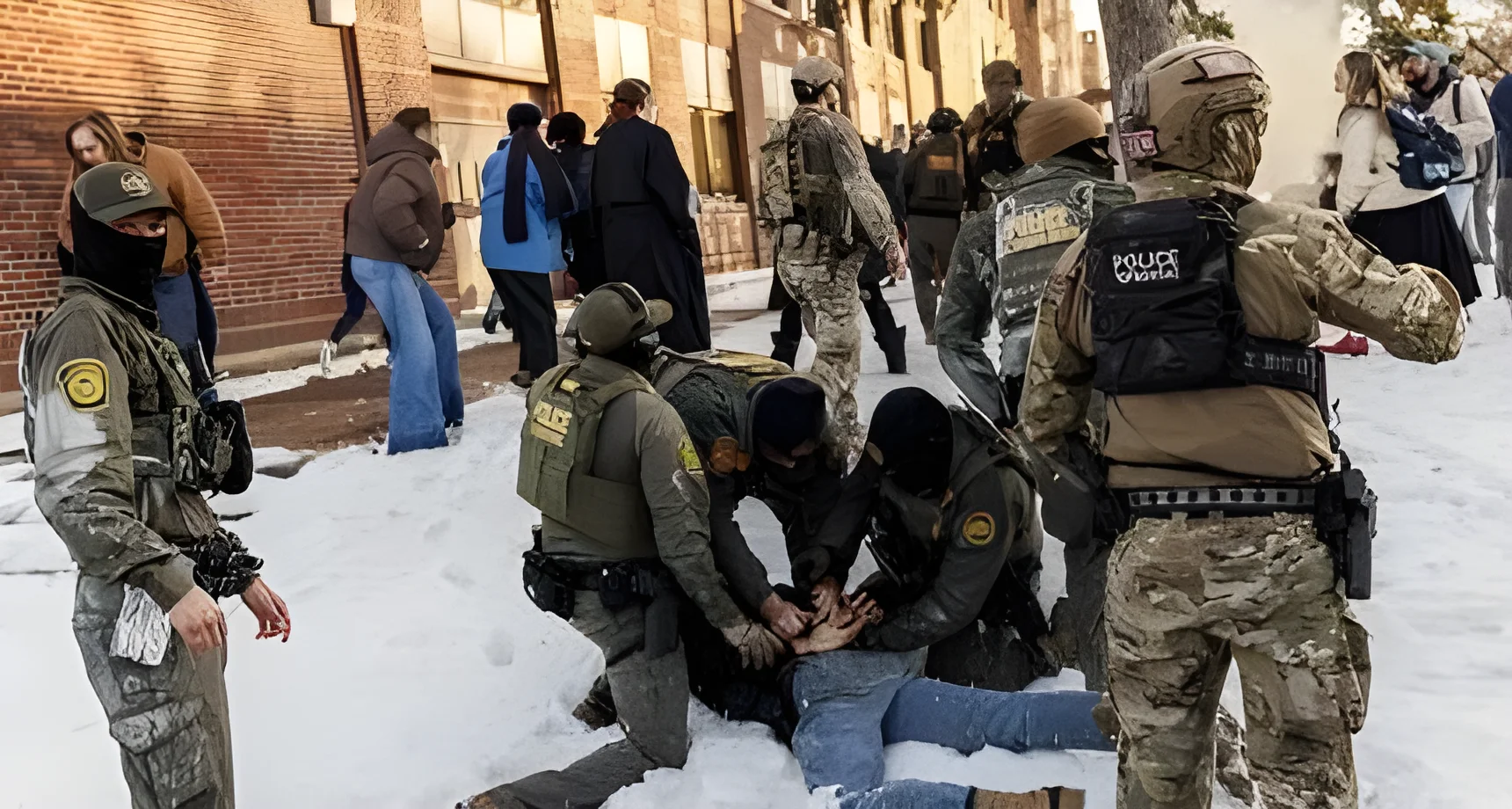
Immigration enforcement is drawing closer to schools, with agents now frequently appearing at school drop-off zones and even on campuses, sparking fear among parents and disrupting the lives of students. Penny Chavez, a resident of Springfield, Ohio, has been watching the situation with growing concern, especially for her two grandchildren, who are U.S. citizens but are Hispanic. She fears they might be detained at or near their school.
Parental Anxiety and School Uncertainty
Chavez has been pressing the Springfield school district for clarity on how school leaders would respond if immigration agents entered a district school. However, she has not received reassuring answers. Parents without legal status whose children attend the district are reluctant to send their children to school due to the lack of clarity.
‘They have the right to know whether or not it’s safe to pick the kids up or drop them off,’ Chavez said.
A year after the Department of Homeland Security rescinded a policy that limited immigration enforcement operations near schools, agents are not raiding schools, but they are coming dangerously close. Reports indicate that parents have been detained at bus stops, and there are images of agents tackling people on school grounds.
Legal and Policy Uncertainty
Legal experts note that the Fourth Amendment has not changed; it still limits agents from entering schools without a judicial warrant. However, the overall approach by immigration agents has been unpredictable, creating highly charged circumstances around schools.
Keri Rodrigues, president of the National Parents Union, and others have called for the reinstatement of the federal policy, with some organizations pressuring Democrats in Congress to withhold funding for the Department of Homeland Security until it is restored. Recent incidents show that ICE is getting closer to entering schools.
‘They’re not physically inside the buildings yet, but they’re literally at the school yard gate,’ Rodrigues said.
A tracker launched by K-12 Dive, an education industry news site, identifies at least nine instances in which immigration agents came onto the grounds of a K-12 school or preschool. In Chula Vista, California, last week, ICE agents arrested both parents of a 12-year-old and a four-year-old after school drop-off, according to a local news report. According to a GoFundMe for the family, the children finished their school day without knowing their parents wouldn’t be the ones to pick them up.
School Leaders Caught in the Middle
School leaders are often left without clear answers for families and are limited in what they can do. David Law, superintendent of Minnetonka Public Schools in a suburb of the Twin Cities and president of the School Superintendents’ Association, said, ‘They’re mad at us, like, ‘Why can’t you stop this?’ Well, we didn’t start it.’
The effect on students, particularly in Minnesota, has been sweeping: more absences from school, an increase in remote learning, and grief from seeing classmates vanish. About one in four St. Paul Public School students were learning virtually amid the enforcement surge, the superintendent told reporters in January.
‘Not only are they being subjected to the presence of ICE at their bus stop or at their school, but it’s this force that is lacking the control and composure that you would expect from law enforcement, and that has to be extremely traumatic for these students,’ said Sarah Pierce, the director of social policy at Third Way, a center-left national think tank.
A looming question is whether ICE will attempt to enter schools without a judicial warrant. For decades, the sensitive locations policy has limited immigration arrests at or near schools. The policy made an exception for circumstances that posed an imminent threat.
That change means spaces considered public, such as a front lawn or near the parking lot, could be subject to ICE activity, said Keith Armstrong, an immigration attorney with the ACLU of Pennsylvania.
But, in internal memos reported by the Associated Press and the New York Times, ICE has asserted broad powers to enter homes without a warrant signed by a judge and to arrest people in public without any warrant. That has raised questions about how the agency might treat sensitive locations, such as schools.
Legal experts and advocates point to the Fourth Amendment, which bars agents from entering schools without a judicial warrant. A ‘long line’ of case law also supports the notion that agents need the signed warrant, Armstrong said. If ICE is targeting families in actions on school premises, ‘that is something we definitely want to know about and see if we can develop a case about.’
The recent incident where agents went on the grounds of Minneapolis’ Roosevelt High signals an ‘attitude shift’ in what agents consider OK, Armstrong said.
‘It seems like there is a change in attitude where previously it would have been sort of unthinkable for ICE to, even with the rescission of the sensitive locations memo, it would have been pretty unthinkable for ICE to really try to do something that brazen,’ he said.
Ken Cuccinelli, former deputy secretary for DHS during the first Trump administration, told Chalkbeat immediately after the policy was rescinded that he believed agents would tend to avoid enforcement at schools, and he did not expect them to target school drop-off or pick-up to ’round up a bunch of people in transit.’
But he said in late January that limiting operations within 1,000 feet of a school would also put a ‘good chunk’ of the country off-limits.
Still, while ICE has been more aggressive in Trump’s second term, ‘they haven’t had to go in a bunch of schools,’ he said.
Democrats, who are facing pressure to withhold DHS funding until the sensitive locations policy is restored, are considering a variety of measures to curb ICE activity. A tentative budget deal reached Friday did not include long-term Department of Homeland Security funding to give policymakers more time to haggle.
Sen. Michael Bennet, a Democrat from Colorado, said restoring the sensitive locations policy is a priority, but it’s one item in a list of competing priorities, including preventing agents from wearing masks or ensuring they’re using warrants appropriately.
Bennet, who led Denver Public Schools from 2005 to 2009, said parents and children are separated during the school day and have the reasonable expectation that they’ll be reunited when school ends. ICE’s recent actions are upending that assumption for vulnerable families.
‘There is a ripple of fear that is running through our communities,’ he said. ‘Traditionally, schools and hospitals and churches have been sanctuaries and places where kids shouldn’t have had to worry about immigration enforcement.’
ICE unpredictability leads to school unpredictability. In Springfield, Ohio, Chavez said people of color in the community, including citizens, are making contingency plans for child care in case families are separated during the school day — much like families have done in other cities, at times with the support of public schools.






Comments
No comments yet
Be the first to share your thoughts