

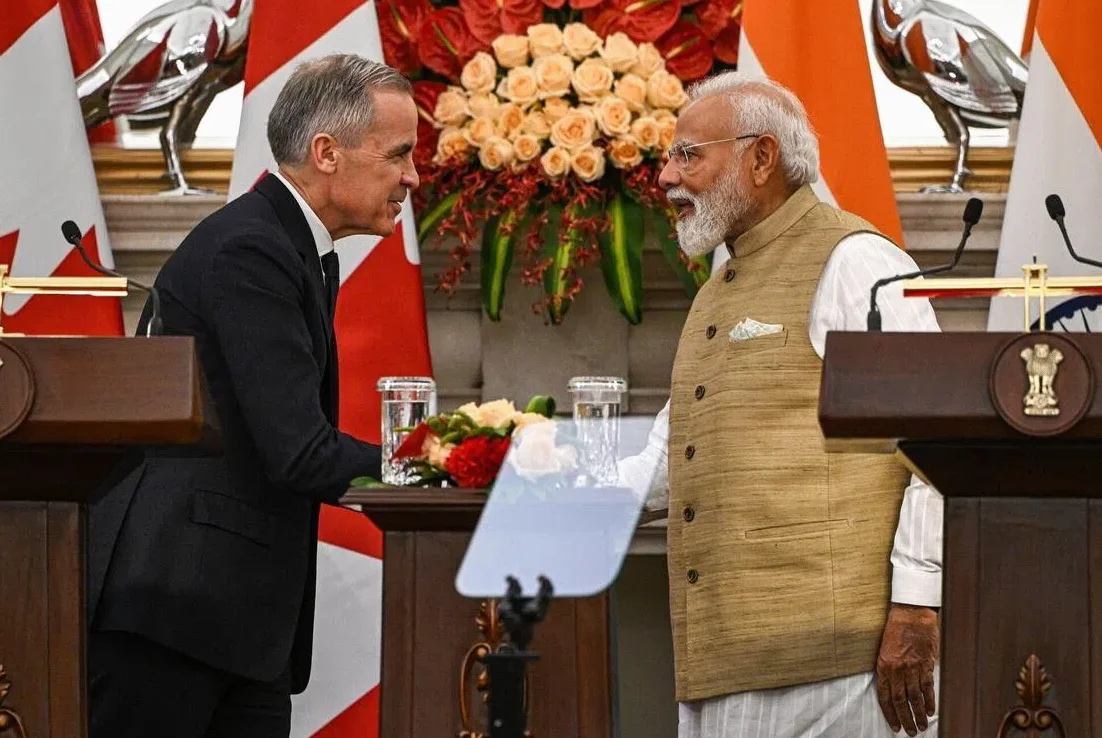
NEW DELHI — India and Canada have launched a new era of strategic cooperation, signing agreements on energy, critical minerals, and defence as Prime Minister Mark Carney’s visit marks a reset in their bilateral relationship. The move comes amid global turbulence, including the threat of a prolonged conflict in the Middle East, which is changing international alliances and trade dynamics.
Resetting Relations After Years of Strain
The recent diplomatic engagement follows years of tension, particularly over the 2023 killing of Hardeep Singh Nijjar, a prominent Sikh activist in Canada. That incident triggered a brief diplomatic breakdown between the two nations and led to a period of strained relations.
Prime Minister Mark Carney, who took office in 2025, has made it a priority to mend ties, emphasizing the need for a forward-looking partnership. His visit to India, his first official bilateral trip, highlights Canada’s intent to diversify its economic and political ties amid uncertainty from the United States, both countries’ largest trading partner.
During a joint press appearance with Prime Minister Narendra Modi, Carney described the visit as a significant step forward: ‘This is not merely the renewal of a relationship; it is the expansion of a valued partnership with new ambition, focus, and foresight — a partnership between two confident countries charting our own course for the future.’
Trade and Energy Agreements Shape the Future
One of the key outcomes of the talks was a decision to accelerate negotiations on the Thorough Economic Partnership Agreement, launched in November 2025. The agreement aims to double bilateral trade to $50 billion by 2030, a target that follows recent trade deals India has signed with the European Union.
Both countries have set a goal to conclude a free trade pact by the end of 2026. For India, a key priority is to boost nuclear power to meet growing energy demands, including those from data centres. To support this, India’s Department of Atomic Energy signed a 10-year contract with Cameco, a Saskatchewan-based uranium provider, for $2.6 billion in uranium supply.
According to a statement from Carney’s office, Canada will supply nearly 22 million pounds (1 million kg) of uranium to India for nuclear energy generation from 2027 to 2035. In 2025, nuclear power accounted for about 3 per cent of India’s energy needs, according to government data.
Defence Cooperation and Regional Security
Beyond trade, India and Canada have agreed to strengthen defence cooperation. Prime Minister Modi announced the establishment of an India-Canada Defence Dialogue, signaling a deeper commitment to security collaboration.
‘Growing cooperation in the field of defence and security is a symbol of our deep mutual trust and the maturity of our relationship,’ Modi said. ‘We will work to enhance defence industries, maritime domain awareness, and military exchanges.’
Canada, the world’s second-largest uranium producer, has supplied India with uranium under a Nuclear Cooperation Agreement signed in 2010. The recent agreement expands this relationship to include critical minerals, which are essential for clean energy, electric vehicles, and advanced manufacturing.
Analysts suggest that while the reset in relations is positive, challenges remain. Canadian media reported that Canadian Security Intelligence Service Director Dan Rogers recently cited ‘China, Russia, India and others’ as active perpetrators of foreign interference targeting Canada.
Professor Harsh V. Pant of the Observer Research Foundation noted that both countries are now seeking to address these issues behind closed doors, a shift from the previous administration’s approach. ‘I think there is a commitment now in New Delhi and Ottawa to build a forward-looking relationship even as the two sides manage more challenging aspects of the relationship in a quiet, diplomatic way,’ he said.
Public opinion in Canada appears to support the reset in ties with India. A survey by the Angus Reid Institute found that 53 per cent of Canadians believe it is the right time for Carney to visit India, and 57 per cent think Canada should prioritize trade and investment in its relationship with India.
However, the visit occurred against the backdrop of ongoing conflict in West Asia, where U.S. and Israeli strikes on Iran have raised concerns about global economic stability. The longer the conflict continues, the more it could impact trade and energy markets worldwide.
At the World Economic Forum in Davos in January, Carney called for a new ‘rules-based international order’ for middle powers, urging Canada and others to unite to counter the rise of hard power and great power rivalry amid a ‘rupture in the world order.’
As both countries look to the future, their focus remains on economic engagement, trade, and people-to-people ties. This forward-looking orientation, according to experts, reflects a shared commitment to building a strong and resilient partnership in the years ahead.



Comments
No comments yet
Be the first to share your thoughts