

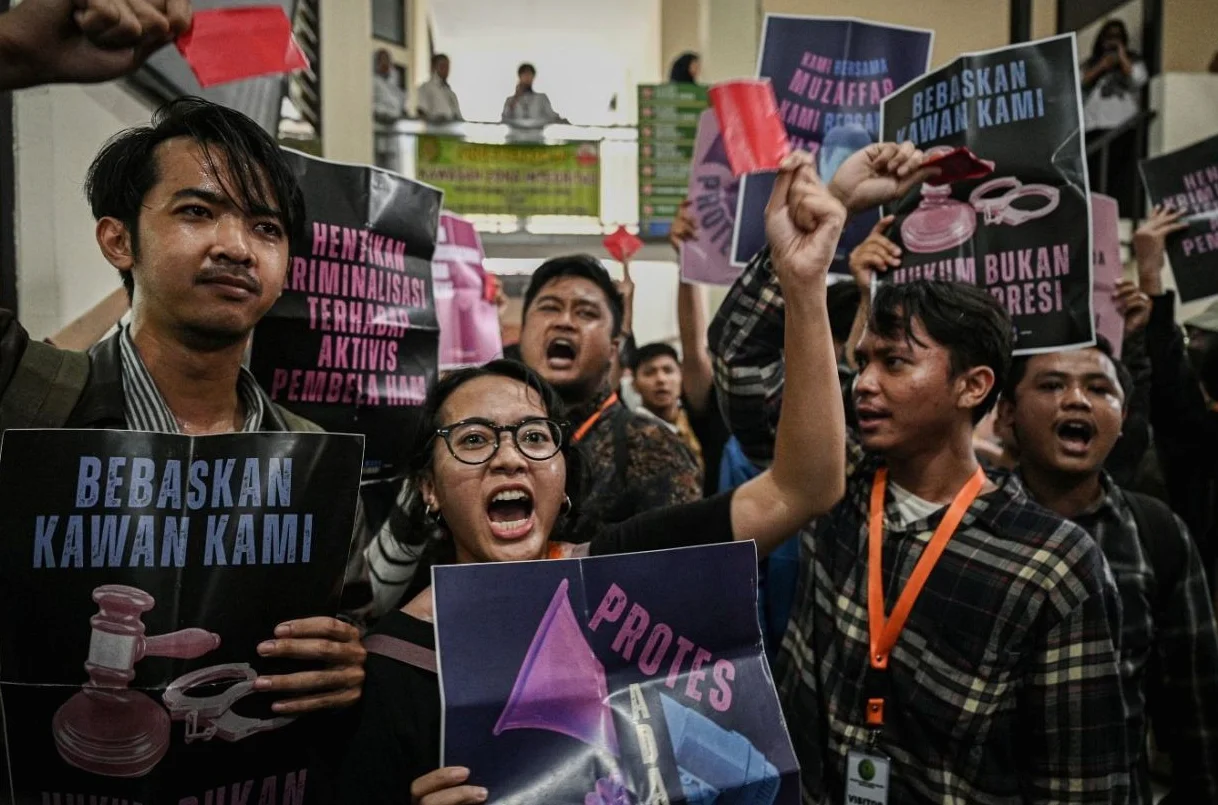
Jakarta — Indonesian prosecutors have demanded two-year prison sentences for four activists accused of inciting nationwide riots in August 2023, a move that has drawn strong criticism from human rights organizations who accuse the government of attempting to silence dissent.
Legal Battle Over Social Media Posts
Last Friday, prosecutors from the Attorney General’s Office (AGO) asked the Central Jakarta District Court to sentence Delpedro Marhaen, director of the Lokataru Foundation, and three other activists to two years in prison. The accused include Muzaffar Salim, a staff member at the foundation, Syahdan Husein, an online activist from the student movement Gejayan Memanggil, and Riau University student Khariq Anhar.
The prosecution alleges that the four individuals led social media campaigns that incited “hatred and hostility” toward the government during anti-government protests in late August and early September 2023. The protests escalated into violence after a police tactical vehicle ran over and killed a motorcycle driver attempting to disperse the crowds.
According to prosecutors, the activists violated the Electronic Information and Transactions (ITE) Law and the Criminal Code (KUHP) by publishing 19 “provocative” posts using hashtags such as #indonesiagelap (dark Indonesia) and #reformasipolri (let’s reform the police).
Free Speech Concerns Intensify
Civil society groups have strongly criticized the prosecution, with the pro-democracy Gerakan Nurani Bangsa (GNB) calling for the activists’ acquittal. The group, which includes former first lady Sinta Nuriyah Wahid and former religious affairs minister Lukman Hakim Saifuddin, has prepared an amicus curiae brief in support of the defendants.
“We request the panel of judges to clear the defendants of all charges and find them innocent,” said Lukman Hakim Saifuddin, a GNB representative, in an interview with The Jakarta Post. He added that the group is preparing legal arguments to challenge the prosecution’s case.
Amnesty International Indonesia executive director Usman Hamid also condemned the AGO’s actions, calling it an example of “malicious prosecution” aimed at silencing government critics. “The prosecutors are sending a troubling signal that expressing dissent is a criminal offense,” he said. “Their sentence demand further validates the state crackdown on critics, which civil society groups have long warned against.”
Impact on Civil Society and Free Expression
The unrest in late August 2023 saw thousands of students, workers, and civil society members take to the streets in Jakarta to protest economic inequality and the lavish perks given to lawmakers. The protests quickly spread nationwide and turned violent after the fatal police incident involving a motorcycle driver.
An independent investigation by the Commission for the Disappeared and Victims of Violence (Kontras), the Indonesian Legal Aid Foundation (YLBHI), and the Jakarta Legal Aid Institute (LBH Jakarta) found that at least 13 people died and 6,000 were arrested during the unrest. As of February 2024, 703 individuals were still facing legal proceedings, with 13 activists accused of acting as agents provocateurs.
The report described the government’s response as the most extensive crackdown since the fall of the authoritarian New Order regime in 1998, signaling a return to repressive tactics under the current administration.
Iqbal Ramadhan, a member of the legal team representing the four activists, argued that the prosecution had failed to provide credible evidence linking the activists’ social media posts directly to the unrest. “The prosecutors appear to pin the blame for the August unrest solely on the four defendants without credible evidence,” he said.
Ramadhan added that the case is not just about the four individuals but also about the government’s broader campaign to suppress freedom of expression. “We believe the prosecutors are not only targeting the four defendants, but also attacking freedom of expression and aiming to silence the critical voices of the younger generation,” he said.
The case has sparked a national debate about the balance between national security and free speech, with many fearing that the government is using legal mechanisms to quell dissent. As the trial proceeds, the outcome could set a precedent for future cases involving online activism and political expression in Indonesia.






Comments
No comments yet
Be the first to share your thoughts