

 Bloomberg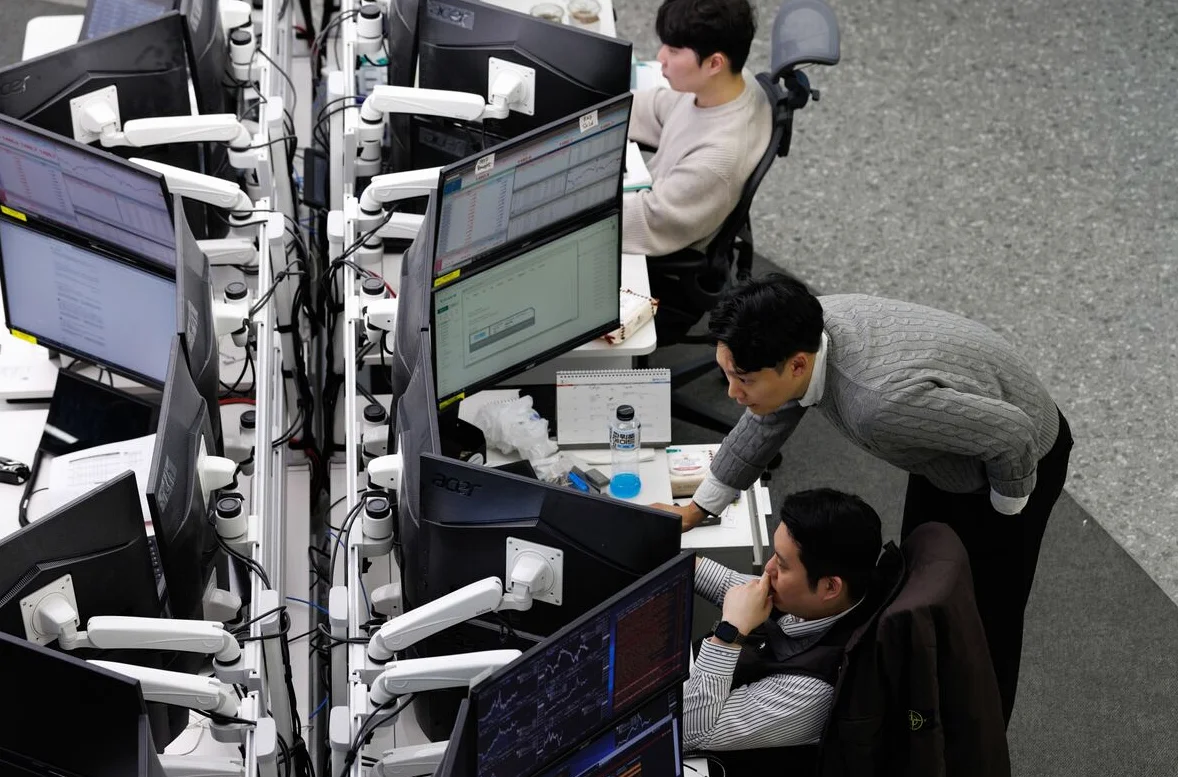
The Iran war has disrupted a dominant investment strategy, leading to a sharp sell-off in Asian equities as concerns over oil prices and inflation threaten the region’s economic outlook. The MSCI Asia Pacific Index has fallen 6% this week, signaling a reversal of recent capital flows into Asia and a renewed shift toward the United States as a safe haven.
Oil Prices and Geopolitical Risks
The surge in Brent crude prices has intensified fears of inflation, stoking uncertainty among investors. Asian markets, which have historically benefited from AI-driven growth and cheap valuations, are now facing renewed scrutiny. South Korea and Taiwan, which outperformed last year, are now seeing profits taken as investors seek safer assets.
“Capital doesn’t wait for certainty — it’s already rotating, and the dollar’s strength this week tells you everything about where the smart money is heading,” said Hebe Chen, senior market analyst at Vantage Global Prime. “China, Japan, Korea, and Taiwan are pure import dependents with no buffer, making this oil shock exponentially more corrosive for the region than for the West.”
Regional Exposure and Economic Vulnerabilities
Japan and South Korea are particularly vulnerable due to their reliance on oil shipments through the Strait of Hormuz, where a significant portion of their imports pass. In contrast, China has access to Russian crude and larger reserves, providing a buffer against potential supply shocks.
“Japan and South Korea could face more pressure as over 60% of their oil imports are transported via the Strait of Hormuz,” said Alicia Garcia-Herrero, chief economist for Asia Pacific at Natixis SA. “The economic impact on Asia goes beyond oil, affecting mobility, construction, finance, and defense.”
Bloomberg Economics notes that Asian economies including China, India, and Indonesia are among the world’s largest oil importers. A 20% rise in Brent crude prices could cut regional earnings by 2%, according to Goldman Sachs.
Shift in Capital and Market Reactions
The recent sell-off mirrors the market reactions following the 2022 invasion of Ukraine, with a stronger dollar and tighter financial conditions affecting Asian markets. Investors are now pricing in about 50 basis points of tightening for the Bank of Korea over the next 12 months, up from 25 basis points previously expected.
“The lack of support from monetary easing will be negative for stocks,” said Rajeev de Mello, global macro portfolio manager at Gama Asset Management. “Sentiment was very buoyant among EM investors and that may unwind as well.”
Even with the recent rebound, the MSCI Asia Pacific Index still leads the S&P 500 by 7 percentage points this year, suggesting that further unwinding of crowded positions could be on the horizon. Foreign investors sold $6.3 billion of Taiwanese stocks in the first three days of the week, according to Bloomberg data.
“The current selloff in Asia is driven by a confluence of events, not just geopolitical risks,” said Elfreda Jonker, client portfolio manager at Alphinity Investment Management. “Some Asian markets like South Korea are particularly vulnerable at the moment given the recent strong rally and resultant high multiples.”
Despite the recent pullback, Asian stocks still hold potential for recovery, but the ongoing geopolitical tensions and rising oil prices are creating a challenging environment. Analysts suggest that the region’s economic resilience will be tested in the coming months as global demand and supply dynamics continue to evolve.






Comments
No comments yet
Be the first to share your thoughts