

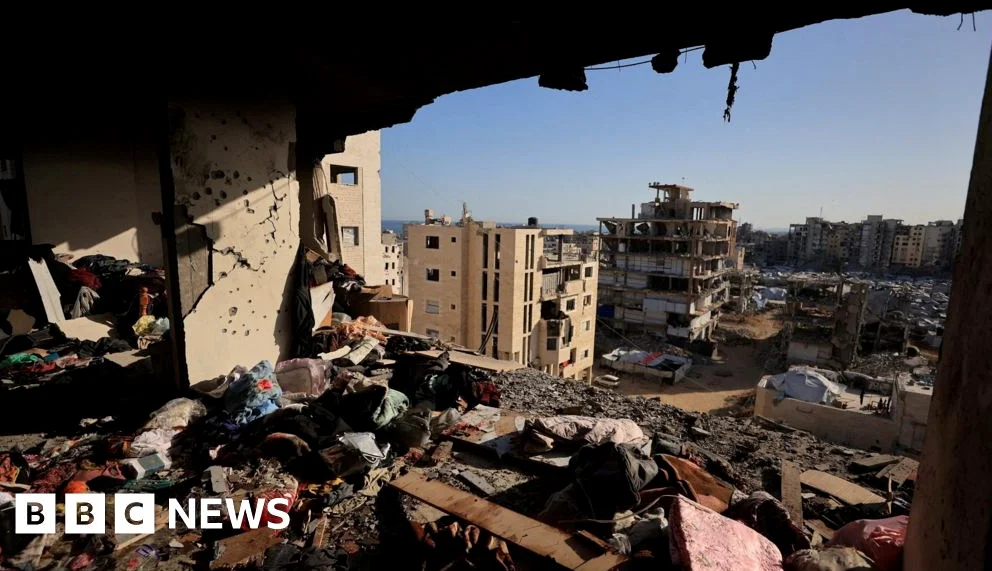
Nine Palestinians were killed and 20 injured in Israeli airstrikes against schools and institutes housing refugees in Gaza, according to reports on October 2 — the attacks occurred after Israel was struck by Iranian ballistic missiles the previous day in retaliation for the deaths of Hamas and Hezbollah leaders.
Escalating Violence and Civilian Impact
On October 1. Israeli airstrikes killed 37 people in Gaza, according to Palestinian health officials; In Nuseirat,one of eight historic refugee camps—two Israeli attacks on two houses killed 13 people, including women and children. Another strike on a school in the Tuffah neighborhood of Gaza City killed seven people, according to medics.
Dr. Mads Gilbert, a Norwegian physician working at Al-Shifa Hospital in Gaza, described the ongoing Israeli military operations as indiscriminate. “The Israeli army is bombing all areas in the Gaza Strip, and it is not clear that certain places are being spared from the attacks,” he said. He noted that the population has severely restricted movement due to the constant threat of aerial bombardments from Israeli warplanes. “It is like an endless, strong thunderstorm,” he added, describing the constant sound of F-16 jets overhead and heavy shelling by Israeli naval forces along the coast.
Medical Infrastructure Under Strain
According to Dr. Gilbert, Al-Shifa Hospital, the largest in Gaza, is overwhelmed with a continuous influx of victims. Since the conflict began, 695 people have been killed, including 166 Palestinian children, and 4,990 have been injured, including 1,310 children. “These figures are also reflected in the admissions at Al-Shifa Hospital,” he said. While other hospitals in Gaza, such as Aqsa Hospital, have been destroyed or damaged, the overall medical capacity has been significantly reduced, leading to an increased burden on remaining facilities.
Dr. Gilbert also highlighted the ongoing challenges with the hospital’s power supply, which relies on generators that frequently fail. “The power situation is extremely unstable,” he said, adding that this poses further complications for treating the injured.
Broader Regional Tensions
The Israeli military stated that the October 1 airstrikes were aimed at Hamas militants operating from a command center in a complex that previously served as Al-Shejaia Schools. However, the attacks resulted in significant civilian casualties, raising concerns about the proportionality and targeting of the military actions.
The escalation in violence follows a broader regional context, with Iran launching ballistic missiles at Israel on October 1 in response to Israeli operations against Hamas and Hezbollah leadership. The cycle of retaliation has led to increased civilian suffering, with medical workers struggling to cope with the scale of casualties and limited resources.






Comments
No comments yet
Be the first to share your thoughts