

 BBC
BBC 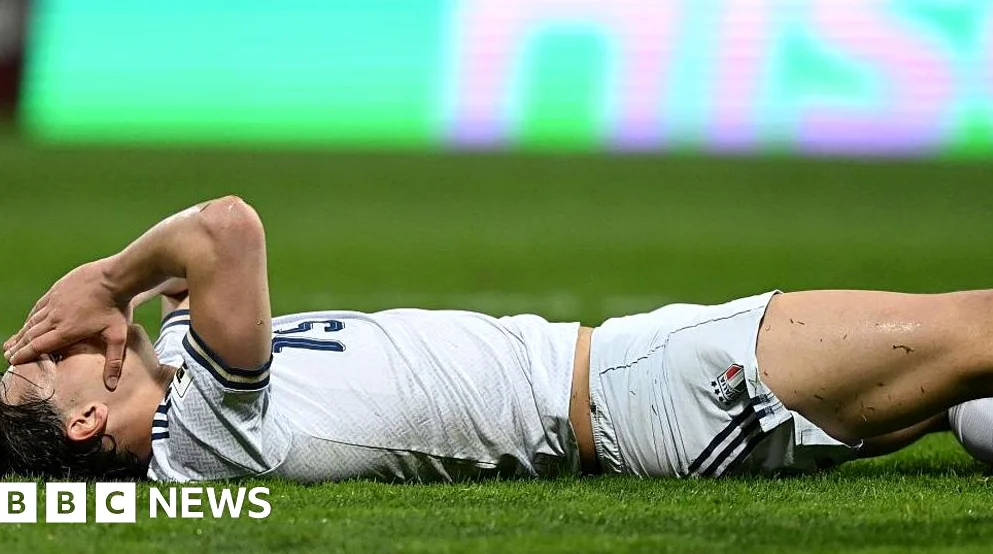
Italy’s failure to qualify for the World Cup for a third straight time has left the country reeling, with some calling it a ‘third apocalypse’ in the nation’s footballing history. On Tuesday night in Zenica, the Azzurri were defeated 4-1 on penalties by Bosnia and Herzegovina, ending hopes of a return to the global tournament.
Golden Days Gone: A Nation in Shock
Tommaso Silvestri, 65, a man leaning against a wall in Rome, scans the morning’s headlines, which now read ‘apocalypse,’ ‘scandal,’ and ‘disaster.’ He says the Italian team has ‘made a real mess of it.’ ‘We had players who couldn’t even find the target,’ he said, shaking his head.
Silvestri, who once watched the golden days of Italian football, said the ‘golden days are well and truly gone.’ Since winning the 2006 World Cup, Italy has largely disappointed in international tournaments, with only a surprise victory at the 2021 Euros against England to show for its efforts.
Political and Public Reactions
The loss has sparked swift and emotional reactions across Italian politics and society. Ignazio La Russa, president of the Senate and a senior figure in Prime Minister Giorgia Meloni’s far-right Brothers of Italy party, lamented, ‘Everything has a limit.’ He admitted the team had been supported, hoped for, and even criticized for questionable refereeing decisions, but he said deep down, many feared the outcome.
Roberto Saviano, author of Gomorrah and a prominent anti-mafia writer, pointed to deeper structural failures in Italian football, from governance to youth development. He said clubs are ‘at the mercy of criminal organizations’ and that there is ‘no investment in young players’ or ‘care for second-generation talent.’
Disappointment and Betrayal
Giovanni Colli, 71, sipping an espresso at a café near the Pantheon, said he felt ‘betrayed’ by the team’s failure to qualify three times in a row. ‘How on earth did it happen? What a huge disappointment. Everyone should resign. Give the young players a chance,’ he said.
The emotional weight of the loss was evident in the face of coach Rino Gattuso, who struggled to hold back tears after the defeat. ‘We don’t deserve this, it’s not fair. I’m sorry I couldn’t make it happen,’ he said, before retreating to the dressing room.
Gattuso, who took charge of the national team in June, expressed pride in his players despite the loss. ‘I’m proud of my boys and what they gave on the pitch,’ he said.
A Nation’s Disillusionment
Sport journalist Elisabetta Esposito of La Gazzetta dello Sport told the BBC that Italian football is facing a difficult period. She warned that the third consecutive failure to qualify could deepen young people’s disengagement from the national team.
‘The disappointment is profound, but the country is not only disappointed but almost disillusioned. It’s as if a new generation no longer knows what it means to cheer for their country,’ she said.
Esposito added that the match was a technical disaster. ‘From a technical standpoint, everything went wrong. The team hasn’t worked together enough. Rebuilding will require a long-term strategy,’ she said.
What’s Next for Italian Football
Italy’s failure to qualify for the World Cup has raised serious questions about the future of the national team. With no immediate solution in sight, the focus will likely shift to restructuring youth development and governance in the sport.
Teresa, 56, walking her dog in central Rome, said she didn’t know much about football but called the loss ‘a bit of disaster.’ Her words reflect the sentiment of many Italians who may now be questioning the future of their once-dominant footballing culture.
Historical Context and Future Outlook
Italy’s failure to qualify for the World Cup for the third time in a row is the worst performance in the nation’s football history. The last time Italy failed to qualify for the World Cup was in 2017, when they were knocked out in the play-offs by Sweden. This is the first time they have failed to qualify for three consecutive tournaments.
With the 2026 World Cup just around the corner, the pressure on the Italian football federation to reform and rebuild the national team has never been higher. The challenge will be to not only improve the team’s performance but also to restore the public’s faith in the sport.
A Long Road Ahead
Italian football has always been a source of national pride, but the recent failures have left many questioning whether the golden days are truly gone. With no clear path forward, the nation may be in for a long and difficult road ahead.
The loss to Bosnia and Herzegovina has left a deep scar on the Italian footballing community. But with time, effort, and a renewed commitment to youth development and governance, there may still be hope for a return to glory.






Comments
No comments yet
Be the first to share your thoughts