

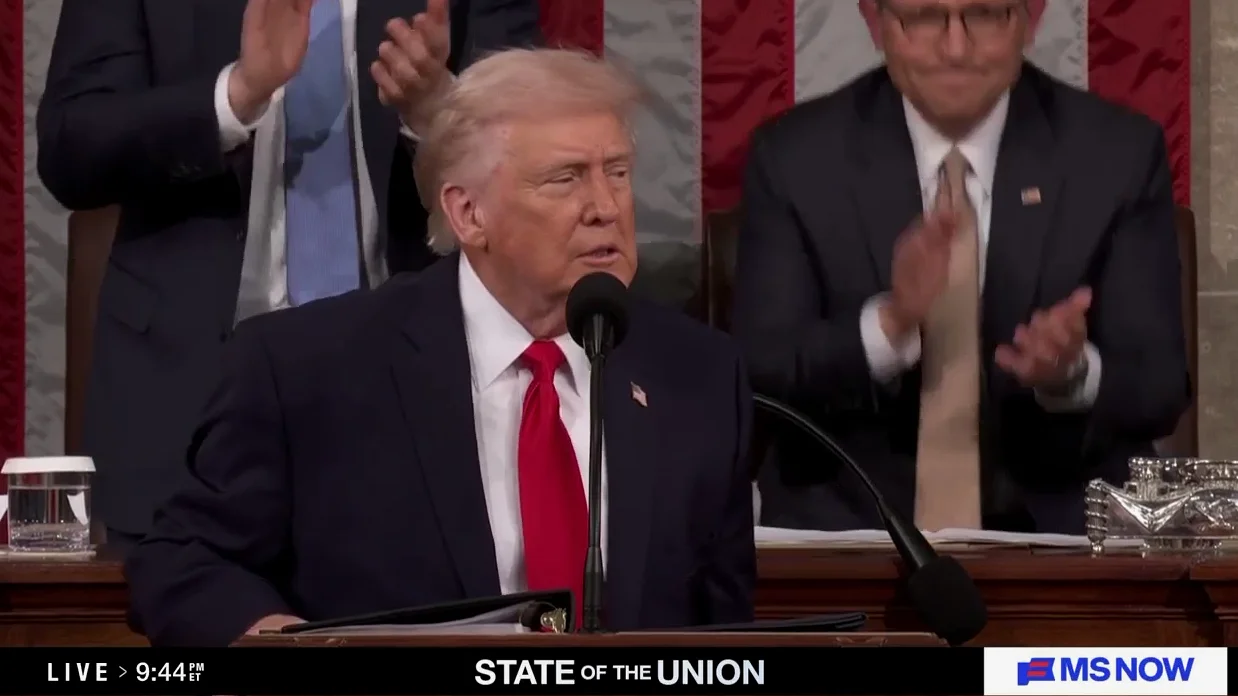
Speaker of the House Jebus Johnson stood up and applauded President Donald Trump after the latter claimed he does not require Congressional approval to continue imposing tariffs, despite a recent Supreme Court ruling striking down some of Trump’s emergency tariffs as illegal.
Trump’s Legal Claims and the Supreme Court Ruling
During Trump’s State of the Union address on Tuesday, he criticized the Supreme Court for striking down his emergency tariffs, which he had imposed unilaterally. Trump argued that he has the authority to continue imposing tariffs under several sections of the Trade Expansion Act, including Sections 122, 232, 301, and 338.
However, legal experts have pointed out that these sections are not as straightforward as Trump claims. While Trump suggested he could proceed without Congressional approval, most of his proposed actions would likely require legislative backing. The Supreme Court’s ruling in early February invalidated some of Trump’s emergency tariffs, citing a lack of clear legal authority.
Trump continued to defend his position, asserting that the legal power he has as president to negotiate new deals could be more beneficial to foreign countries. He claimed that most nations and corporations would prefer to maintain the existing trade agreements, and that the threat of tariffs had helped him settle several international disputes.
Impact on Trade and Congressional Authority
Trump argued that the tariffs he imposed have been tested and proven effective, and that they would eventually replace the modern income tax system, reducing the financial burden on American citizens. This claim has raised concerns among economists and lawmakers, who question the long-term sustainability and legality of such a policy.
During his speech, Trump also took a swipe at 22 Nobel Prize-winning economists who had criticized his economic policies. He claimed they had ‘got it totally wrong,’ despite widespread skepticism from the academic and policy communities about his economic assertions.
Trump’s remarks were met with applause from nearly all Republican members of the House, including Speaker Johnson, who appeared to endorse the president’s stance on the issue. This reaction highlights the current political alignment between the executive and legislative branches on trade policy, despite legal challenges.
According to legal analysts, Trump’s claims about the legal basis for his tariffs are tenuous at best. While some sections of the Trade Expansion Act may provide a framework for imposing tariffs, they do not offer the broad authority Trump is suggesting. Most of his actions would require Congressional approval, particularly in light of the recent Supreme Court ruling.
What’s Next for Tariff Policy and Congressional Action
With the Supreme Court ruling now in effect, Trump faces the challenge of finding a legal basis for continuing his tariffs. While he has emphasized the use of alternative legal statutes, these remain subject to judicial review and could be challenged in court.
Analysts suggest that Trump may attempt to push for Congressional action to legitimize his tariffs, but this could be a politically difficult task given the current composition of the House. However, the president’s administration may also seek to extend the use of existing legal sections to justify continued tariff imposition.
As the debate over trade policy continues, the economic implications for both American consumers and international trade partners remain uncertain. The potential for increased tariffs could lead to higher prices for imported goods, affecting both businesses and households.
The situation also raises questions about the balance of power between the executive and legislative branches. While Trump has historically sought to minimize Congressional involvement in his policies, the Supreme Court’s recent ruling has highlighted the limits of executive authority in the absence of legislative backing.



Comments
No comments yet
Be the first to share your thoughts