

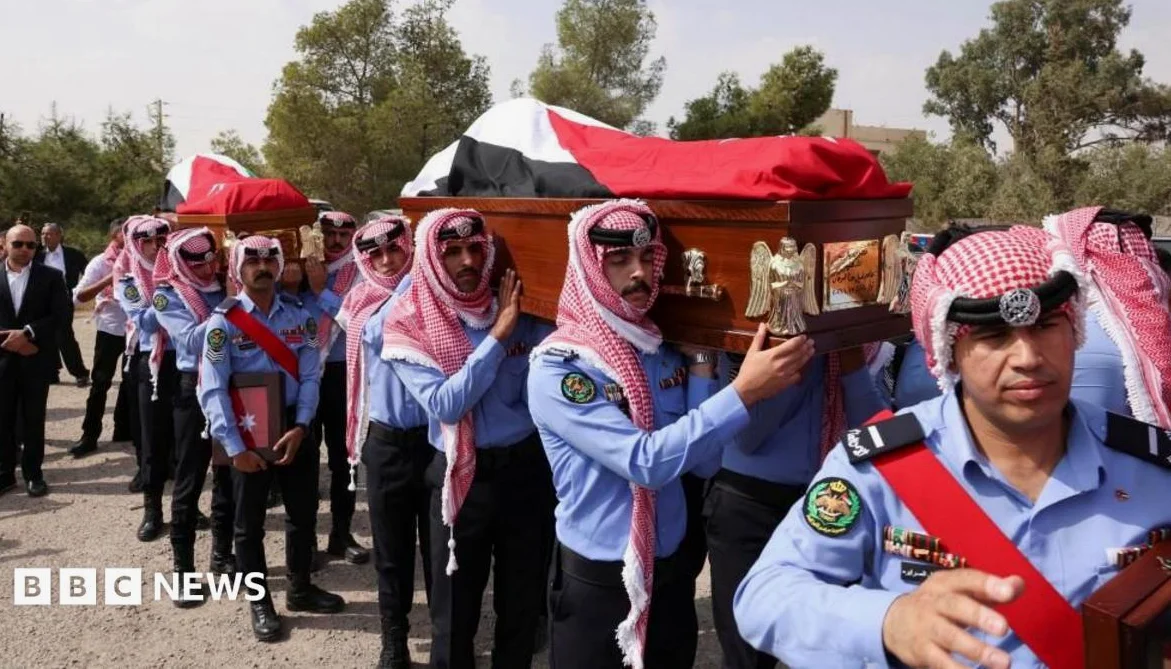
Gunmen opened fire during a funeral at St George’s Greek Orthodox church in the village of Hamoud, killing nine people and wounding 34 others, according to BBC News and The Straits Times. Al Jazeera and The Hindu reported 25 injured. CCTV footage showed the attackers approaching the church with guns and firing into the crowd. The attack shocked Jordan, a Muslim-majority country with a Christian minority of about 300,000 people.
The three men, identified as two Jordanian brothers and their brother-in-law, fled the scene and were arrested three days later in an abandoned house in Karak. They resisted arrest, opening fire on security forces. All three were wounded, but no security personnel were injured, the Public Security Directorate confirmed.
King Abdullah II condemned the attack, writing on X that it would be met with “the harshest retaliation” and that those who tried to divide Jordanians with violence would fail. He praised security forces for their pursuit of the suspects and ordered a review of the country’s security procedures in response to the incident.
In retaliation for the church attack, Jordan launched airstrikes on southern Syria, targeting what it described as “terrorist organisations.” Syrian health officials reported that five people, including women, children, and an elderly man, were killed in the strike on a village in Daraa province. Jordan acknowledged the civilian casualties and agreed with Syria to form a joint security committee to review the incident.
The death sentences are subject to appeal and automatic review by Jordan’s Court of Cassation. Executions in Jordan are carried out by hanging. The country had previously observed unofficial moratoriums on executions from 2006 to 2014 and again from 2017 until June 2026.
The attack targeted a Christian community in Karak, a governorate with a significant Christian population.
The joint security committee with Syria aims to address the consequences of the airstrikes and prevent future incidents.




Comments
No comments yet
Be the first to share your thoughts