

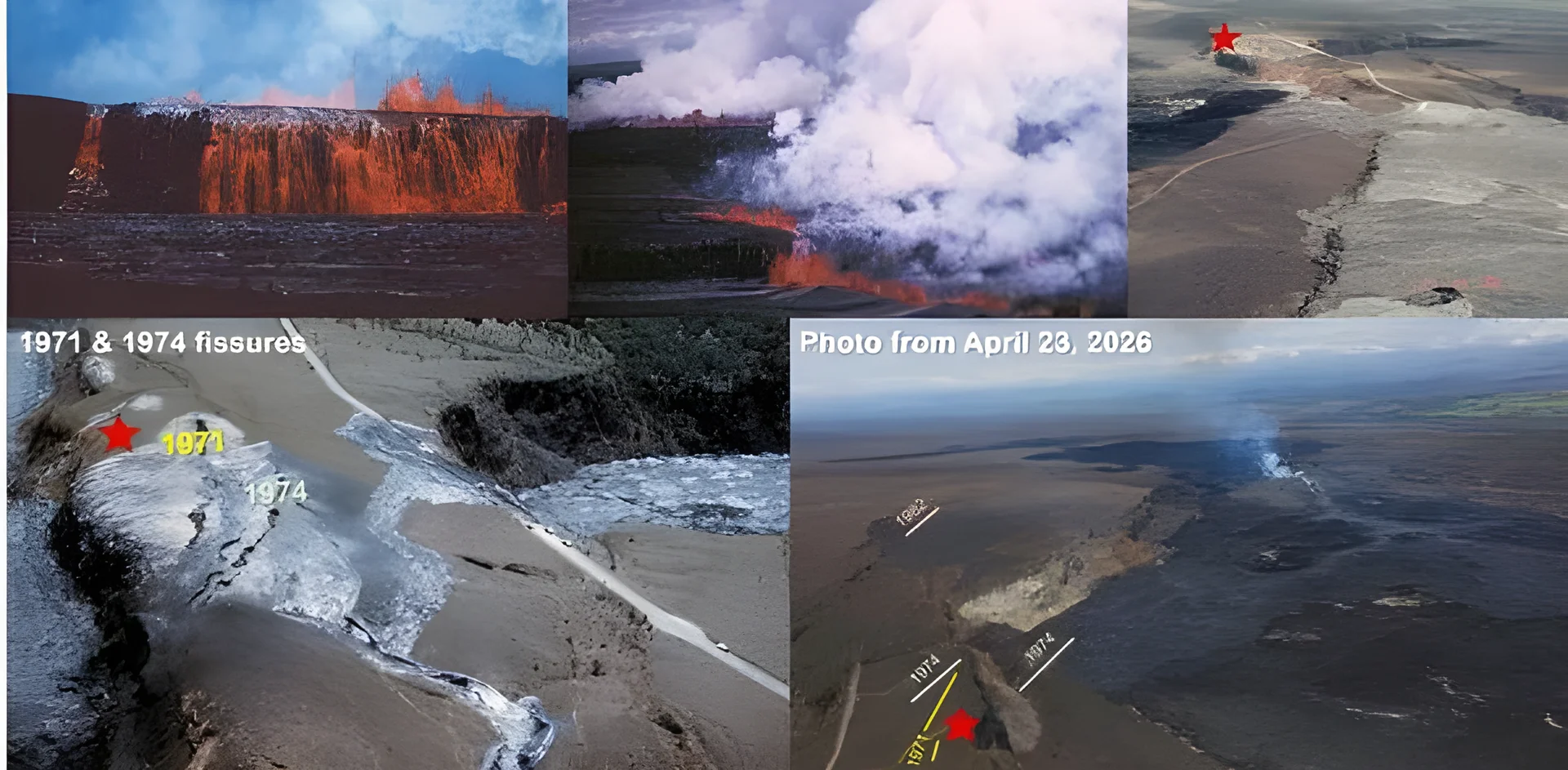
On April 23. 2026, the Kilauea volcano on Hawaii’s Big Island erupted for the 45th time since December 2024, sending lava fountains up to 700 feet high from the Halemaumau crater. According to the Hawaiian Volcano Observatory (HVO), the eruption ended abruptly after 8.5 hours. The eruption started with precursory activity on Monday, April 21, when lava overflowed from the north vent in Halemaumau, followed by more overflows and visible glow from both vents. Low-level seismic tremor was continuous at the summit, with 15 small-magnitude earthquakes recorded between Monday and Tuesday morning.
Volcanic Activity and Public Safety
HVO reported that wind conditions during the eruption sent volcanic gases and rocks to the south and southwest. Tephra—small glassy volcanic fragments—were likely to fall within 3 miles of the vents, while lighter ash and Pele’s Hair could travel farther. Despite the activity, Hawaii Volcanoes National Park and Highway 11 did not experience significant tephra deposition. After the eruption, HVO lowered its alert level from orange ‘watch’ to yellow ‘advisory’ due to reduced hazards to nearby communities and aviation.
Ken Hon, the lead scientist at the Hawaiian Volcanoes Observatory, explained that a magma chamber beneath Halemaumau is receiving magma at a rate of 3.8 cubic meters per second from the Earth’s interior. This causes the chamber to expand, pushing magma upward through cracks to the surface. The current eruption, which began on December 23, 2024, has produced 45 episodes of lava fountaining, each lasting up to 12 hours and separated by pauses of several days to weeks.
Historical and Cultural Significance
Volcanic activity at Kilauea is not new. The USGS noted that while most eruptions occur within Halemaumau, which is within the larger Kaluapele caldera, some have occurred outside of it. Notable past eruptions include the 1959 Kīlauea Iki eruption, which formed the visible Puʻupuaʻi cone. Earlier eruptions in 1832, 1868, and 1971 also occurred outside the caldera. According to the USGS, the current activity is part of a long-standing pattern of summit eruptions at Kilauea, with the most recent being the 45th episode since the eruption began over a year ago.
Halemaumau crater holds cultural significance for Native Hawaiians, who believe it is the home of Pele, the goddess of volcanoes. Janice Wei, a volunteer with the National Park Service, frequently documents these eruptions. She described the experience as being “in the first row of the most extraordinary show of nature.” According to her, the sound of molten rock shooting into the air resembles the roar of a jet engine or crashing ocean waves. The heat from the lava can be felt over a mile away.
Environmental and Health Concerns
Experts have raised concerns about the health effects of the eruption. HVO warned that the volcano emits approximately 50,000 tons of sulfur dioxide per day, which can form a smog-like haze known as ‘Vog.’ This poses a risk to individuals with respiratory conditions. Also, fine glass fibers known as Pele’s Hair can travel over ten kilometers, irritating skin and eyes. Drivers on Highway 11 near the national park were advised to be cautious of falling lava fragments and pumice.
Although the lava remains within the Halemaumau crater for now, experts warn of potential hazards such as unstable crater walls, ground cracks, and rockfalls in the surrounding area. Authorities are monitoring the situation closely to ensure public safety.






Comments
No comments yet
Be the first to share your thoughts