

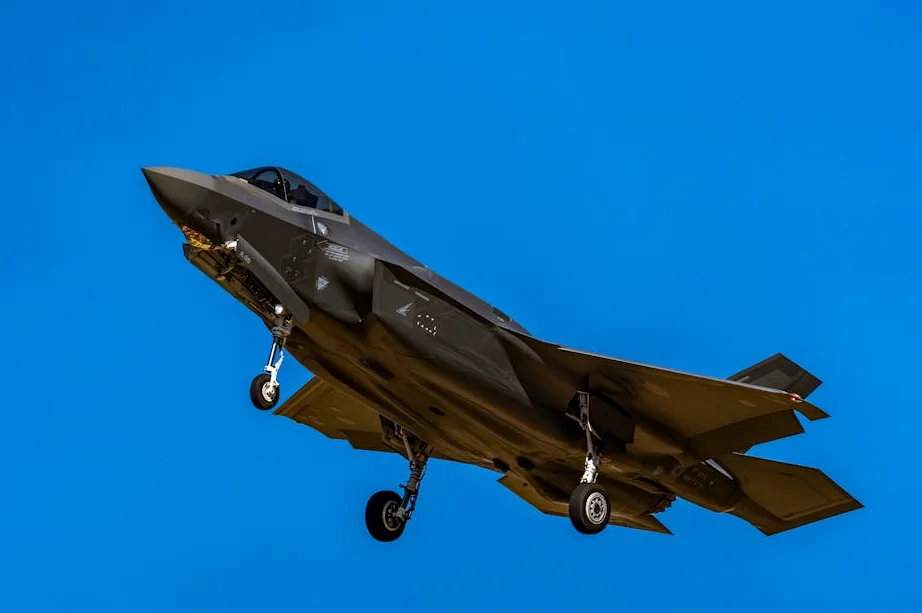
Lockheed Martin’s stock jumped nearly 7% in overnight trading Sunday, making it one of the most closely watched tickers on Wall Street to open the week. The catalyst was swift and unmistakable — the United States and Israel launched coordinated military strikes on Iranian military bases in an operation officially named ‘Operation Epic Fury,’ and Lockheed Martin’s F-35 fighter jets were front and center in carrying it out.
The F-35’s role in the operation
U.S. Central Command released video footage and photographs on X showing F-35s taking off for the mission, leaving little ambiguity about which aircraft were at the heart of the operation. The F-35 is Lockheed Martin’s flagship product and the company’s single largest revenue driver. Lockheed describes it as the most lethal and connected fighter jet currently in active operation, and Sunday’s mission put that claim on full display for a global audience.
The timing added another layer of significance. Just days before the strikes, Lockheed had announced the successful flight test of an AI-enhanced Combat Identification capability built directly into the F-35’s information fusion system. The technology is designed to help pilots identify threats faster and make sharper decisions under pressure — a capability that took on new relevance almost immediately after the announcement.
Lockheed also disclosed that it had deployed real-time, over-the-air software updates to the Aegis combat system installed on U.S. Navy ships operating in the Red Sea, enabling faster countermeasures against incoming drone and missile threats.
Other defense stocks moved higher too
Lockheed Martin wasn’t the only defense company to benefit from the overnight surge in market activity. Three other major players saw notable gains in the same session. The coordinated strikes and the involvement of U.S. military assets created a ripple effect across the defense sector, with investors anticipating increased demand for military technology and equipment in the coming months.
Where LMT stands heading into the week
Even before Sunday’s move, Lockheed Martin’s stock was trading at elevated levels. The company carried a price-to-earnings ratio of 30.62 — near its five-year high — and a price-to-sales ratio of 2.05, which sits close to its 10-year high. At least one financial analysis platform had flagged the stock as modestly overvalued, placing its estimated fair value at $542.78.
Analyst consensus heading into the week held a target price of $657.75 with a recommendation score of 2.6, and institutional ownership stood at 75.01%. The stock’s relative strength index reading of 63.82 placed it approaching overbought territory, a technical signal worth watching as the broader market processes the geopolitical developments driving the gains.
Lockheed Martin holds a market capitalization of $151.41 billion and reported trailing 12-month revenue of $75.05 billion. The company’s stock performance has been closely watched by investors, especially in light of recent geopolitical tensions involving Iran, Israel, and the broader Middle East.
The strikes were ordered by President Donald Trump in coordination with Israeli Prime Minister Benjamin Netanyahu and targeted Iranian military infrastructure over the weekend. Iran’s Supreme Leader Ayatollah Ali Khamenei and members of his family were reported killed in the strikes. Iran responded by launching missiles and drones toward Gulf nations, including the UAE and Qatar, escalating tensions across the region almost immediately.
The involvement of U.S. military assets in the operation has raised questions about the long-term implications for regional security and the global arms trade. Analysts suggest that the increased reliance on advanced military technology, such as the F-35, could lead to greater demand for defense contractors like Lockheed Martin in the coming years.
With the situation in the Middle East showing no signs of de-escalation, the defense sector is likely to remain a focal point for investors and policymakers alike. The recent surge in Lockheed Martin’s stock highlights the growing importance of military technology in times of geopolitical uncertainty.






1 Comment