

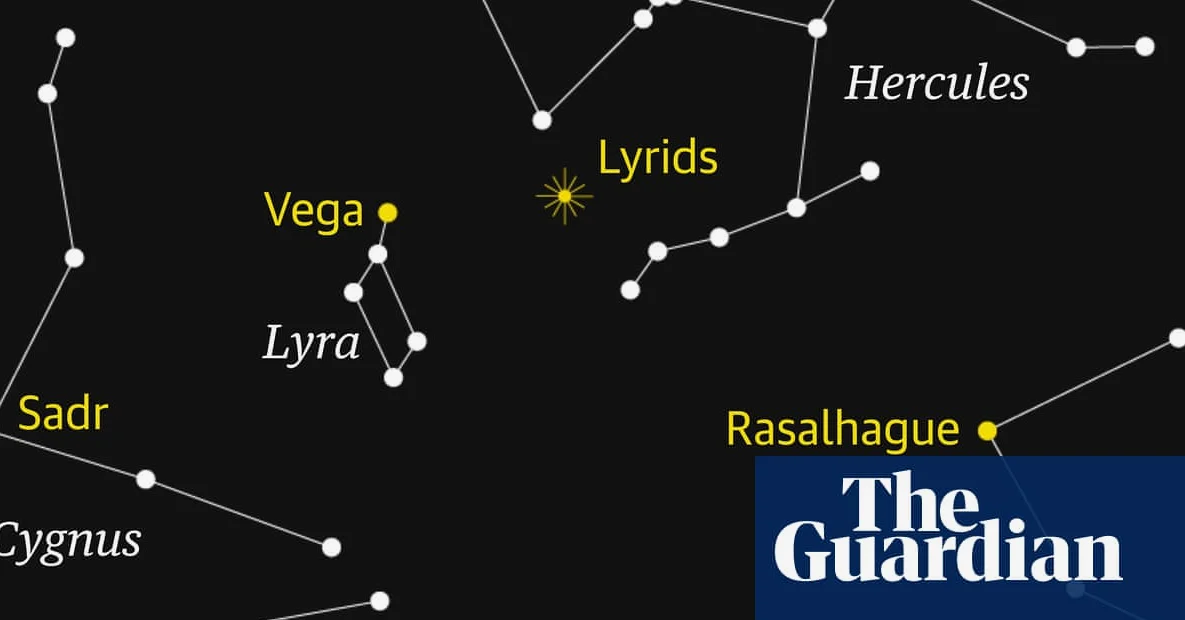
The annual Lyrid meteor shower returns to the spring skies this week, offering stargazers a chance to witness up to 18 meteors per hour at its peak, according to The Guardian. Active since April 16. The shower reaches its climax during the late evening of Wednesday, April 22, and early Thursday, April 23; the meteors appear to originate from the Lyrids radiant in the constellation Lyra, near the bright star Vega.
The Spring Triangle: A Guide to Finding Celestial Landmarks
While the Lyrid meteor shower captivates the attention of skywatchers, another celestial feature to observe is the so-called spring triangle — Comprising Arcturus in Boötes, Spica in Virgo, and Regulus in Leo, this asterism spans a large portion of the spring sky. Some observers prefer to use Denebola. The second brightest star in Leo, as the triangle’s apex, slightly altering its shape.
The spring triangle serves as a helpful marker for exploring other constellations in the region. Below it lie the faint constellations of Corvus, Crater, and Hydra, which will be the focus of next week’s observations. From the southern hemisphere, the triangle is best viewed in the northern sky but is more accurately called the autumn triangle.
History and Origin of the Lyrid Meteor Shower
Records of the Lyrid meteor shower date back to 687 BC, with its modern-day origin linked to comet Thatcher, discovered in 1861. The meteors are created when dust particles from the comet’s tail enter Earth’s atmosphere and burn up, producing streaks of light across the sky. These meteors are known for being bright and fast, sometimes leaving smoky trails behind.
For the best viewing experience, observers should wait until after midnight when their eyes have adjusted to the dark—a process that takes 20 to 30 minutes. The optimal time to watch is when the radiant point in Lyra is high in the sky, which occurs around 00:01 BST on Thursday, April 23, according to The Guardian.
Observing from the Southern Hemisphere
While the Lyrid meteor shower is visible from both hemispheres, viewers in the southern hemisphere face a challenge. The radiant point will be low in the northern sky, making it harder to observe. However, with clear skies and patience, some meteors may still be visible.
The Lyrid meteor shower is a recurring event that offers a unique opportunity to witness the beauty of the night sky. Whether focusing on the spring triangle or the meteor shower, stargazers are encouraged to take advantage of these celestial phenomena this week.






Comments
No comments yet
Be the first to share your thoughts