

 BBC
BBC 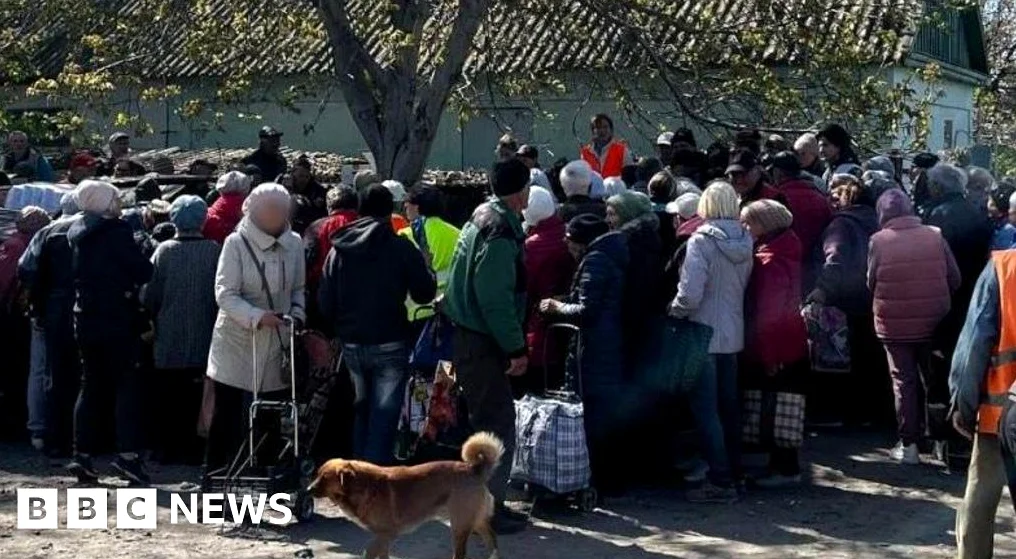
Life in a War-Torn City
Ludmilla, a resident of Oleshky, speaks from a fire-damaged rooftop in southern Ukraine over the phone — she says the road is mined, so people are stuck there. ‘People are trying their best to survive,’ she explains. Her city has been largely cut off from fresh supplies of food or medicine for months; she describes being trapped and watching the city decay before her eyes.
Desperate Conditions and Limited Aid
Ukraine’s commissioner for human rights has warned of a ‘humanitarian crisis.’ While some recent deliveries of aid have occurred, organized by volunteers or aid groups, prices are high, and people have had to forage for food in abandoned homes of neighbors. Pasta and tinned goods have become key staples for the roughly 2,000 remaining residents — Ludmilla’s name, along with other residents, has been changed to protect their identities.
Residents report that leaving Oleshky is a gamble with life along what’s been dubbed ‘The Road of Death,’ due to reports of heavy mining, as the city is geographically and militarily isolated, cut off by a river and wrecked bridges to the north and dangerous or impassable roads inland. Oleshky has been under Russian occupation since the Kremlin launched its full-scale invasion and is now caught in the crossfire of opposing armies.
Evacuation Attempts and the Dangers Ahead
As winter set in. Snowfall made the danger points harder to see amid intensified mining, but the snow is gone and the mines remain — Despite the risks, some successful evacuations have occurred along ‘The Road of Death,’ south-west along the route of the Dnipro river. Volodymyr, a 50-year-old resident, says leaving Oleshky involved praying to God they wouldn’t hit a mine; Traumatised by drones and seeing a neighbor’s body carted away after shelling, he and his family eventually left in an ambulance arranged by volunteers.
‘The entire highway from Oleshky to Hola Prystan’ is littered with burnt-out cars, and some of them burned with people still inside,’ Volodymyr recalls. Satellite imagery from November shows at least eight damaged vehicles on a 1km stretch of the road heading out of Oleshky towards Kardashynka. A large scorch mark on the road between Kardashynka and Hola Prystan’ first appeared in late January. Verified footage from that period shows a badly damaged vehicle that appears to have veered off the road. Claims suggest that vehicles, including ambulances, have been blown up or strayed onto mines.
Small trench networks are visible at intersections on the approaches to the city, indicating the area is militarized, but these have been in place for many months. The BBC has been in contact with seven people who are either still in Oleshky or recently evacuated. These accounts are gathered through phone calls, messaging apps, and questions sent through a Ukrainian official who has remained in touch with residents. The BBC has sought to corroborate stories through photos, location data, and online records where possible.
Ludmilla’s own home was destroyed when the Kakhovka Dam was blown up under Russian occupation in June 2023, causing catastrophic flooding. ‘I’m in someone else’s house, which is also burned,’ she says. She won’t move because the destruction is still happening everywhere. Trees hit by shelling are easier to break down for firewood, she says. Inside the city, Russian soldiers are believed to be hiding in buildings from roving Ukrainian drones. ‘We don’t see them but they’re there,’ Ludmilla says. Some reports suggest bodies can lie uncollected for days or be abandoned by the military to rot.
The Ukrainian Parliament Commissioner for Human Rights, Dmytro Lubinets, has appealed to Russian authorities for a ‘humanitarian corridor’ to allow safe evacuations. Lubinets accuses Russia of inflicting ‘deliberate terrorism’ against civilians. Ukrainian officials claim that both civilians and Russian soldiers stationed in the city have been left to their fate by the occupying authorities. Russia’s Embassy in London told the BBC that the ‘humanitarian difficulties’ are because of ‘systematic strikes’ by Ukrainian forces on the city. The Russian-appointed governor of the Kherson region, Vladimir Saldo, has accused Ukraine of destroying the city’s schools and kindergartens, according to the Embassy. However, Saldo’s Telegram posts in April do not specifically mention the humanitarian situation.
The International Red Cross (ICR) has said it is talking to authorities on both sides as it seeks further information about the situation in Oleshky. It is difficult to assess the degree to which Russian troops or Ukrainian drones have left mines posing a risk to civilians. One Ukrainian soldier told the BBC that Ukraine has used mines to prevent Russia from delivering weapons to its fighters inside the city. He claims Ukrainian forces keep volunteers informed about safe routes while accusing Russia of ‘scattering’ such explosives. Some residents say they would like to leave, but this is not necessarily the case for everyone. Elderly Ukrainians in front-line towns can be particularly reluctant to swap their homes for an unknown future.
Another resident, called Hanna, described recently seeing a drone hovering right above a woman aged about 90. ‘She just looked up, waved her hand as if to say: ‘Come what may’ and hobbled on,’ Hanna said.






Comments
No comments yet
Be the first to share your thoughts