

 BBC News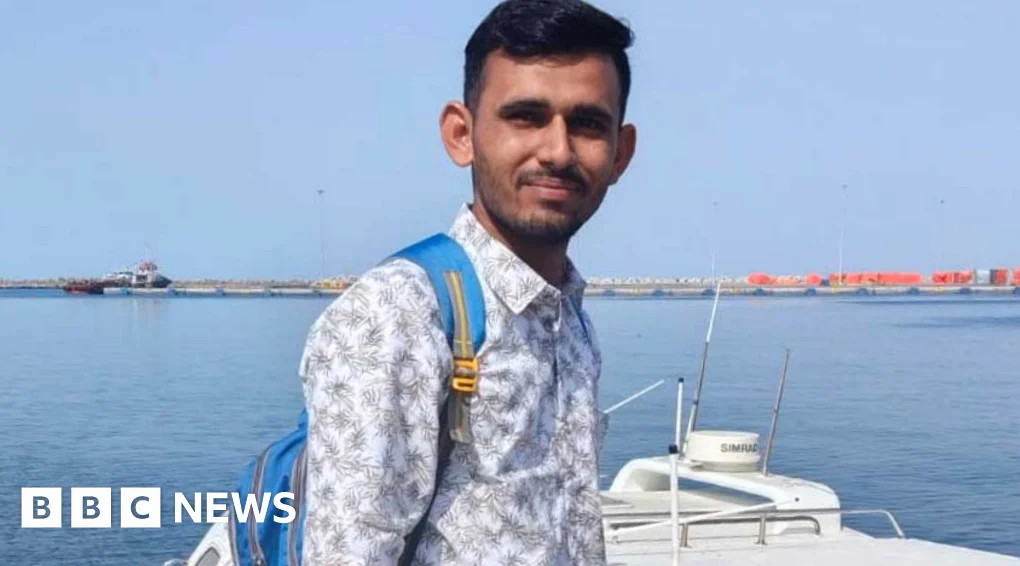
Sunil Puniya, 26, was on his first job at sea when a missile struck the oil tanker Skylight in the early hours of 1 March. The US-sanctioned vessel had travelled from Dubai and was nearing the Strait of Hormuz— one of the world’s busiest shipping routes. Skylight was the first commercial vessel to be struck after the US-Israel war with Iran erupted in the region.
Aboard the Tanker During the Attack
At the time of the attack, Sunil was asleep in his cabin on the third floor. He woke to find the ship engulfed in chaos. The missile had struck the engine room, sparking a fire that rapidly spread through the vessel. “There was a complete blackout, and smoke had spread everywhere,” he said. “Everyone was having trouble breathing.”
“There were some sailors from South India who were crying and making panicked calls home. I told them to stop calling and helped bring them up on to the deck,” Sunil said. But by the time they reached the deck the fire was already spreading. “There was oil everywhere,” Sunil said. “The flames were coming towards us so we jumped into the sea.”
Friends Lost and Found
The Oman Navy launched a rescue operation within an hour of the attack and pulled survivors from the water. But not everyone could be accounted for. “As soon as I realised Dalip wasn’t there, that’s when it hit me,” Sunil said. “I started panicking. I kept thinking: how will I answer to his family?”
Dalip Rathore, 25, had joined Skylight the day after Sunil. India is one of the biggest suppliers of seafarers to the global shipping industry. But Dalip and Sunil discovered they were from neighbouring villages in Rajasthan and soon became close friends. “In those moments, Dalip was there for me. He became like a brother,” Sunil said. Hours before the strike, Dalip had taken over Sunil’s watch in the engine room — the area hit by the missile.
Dalip and the ship’s captain, Ashish Kumar, were both killed in the attack. While some of the captain’s remains were recovered, Dalip’s body has never been found.
A Wider Crisis in the Strait of Hormuz
Their story is part of a wider crisis that has been unfolding in the Strait of Hormuz. At the beginning of the war, Tehran swiftly responded to strikes by blocking the Strait and with it a key route for 20% of the world’s oil and liquified natural gas. Maritime intelligence firm Kpler told BBC Verify that 38 commercial vessels have been hit in and around the Strait since the start of the conflict. Their data shows 24 ships were hit by Iran and four by the US, with the rest unconfirmed.
The war has left many hundreds of ships unable to get through the strait. More than 20,000 seafarers are currently stuck in the Gulf, according to the International Maritime Organization. Under maritime law, shipowners are responsible for the welfare and repatriation of their crews. If shipowners fail to act, responsibility can then fall to the vessel’s flag state and, ultimately, port authorities.
Many ship owners have been organizing supplies for their crews who are stranded in the strait, using small boats to deliver food and essentials to vessels at anchorage. Others, however, have been left with very little. Since the conflict escalated, the International Transport Workers’ Federation (ITF), a union that supports seafarers in distress, says it has received more than 2,000 calls for help from people on a variety of commercial ships that have been trapped in and near the Strait.
The problems include unpaid wages, contract disputes, difficulties getting home, and shortages of basic supplies such as food and water. Mohamed Arrachedi, the ITF’s network coordinator for the Arab world and Iran, says some crews are effectively stranded at sea. He shared voice notes with the BBC from three seafarers currently anchored on a small boat off the coast of Oman. In the recordings, the men plead for help, saying they are running low on provisions and have not heard from the shipowner for months.
“Unfortunately, the industry as a whole has not succeeded in eradicating this cancer that is the abandonment of seafarers,” said Arrachedi. The ITF defines abandonment as cases where shipowners walk away from crews, leaving them unpaid, stranded, and without essentials such as food, water or medical care. A total of 6,223 seafarers were abandoned across 409 ships last year. It’s a small proportion of the 100,000-strong fleet of merchant vessels’ operating around the world, but the union says it’s a worrying trend.
David Loosley from Bimco, one of the world’s largest international shipping associations, said that while the industry operates under international regulations, there are “isolated instances where standards are not fully upheld, with serious consequences for seafarer welfare.” “Geopolitical conflicts significantly heighten the risks faced by those at sea,” he added.
While many seafarers stuck in the region have not been abandoned, the conflict has made an already precarious situation even more dangerous for those who are. Rex Pereira, 28, from Mumbai, was not on Skylight but was recruited by the same agents as Sunil. He said he had endured appalling conditions at sea for more than four months before the war broke out. He said their drinking water was contaminated with diesel, that much of the food they had to eat was expired, and shared pictures of dirty brown water that he said the crew were told to wash with.
Despite his request to leave the vessel within days of boarding, he received no response to his calls for help. Instead, he was kept at sea for months. When the war started he was stationed off the coast of Iraq and witnessed missiles being fired close by. “We could see Iran from where we were,” he said, adding that missiles “were flying all over us.” “There was a huge explosion and smoke and the entire ship was vibrating,” he said. “We were very scared, we were shivering and we were contacting anyone possible, anyone possible.”
Rex never found out who the owner of his ship was but eventually managed to return to India after getting help from a shipping union and the Indian embassy, but his family had to pay thousands of pounds in travel costs to help get him home.





Comments
No comments yet
Be the first to share your thoughts