

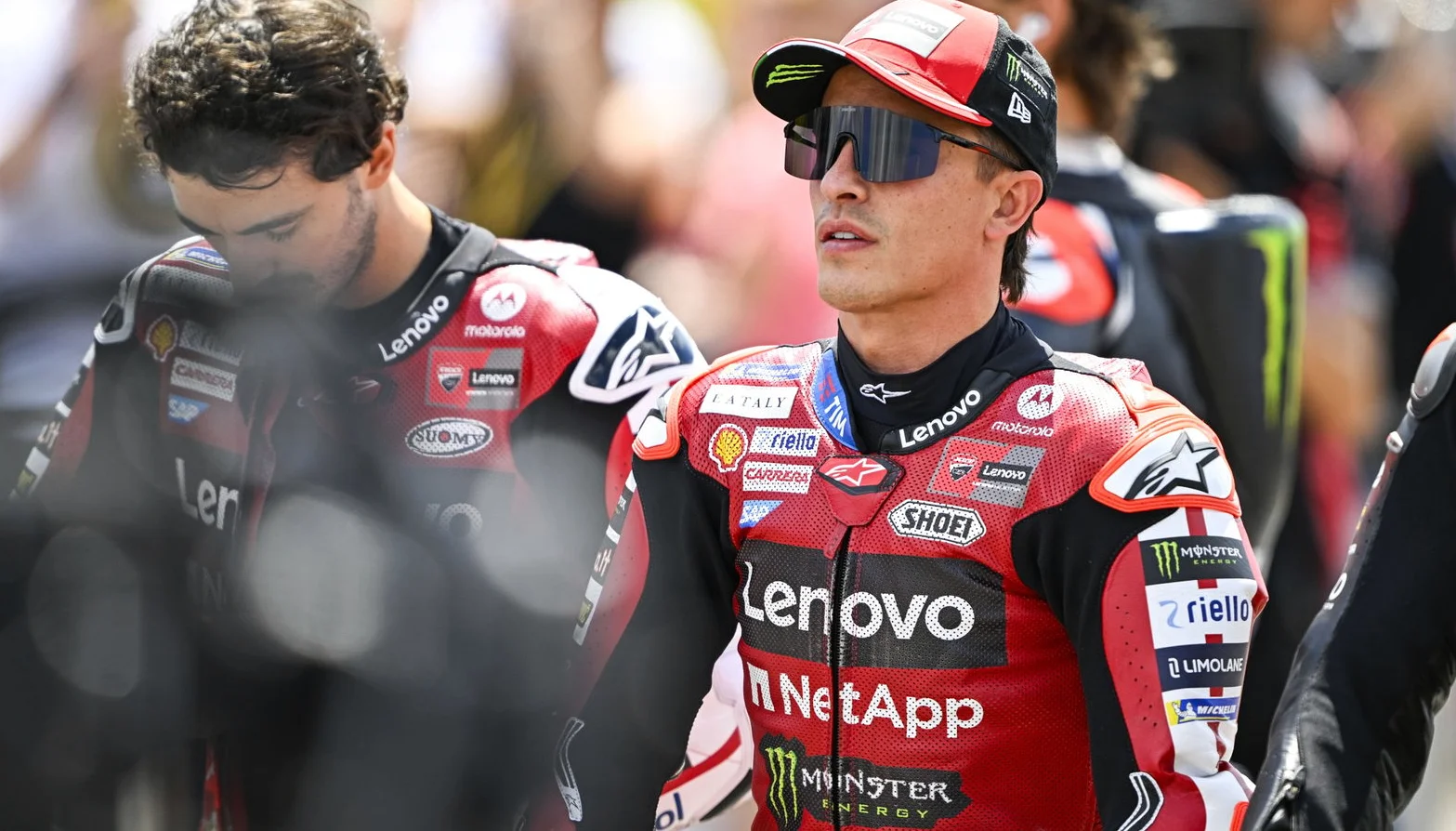
Marc Márquez’s decision to sign with Ducati has stirred significant reactions within MotoGP. Jorge Martin. Who had been in contention for the seat alongside Francesco Bagnaia, was ultimately passed over in favor of the nine-time world champion, as revealed by Aprilia’s Luca Pernat. According to Pernat. Bagnaia was ‘furious as hell’ upon learning that Marquez would be his teammate, a move he believes shifted Ducati’s focus away from the Italian — Bagnaia, who has secured two world titles for the Italian manufacturer, reportedly felt that the team began prioritizing Marquez’s preferences in bike development. Pernat admitted he would have ended Bagnaia’s Ducati tenure earlier, stating, ‘For him, seeing Marquez so close and knowing they’ve developed a part of the bike for Marc was a blow.’
Marquez’s Lifestyle and Medical Advice
Despite the allure of moving to the low-tax country of Andorra—a common choice for many Spanish riders,Márquez has opted to remain in Spain. He explained his decision during the German MotoGP, noting that the medical facilities in Madrid are key to his performance. ‘Since my injury, I need special machines, physios, and different training,’ he said. Márquez also dismissed the idea that tax considerations were a primary factor, adding, ‘I understand the people that want to move, they are free to move. But I feel well in Spain. And I want to live where I feel that can give me the maximum to perform well on the circuit.’.
In addition to his location choice. Márquez has adopted unique medical advice to prolong his MotoGP career. Recent interviews reveal that doctors have advised him to avoid sleeping on his right side due to the damage sustained in his right arm. ‘I can’t sleep on the right side. It’s prohibited,’ he said. Márquez has undergone six operations on his right arm, with the first occurring at the 2020 Jerez Grand Prix. Doctors have warned that sleeping on the affected side could exacerbate existing issues. ‘I have to live with pain,’ he admitted, highlighting the physical toll of his sport.
Competition and Technical Shifts in MotoGP
Márquez’s perspective extends to the technical and competitive terrain of the sport. At the forefront of the 2026 season, Aprilia riders Jorge Martin and Marco Bezzecchi have sparked debate over their relative merits. According to Márquez, the question of who is the better rider is misguided, as the current technological demands of MotoGP mean that compatibility between rider and machine is more decisive than raw talent alone. Bezzecchi has outperformed Martin in direct comparisons this season, finishing ahead in five of six races and in the qualifying sessions. This shift marks a reversal from the 2022–2024 period when Martin dominated over Bezzecchi, recording 1,088 points compared to 593.
Márquez attributes this change to the transition from Ducati to Aprilia. ‘At Ducati, Martin was faster than Bezzecchi. Now, at Aprilia, Bezzecchi is faster than Martin,’ he explained. This dynamic has reshaped the competitive scene, making the 2026 season particularly intriguing as the technical capabilities of teams and the adaptability of riders come into sharper focus.
Implications for Honda and Quartararo
While Márquez’s moves are central to the narrative, the broader implications for Honda and Fabio Quartararo are also emerging. Quartararo’s decision to join Honda marks a significant pivot, as he is the first rider to make the move from Yamaha to Honda in his MotoGP career. The transition has been described as both ambitious and necessary for Honda, which has struggled to replace Márquez’s dominance since his departure. Current Honda riders such as Joan Mir, Luca Marini, and Johann Zarco have shown promise but have not reached the level of Quartararo, who has consistently performed at an elite level since entering MotoGP.
Analysts suggest that Honda’s new leadership, including Mikihiko Kawase and Romano Albesiano, along with top test riders Aleix Espargaro and Taka Nakagami, positions the team for a potential resurgence. Quartararo’s addition is seen as a critical step in that direction. ‘Quartararo wasn’t just an ambitious addition, but a necessity,’ noted one source. However, the challenge remains whether Quartararo’s riding style is suited to Honda’s 850cc machines, a question that has yet to be fully answered.

Comments
No comments yet
Be the first to share your thoughts