

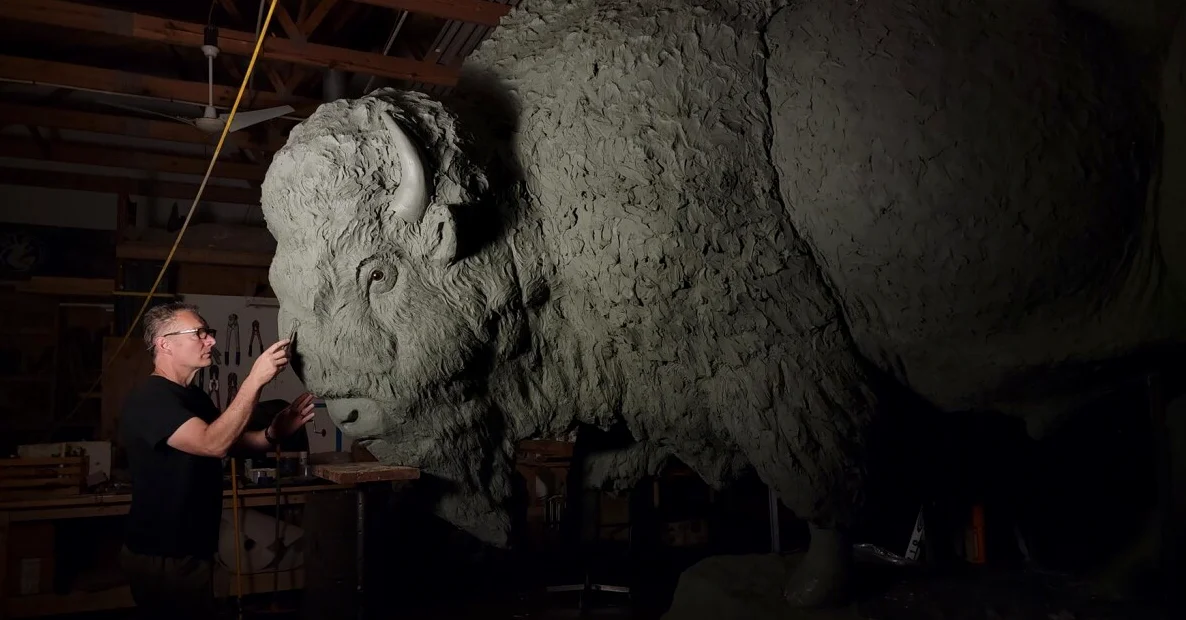
A 10-foot-tall bronze bison sculpted by Missouri artist Gary Staab will soon be displayed at the Smithsonian’s National History Museum on the National Mall, marking the 250th anniversary of the Declaration of Independence. The three monumental sculptures — of a bull, cow, and calf — are currently on a cross-country road trip from Loveland, Colorado, where they were cast, to their new home in Washington, D.C.
Art and History on the National Mall
The Smithsonian’s National History Museum commissioned the trio of bronze sculptures to celebrate the American bison, designated as the national mammal, and to commemorate the 250th anniversary of the signing of the Declaration of Independence. The works will be installed on March 19 on a pair of granite plinths flanking the museum’s entrance.
According to museum director Kirk Johnson, the decision to scale the bison larger than life was intentional. ‘We wanted the bison not to look like mice, but to look like bison,’ he said. The sculptures will loom over visitors as they ascend the museum’s marble steps, offering a dramatic visual impact.
Staab, known for his dinosaur sculptures in museums across the country, described the project as both a challenge and an honor. ‘Given the pride of placement on the National Mall, it’s kind of humbling to be involved in the project, to be honest,’ he said.
A Sculptor’s Journey to the National Mall
Staab’s work is not just about size but also about capturing the essence of the bison’s life cycle. The sculptures depict a calf ready to nudge its mother for a meal, a bull striding with a commanding silhouette, and a cow in a maternal posture.
‘I wanted to create something that’s accurate and exciting,’ Staab said. ‘Bison are so amazing as far as their structure. They have a lot of great shapes inside of that beautiful silhouette that they make.’
The artist spent time observing bison to understand their movement and behavior. ‘You have to try and breathe the same air as that animal, get close to them to understand how they move,’ he said.
From Near Extinction to National Icon
The bison’s journey from near extinction to national icon is central to the museum’s narrative. By the close of the 19th century, fewer than 1,000 bison remained in North America due to overhunting. The Smithsonian’s Natural History Museum played a key role in the conservation effort, with taxidermist William Temple Hornaday collecting specimens and bringing live bison to the National Mall in 1886.
Hornaday’s work led to the recovery of the species, and today, there are roughly half a million bison in all 50 states. Staab’s bull sculpture is based on the specimens collected by Hornaday.
Johnson emphasized the bison’s historical significance. ‘George Washington shot a bison in West Virginia, and there’s records of bison here on the Potomac in Virginia, even back in the 1600s,’ he said. ‘It is very much like the archetypal American animal.’
As the sculptures travel to Washington, D.C., they will make stops at natural history museums in Colorado, Nebraska, Iowa, and Illinois. The museum has dubbed the journey a ‘cross-country stampede,’ with Johnson joining Staab on the trip.
The sculptures will become part of the museum’s collection, which includes more than 148 million specimens. Their addition will serve as both a tribute to the bison’s resilience and a symbol of the United States’ natural heritage.
For the public, the sculptures will offer a tangible connection to American history and the natural world. As Staab and Johnson prepare for the final leg of the journey, the bison’s story — from near extinction to national icon — will be told in bronze and stone.






Comments
No comments yet
Be the first to share your thoughts