

 BBC News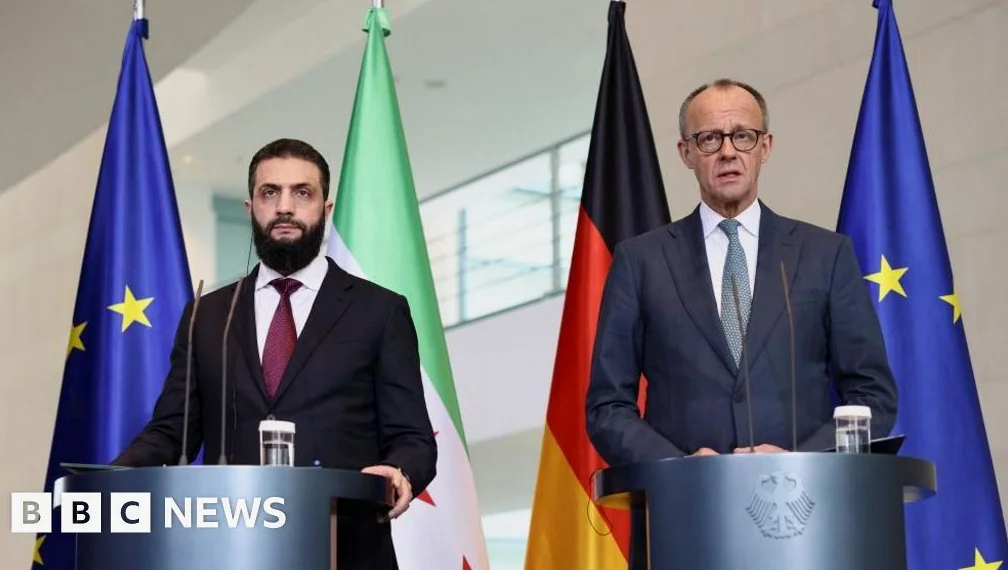
Germany’s Chancellor Friedrich Merz has stated that he and Syrian President Ahmed al-Sharaa hope that 80% of Syrians currently living in Germany will return home within the next three years. This statement comes amid ongoing discussions about the future of Syrian refugees in the country, many of whom arrived during the 2015 refugee crisis.
Context of the Refugee Crisis
During the Syrian civil war, nearly a million Syrians sought refuge in Germany. The influx of refugees became a defining moment in German politics, especially after former Chancellor Angela Merkel’s decision not to close the country’s borders to those fleeing the conflict. ‘Wir schaffen das,’ she said at the time, translating to ‘We’ll manage this.’ That phrase. Intended to convey confidence, later became a point of political controversy.
Merkel’s approach allowed for a significant number of Syrians to settle in Germany, where many have since built lives, worked, and raised families. However, as the situation in Syria has evolved, the German government under Merz has taken a more stringent stance on immigration, particularly in light of the rising influence of the anti-immigration AfD party.
Merz said during a meeting with Sharaa in Berlin that the situation in Syria has ‘now changed fundamentally,’ and that the need for protection must be reassessed. He emphasized that the focus would initially be on returning those who no longer have valid residence rights, particularly criminal offenders. However, he added that more would follow in the coming years.
Returning to Syria
Merz stated that around 80% of Syrians currently residing in Germany are expected to return to their home country over the next three years. He acknowledged the significant contributions of Syrian refugees in Germany but noted that most want to return to Syria, where they can play an important role in rebuilding the country.
Both Merz and Sharaa acknowledged that some Syrians would remain in Germany — Merz emphasized that it was in Germany’s interest for Syrian doctors and caregivers to be allowed to stay if they choose. Sharaa, on the other hand, expressed gratitude for Germany’s support during the crisis and highlighted the desire to establish a ‘circular’ migration model that would allow Syrians to contribute to their homeland’s reconstruction while retaining the stability they have built in Germany.
Sharaa said. ‘We are proud that Syrians have learned very quickly to contribute to society. We are working with our friends in the German government to establish a circular migration model.’ This model would enable Syrians to return to Syria while maintaining the lives they have built in Germany, if they so choose.
However, not all are convinced that returning to Syria is feasible. Franziska Brantner. A member of the Green Party and part of the opposition, said that many Syrians cannot return because of the lack of infrastructure and the unstable security situation in Syria. She noted that many Syrians are ‘deeply anchored’ in Germany, holding systemically important jobs and having children in school.
Brantner’s concerns reflect the reality for many Syrian refugees who have integrated into German society — For them, the idea of returning to a country still recovering from war may not be viable or desirable. The challenges in Syria. Including political instability and economic hardship, remain significant obstacles to the proposed return.
Protests and Political Tensions
Sharaa’s visit to Germany has been met with protests, particularly from the Kurdish Community in Germany (KGD), which has called on Merz to demand binding commitments regarding the protection of minorities in Syria. The KGD accuses Sharaa of human rights violations and war crimes, which adds a layer of complexity to the discussions about refugee returns.
Merz’s government has faced pressure to balance its commitments to international human rights standards with its domestic political agenda, which includes addressing public concerns about migration. The surge in support for anti-immigration parties across Europe has made migration a central issue in political discourse.
The refugee crisis of 2015 remains a touchstone in European politics, with many governments now implementing stricter immigration controls, as Merz’s proposal to return most Syrian refugees to their home country is seen by some as a response to these shifting political dynamics.
Merz said that the return of most Syrians is not a rejection of their contributions but a recognition of the changing situation in Syria. He added that the German government is working to ensure that those who wish to remain can do so, particularly in vital professions such as healthcare and caregiving.
Looking ahead. The implementation of the proposed return policy will depend on several factors, including the stability of Syria, the availability of infrastructure, and the willingness of Syrians to return. The German government will need to address these concerns while maintaining its commitment to international human rights standards.
As the discussions continue, the impact of this policy on both Germany and Syria remains to be seen. For now, the focus is on ensuring that the return process is carried out in a way that respects the rights and needs of all parties involved.





Comments
No comments yet
Be the first to share your thoughts