

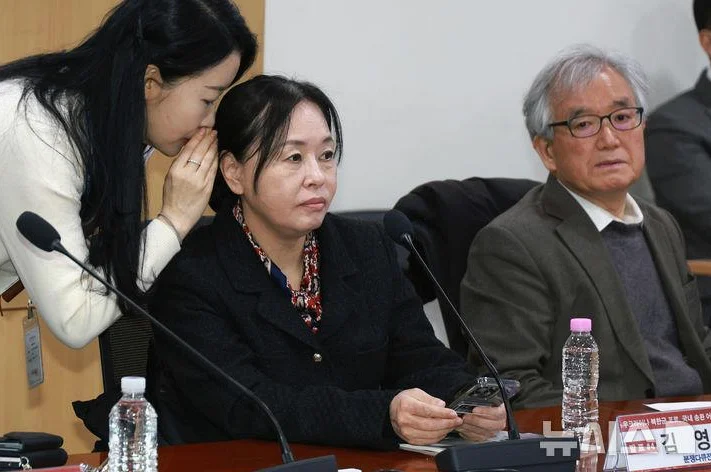
SEOUL — Two North Korean soldiers held as prisoners of war in Ukraine pleaded on South Korean television to be allowed into the South, highlighting fears of brutal punishment if returned home. The men, interviewed by conflict journalist Kim Young-mi for MBC’s “PD Notebook,” appeared without face blurring in a broadcast that drew sharp public and political attention.
Kim described the unmasked interviews as a calculated risk during a policy seminar on Feb. 3 at the National Assembly Members’ Office Building in Yeouido, Seoul. “The starting point was wanting to give them a chance to publicly say whether they truly want to be repatriated or not,” she told attendees, according to participants.
The seminar, hosted by lawmaker Yu Yong-weon and titled “How should South Korea respond to North Korean POWs in Ukraine?,” saw broad consensus. Speakers called on the government to expedite the men’s transfer, possibly via the International Committee of the Red Cross. After a closed briefing, Rep. Lee Seong-kweun reported that the National Intelligence Service verified the POWs’ defection wishes. “Efforts are under way through multiple channels to support their transfer,” he said, adding that international law demands respect for their choices.
South Korea’s Foreign Ministry treats North Koreans as nationals under the constitution. Officials stated the men would receive protection if they arrive. A 1952 United Nations General Assembly resolution backs this stance, barring force in POW repatriation and mandating humane treatment per the Geneva Conventions.
Agreement holds that forced return to Pyongyang risks torture. Yet South Korea’s hands are tied. As a non-belligerent in the Russia-Ukraine war, Seoul lacks direct use. Ukraine and Russia hold sway, with North Korea’s troop deployments adding indirect influence.
Elizabeth Salmon, the U.N. special rapporteur on North Korean human rights, emphasized non-refoulement—the ban on returning people to likely torture. “The final decision rests with the Ukrainian government,” she said. Ukrainian authorities decide first whether to send the POWs back to Russia or North Korea.
Complications loom large. Ukraine might use the men in prisoner swaps with Russia. Publicly revealing their faces and wishes, as Kim did, could backfire. Salmon called the image circulation shocking, urging privacy protection.
Analysts warn overt South Korean interest might provoke Pyongyang and Moscow to demand their return, turning the POWs into bargaining chips amid ceasefire talks. Jeon Seong-hoon, a visiting research fellow at the Sejong Institute, advised caution. “Prisoners should be brought to South Korea based on universal humanitarian values, but the process must be handled carefully to manage the all-but-certain backlash from Pyongyang,” he said.
Jeon pushed for bipartisan quiet support to avoid partisan fights. Shin Jong-woo, secretary-general of the Korea Defense and Security Forum, noted the POWs’ exclusion from recent Russia-Ukraine exchanges signals Kyiv’s awareness of backlash risks. “Assisting their safe transfer to a third country could be a wise move before they are brought to Korea,” he suggested.
Securing passage demands discreet talks with Kyiv, potential third-country transit and airtight security. For President Lee Jae-myung’s administration, the case links to overarching North Korea strategy, demanding finesse amid certain retaliation from the North.
Comments
No comments yet
Be the first to share your thoughts