

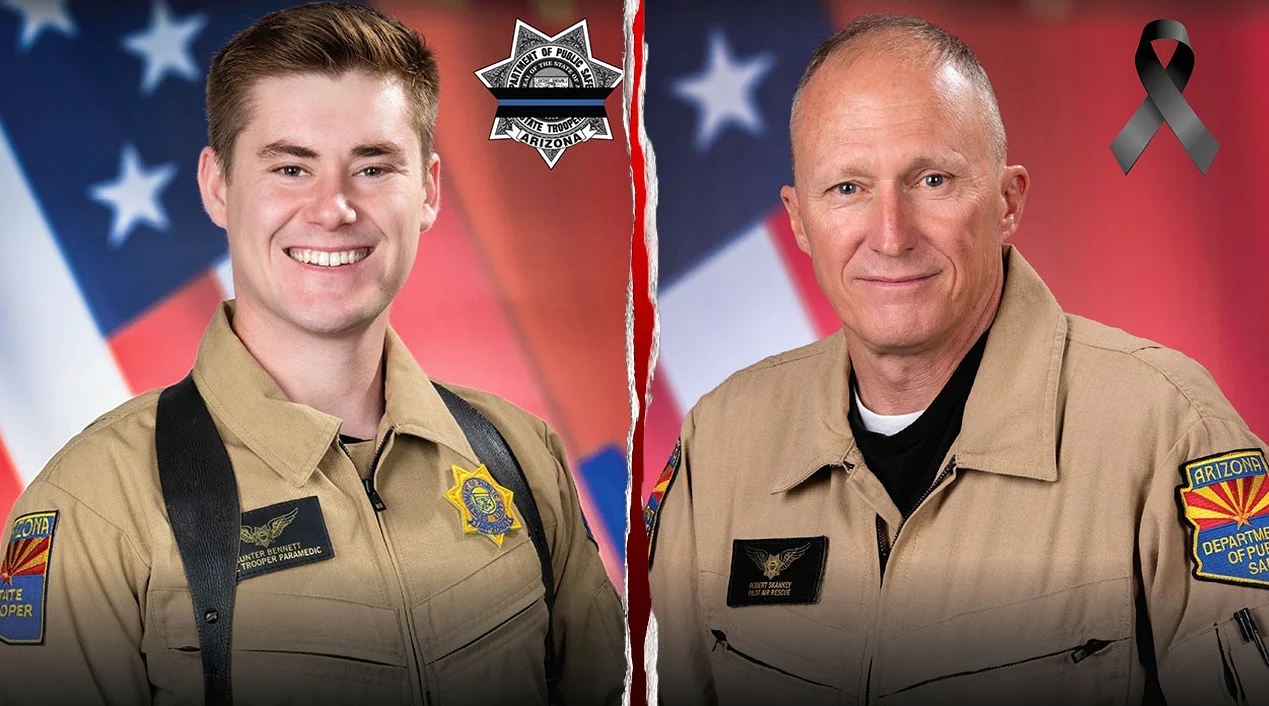
The National Transportation Safety Board (NTSB) has released preliminary findings into the February 4 crash of a police helicopter in Flagstaff, Arizona, which resulted in the deaths of two officers. The incident occurred during a pursuit of an active shooter, and the NTSB report suggests a mechanical failure may have played a role in the tragedy.
The Fatal Pursuit and the Helicopter’s Sudden Descent
The crash involved a Bell 407 helicopter, designated Ranger 56, operated by the Arizona Department of Public Safety. Trooper-paramedic Hunter Bennett and aviation supervisor pilot Robert Skankey were killed when the helicopter suddenly began a rapid rotation to the right during the operation.
According to the NTSB report, the aircraft was not struck by gunfire, as no evidence of such an incident was found. The helicopter had no reported issues in its recent maintenance logs, suggesting the problem may have originated from within the aircraft itself.
During the operation, the helicopter was circling to maintain visual contact with the suspect. The report described the aircraft as suddenly descending rapidly toward the ground, with Bennett radioing, ‘We’re going down,’ before the crash.
Mechanical Failure and Evidence from the Wreckage
Data from the helicopter’s engine control unit showed the main rotor speed dropped from 97% to 0% in less than a second, indicating a sudden and severe mechanical issue. At the same time, the engine torque dropped from 60% to 2%, a sign consistent with an instantaneous removal of the rotor load from the power turbine.
An examination of the wreckage revealed angular cuts to the tail rotor driveshaft, which also had deep grooves with blue paint transfer consistent with contact with a main rotor blade. These findings suggest that the tail rotor may have been struck by the main rotor blade, leading to a catastrophic failure.
The NTSB is continuing its investigation into the cause of the crash, which typically takes one to two years to complete. The agency has not yet issued a definitive conclusion, but the findings point to a possible mechanical failure as the primary cause.
The Active Shooter Incident and Its Aftermath
The helicopter crash occurred during a two-hour gunfight with a suspect who had fired at officers with a semi-automatic rifle. The incident began with a domestic violence call around 8:30 p.m. The suspect, identified as 50-year-old Terrell Storey, was later arrested and is currently in county jail facing multiple charges, including two counts of first-degree murder.
Skankey, a former U.S. Marine Corps member who joined the DPS in 2021, is survived by his wife and four children. Bennett, who joined the DPS in 2022, is survived by his wife, Breanna, according to FOX10 Phoenix.
The NTSB report provides crucial insights into the mechanical failure that may have led to the crash. While the investigation is ongoing, the findings highlight the importance of continued scrutiny of helicopter maintenance and safety protocols, especially in high-risk operations.
The report also highlights the risks faced by law enforcement officers during high-stakes situations, where the combination of mechanical failures and the dangers of active shooter scenarios can have tragic consequences.






Comments
No comments yet
Be the first to share your thoughts