

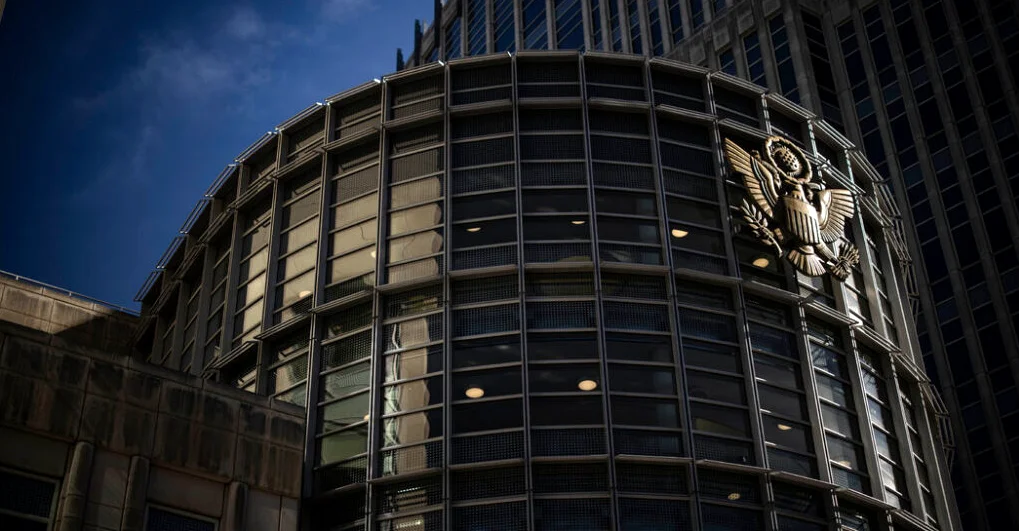
A Pakistani man accused of plotting with the Iranian government to murder U.S. officials, including former President Donald Trump, was convicted on Friday of attempted terrorism transcending national boundaries and murder for hire. Asif Merchant, 47, was found guilty after a jury in Federal District Court in Brooklyn deliberated for less than two hours.
Iranian Government’s Role in the Plot
The trial revealed that the plot was orchestrated under the direction of Iran’s Islamic Major Guards Corps (IRGC), according to evidence and testimony presented over a more than weeklong trial. Merchant faces life in prison for his involvement.
Joseph Nocella Jr., the U.S. attorney for the Eastern District, stated that Iran enlisted Merchant to ‘sow mayhem and murder.’ Merchant, who wore a gray pullover and listened through an Urdu interpreter, did not react as the judge, Eric R. Komitee, read the guilty counts.
Merchant’s Testimony and Legal Defense
Christopher Neff, Merchant’s lawyer, said in a statement that while the legal team was disappointed by the conviction, there were still ‘complex and significant legal issues yet to be decided.’ He expressed confidence that a favorable result would be achieved for his client.
Making the unusual decision to testify in his own defense, Merchant admitted on Wednesday that he had been recruited by a member of the IRGC to hatch a plot. He described himself as a successful business owner who demonstrated to his Iranian contacts that he was serious about the assassination plot because he feared for his life.
‘I was not wanting to do this so willingly,’ Merchant said on Wednesday.
Background and Context of the Plot
The case unfolded amid ongoing tensions between Iran and the U.S., which have escalated since the start of the war in Iran. Iran has targeted U.S. military bases and allies in the region, raising fears of a broader conflict. Last Saturday, the United States and Israel struck Iran, killing its top leaders, including those the U.S. says have planned assassination plots like the one Merchant was behind.
Merchant, who was raised in Karachi, Pakistan, but frequently traveled to Iran, was depicted by prosecutors as a Shiite Muslim who had become a ‘bumbling spy’ after the death of Maj. Gen. Qassim Suleimani, the spymaster behind Iran’s security machine. Suleimani was killed by an American drone on Jan. 3, 2020.
Merchant posted photos on Facebook depicting Trump digging his own grave, a hand holding a decapitated head of Trump, and Trump with a pig juxtaposed next to him. On the day Suleimani was killed, Merchant posted mournful images of the general and vowed ‘severe revenge.’
Prosecutors said the evidence that Merchant plotted with the Iranian government was overwhelming, though he never came close to pulling off his scheme. It involved hiring small-time criminals to steal key documents, stage protests at political rallies, launder money, and murder American politicians.
Details of the Plot and Its Foiling
The plot was foiled by a Pakistani American acquaintance who testified under the pseudonym Nadeem Ali. Ali, a former translator with the U.S. military, became an F.B.I. informant and secretly recorded their conversations, including a June 2024 meeting at a Queens hotel in which Merchant mapped out his scheme on a napkin, with an orange vape representing the target.
At a restaurant on Coney Island, Merchant told Ali that they would be paid for planning the operation, and that their earnings would ‘not be haram,’ or forbidden by Islamic beliefs. ‘This will be halal earning,’ he said, a reference to something that is permissible, according to prosecutors.
Merchant paid $5,000, which he received from a cousin in Tanzania, to provide the hit men a down payment. But the supposed assassins were undercover F.B.I. agents.
Merchant’s Legal Defense and the Role of Family
Merchant’s lawyers presented him as a deeply religious man, with separate families in Iran and Pakistan. Avraham C. Moskowitz, a lawyer for Merchant, said that while Merchant may have made some ‘tasteless’ social media posts, his plan stopped at hiring ‘some guys’ who ‘might do something.’
‘He had no intention of this mission succeeding,’ Moskowitz said during his closing argument on Friday. ‘He was waiting to get arrested.’
Merchant was arrested on July 12, 2024, after federal prosecutors said they caught him trying to leave the country from Texas, where he was staying with relatives. Days later, he was questioned in New York by F.B.I. agents. Merchant claims he told them he wanted his family, whose safety he was concerned about, to come to the United States with green card status.
However, Jacqueline Smith, an F.B.I. agent who questioned Merchant, said he had never brought up his family being threatened. Rather, he mentioned the killing of Suleimani, and seemed to think the Iranian government was behind the assassination attempt on Trump in Butler, Pa., the day after he was arrested, July 13.
‘He said that he thought that Iran was responsible for that, because that’s the same thing he was sent here to do,’ Smith said.


Comments
No comments yet
Be the first to share your thoughts