

 BBC
BBC 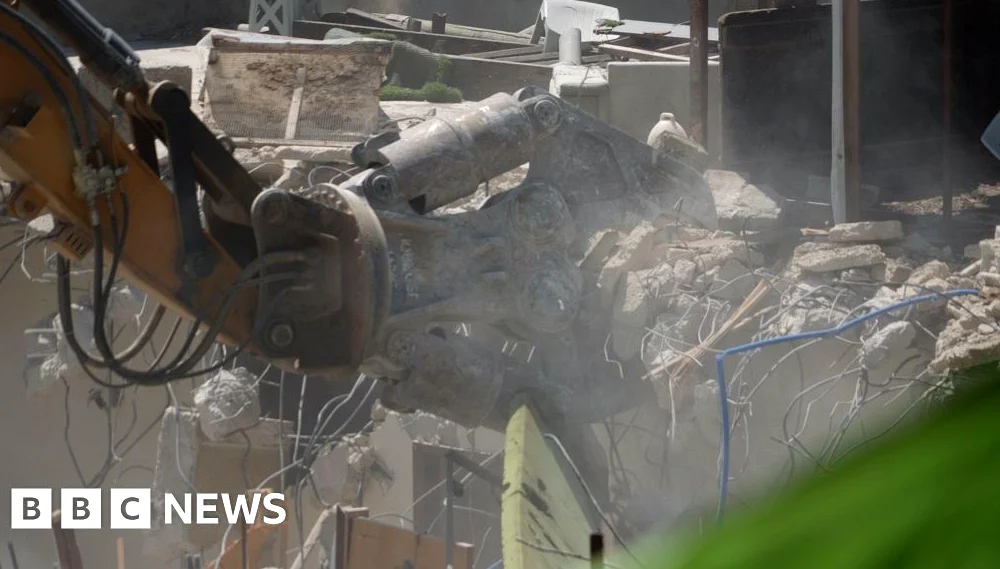
Under the shadow of the Old City in Jerusalem, a Palestinian home is being torn down by an Israeli excavator, and In the al-Bustan area of Silwan, 59 properties have been destroyed since late 2023. With global attention on the war in Gaza and the conflict in Iran and Lebanon, there has been a notable increase in the displacement of Palestinians in the Israeli-occupied east of the city.
Forced Relocation and Illegal Settler Activity
Fayez Awad. 58, sits in the only remaining floor of his property. ‘There is no future — they destroyed the future and everything else,’ he says. Awad and his family spent their lives building the home. ‘This is all we managed to achieve in life — they brought us back to zero again, me and my children.’
Jerusalem, holy to Jews, Christians, and Muslims, is central to the Israel-Palestinian conflict; Israel captured the eastern part of the city in the 1967 Middle East War and later annexed it, a move not recognized by most countries. For over two decades. The Jerusalem Municipality has aimed to convert al-Bustan into the King’s Garden, a biblically-themed park run by a Jewish settler organization.
International Law and Construction Permits
Settlements and forced population transfers are illegal under international law. The Jerusalem Municipality claims it works ‘for the benefit of all city residents’ and aims to create a park in an area lacking public spaces. Palestinian residents highlight the near-impossibility of obtaining Israeli construction permits in East Jerusalem. In 2025, only 7% of new housing approved in Jerusalem was for Palestinians, who make up about 40% of the city’s population.
Residents in al-Bustan claim their attempts to find alternative planning proposals were rejected by the local authority. Many have opted to demolish their homes themselves to avoid costly fines. ‘We’re being given warnings that in the coming months they’ll destroy the rest of the houses,’ says Fakhri Abu Diab, a local activist. His home was previously demolished, and he and his wife now face eviction from a caravan near the rubble.
Geopolitical Challenges and Eviction Threats
Abu Diab claims Israel is using the geopolitical situation to ‘finish the issue.’ He says the international community has left Palestinians ‘all alone.’ ‘The municipality is waging a war of bulldozers against us and our presence,’ he adds. Israel has built about 160 settlements in the West Bank and East Jerusalem, housing 700,000 Jews. Most Israelis consider all of Jerusalem their united capital, while Palestinians seek the east as the capital of their future state. The current Israeli government has pledged to ‘bury’ the idea of Palestinian statehood and is taking steps to do so.
According to the UN, 200 Palestinian households, about 900 people, face eviction cases in Israeli courts, mostly by settlers. Israeli law allows the takeover of properties owned by Jews before 1948, enabling settlers to move in. This is occurring in Silwan’s Batn al-Hawa, where Palestinian families are now labeled ‘illegal squatters.’ Palestinian law prevents them from reclaiming properties within Israel they historically owned.
Close to the al-Aqsa mosque compound, a key holy site, is the ‘City of David’ archaeological project. Yonatan Mizrahi from Peace Now says the project aims to create a touristic area emphasizing the Jewish narrative and belonging to the land. ‘We see more and more settlers coming in and unfortunately more and more Palestinians forced to leave.’
In the Christian and Muslim Quarters of the Old City, Israeli flags mark buildings occupied by settlers. A large flag is on a religious nationalist Jewish school involved in a high-profile eviction case. The Basha family, who have lived there for decades, now face eviction. Mufid Basha, 76, asks, ‘What will we do? We’ve nowhere else to go. This is the only home I’ve ever known.’
Jerusalem’s District Court recently issued a temporary injunction preventing the Basha family’s eviction while it considers their appeal. The EU has called the situation ‘dire’ in East Jerusalem and Silwan, reiterating its strong opposition to Israel’s settlement policy and activities.






Comments
No comments yet
Be the first to share your thoughts